Monday, June 30, 2014

A Lonely Grave: Susannah Kinzie (1851-1853)

Pioneer Cemetery, North Dumfries, Waterloo, Ontario
On the western edge of North Dumfries township west of Cambridge, Ontario is a sign proclaiming a small lot to be a pioneer cemetery. Also known as the Alexander Family Plot, the cemetery contains no gravestones in situ. Fragments of four gravestones, however, can be found learning against a tree in the centre of the lot.

According to the Waterloo Branch of the Ontario Genealogical Society, this cemetery represents the remains of an early pioneer cemetery used by local families including the Alexanders. In 1877, most of the graves were moved to the nearby Ayr Cemetery. When the adjoining road was widened in the 1970s, a gravestone for a young girl was found, as well as the fragments of other stones.

Susannah Kinzie (1851-1853) was the youngest daughter of Jacob Kinzie (1804-1862) and Susannah Stauffer (1809-1868). Susannah's grandfather, Dilmon Kinzie (1774-1854), had emigrated to Canada from Pennsylvania about 1799. The Kinzies were part of a mass exodus of German Mennonites from the United States after the Revolutionary War, attracted by inexpensive land, and the prospect of once again living under British rule.

Sometime before 1860, Susannah's parents emigrated to Michigan and settled in Kent County south of Grand Rapids. They are buried in Blain Cemetery in Gaines Township.

Two other fragments bear inscriptions. The first reads: "In memory of Louisa wife of Robert...." The second fragment contains a date (Dec. 17) and an age (27). The final fragment bears only the name of the engraver. Unfortunately, without a surname, it is difficult to determine who the fragments of these gravestones commemorate.

Saturday, May 31, 2014

Cemetery Crawling

Over the past few weeks I have had the opportunity to visit a number of smaller cemeteries in the Hamilton and Niagara regions of Southern Ontario. Only a few of these cemeteries contain gravestones related to my own research interests. Most I visited as a volunteer photographer and indexer with the Canada GenWeb's Cemetery Project.

When I photograph a cemetery I usually try to make two visits at different times of the day. This allows me to photograph east-facing gravestones when the sun is in the east, and west-facing stones when the sun is in the west. As I later index the photographs, I cross-check against the Ontario Genealogical Society (OGS) transcriptions compiled in the 1980s. This usually sends me back for a third visit to locate any gravestones I may missed. Sometimes I find them. Sometimes they have disappeared. And sometimes I find a stone that was missed by the transcribers.

Here are a few of the cemeteries I have recently photographed:

Marx Binkley Cemetery, Ancaster, Ontario


Marx Binkley (1745-1805) and his family came to the Ancaster area from Lancaster County, Pennsylvania in the late 1790s. He established a family burial ground in 1803, and his 1805 gravestone in one of the oldest in Southern Ontario. His gravestones has an unusual epitaph:
When I am dead and buired
And all my bones are rotten
When this you see oh think of me
Lest I should be forgotten
Beside him is buried his wife, Matelena, who died in 1838.

Henry Binkley Cemetery, Ancaster, Ontario


Henry Binkley, a grandson of Marx Binkley, established this family burial ground in 1852. The oldest gravestone is that of his father William Binkley (1784-1852).

Turney Family Burial Ground, St Catharines, Ontario


Imagine having a cemetery in your backyard. This was the consequence of building a subdivision in the Power Glen area of St Catharines. Access to this graveyard of six stones is via a branch of the Laura Secord Legacy Trail that climbs up from the valley of the Twelve Mile Creek.  The Turney Family Burial Ground is located on land granted to John Turney (1744-1819), a Lieutenant in Butler's Rangers during the American Revolution. While no stone to John Turney survives, there is a stone to his daughter Jenny (1774-1812), wife of William Boyd (? -1837).

Smith Family Cemetery


Another cemetery located on land once owned by an United Empire Loyalist is the Smith Family Cemetery. Nicholas Smith was a fifer in Butler's Rangers. His land is now owned by the Henry of Pelham Winery. None of the stones remain in situ, however, a wooden pavilion has been constructed to protect the fragments of stones that have been found. Nicholas Smith's gravestone is broken in three pieces and is no longer readable. That of his wife is also broken in three but the inscription is clear:

IN MEMORY
of
CATHERINE Consort of
NICHOLAS SMITH
of PELHAM who departed
this life Feb 3, 1817
Years
Blessed are the dead who died in the Lord

St. George's Anglican, St. Catharine


Finally, there is the remnants of the graveyard that once surrounded St George's Anglican Church in Downtown St Catharines. Most of the graves were moved to Victoria Lawn Cemetery many years ago, however, about 60 stones remain, some on the west side of the church, and some in a courtyard squeezed between the church and parish hall.

The stones date from the first half of the eighteenth century, but over the years many have sunk into the ground or become overgrown with grass, some have become obscured by juniper and barberry bushes, some are broken (presumably before the courtyard was enclosed with a locked gate), and two are hidden behind a heat pump. Photographing these gravestones is proving to be a challenge.

Fortunately, in addition to the 1984 OGS transcription, other records of the gravestones exist. In the early 20th century, Janet Carnochan described the cemetery in her Inscriptions and Graves in the Niagara Peninsula. Even more useful is the 19th Century Tombstone Database Project Records held by Brock University Archives. In the summer of 1982, students supervised by Dr. David Rupp collected information on various graveyards in the Niagara region. 

Of particular interest are the photographs and detailed sketches of the gravestones. These records are important since a significant number of gravestones at St George's and other Niagara region cemeteries have been damaged or have disappeared. One example is the stone on the left.

Weathering and the encroachment of ground cover have made the stone difficult to read. According to the OGS transcription this is the gravestone of Samuel Freure (1775-1855) and his son Samuel Freure (1802-1841). The Register of Burials in the Parish of St. George's, St. Catharines records that Samuel Freure, "formerly from England," died on 29 Mar 1855 at the age of 81, and was buried on 2 Apr 1855. But what is inscribed on the stone? Fortunately the 19th Century Tombstone Database Project Records includes a drawing:


Samuel Freure was born in Bedfield, Suffolk, England, the son of Benjamin Freure and Elizabeth Pritty. Samuel likely came to Canada with his son and daughter-in-law in 1836.  


The oldest gravestone at St. George's is that of Jacob Shipman (1796-1813). Three pieces of this gravestone were found resting against the wall of the church. A photograph in the 19th Century Tombstone Database Project Records shows in stone in one piece and beside that of his mother. Jacob was the oldest son of Paul Shipman (1756-1825) and Elizabeth Hawke (1767-1847). St. Catharines was originally known as Shipman's Corners, named after Jacob's father, the second owner of a tavern located at the junction of the Iroquois trail and another trail than ran alongside 12 Mile Creek. Jacob was born in New Jersey, and came with his parents to Upper Canada in 1802.

Jacob was not originally interred at St. George's but at the First Anglican Chapel Burial Grounds located near his father's tavern. This burial ground was closed in 1837 after the site for the future St. George's was procured. At least sixteen graves were exhumed at the old site, and the remains transferred to the new burial ground.

Sunday, April 20, 2014

Shaver Family Cemetery

Shaver Family Cemetery, Ancaster, Wentworth, Ontario
One of the more interesting Ontario graveyards I have visited is the Shaver Family Cemetery in Ancaster west of Hamilton, Ontario. What makes this cemetery unique is while most private family graveyards are small, Shaver is quite large with 68 monuments. Also remarkable is it's state of preservation. There are no signs of vandalism, and the few stones that are broken are likely the result of fallen tree branches.

 Cemetery Dedication
The cemetery is enclosed by a substantial stone wall. On the west side of the wall is a large stone inscribed with the following:
This cemetery was erected A.D. 1848 as a token of filial affection and respect by the 13 children of William and Mary Catherine Shaver, who settled this farm in 1798, it being then a wilderness.
John Shaver (1739-1795)
The Shaver family (originally Schaeffer) came to the Ancaster area from northwestern New Jersey in 1789. The head of the family, John Shaver (1739-1795) was born in Germany and had emigrated with his parents in 1765. He was a United Empire Loyalist who served with Butler's Rangers during the Revolutionary War. According to family tradition, John Shaver returned to New Jersey after the war to find that his first wife, Katrinka had died, and that his neighbours were less than friendly. John Shaver's gravestone is at nearby Betheda United Church Cemetery, and is one of the oldest gravestones in Ontario. His second wife, Mary Magdalene Hone (1761-1836) is buried beside him.

In 1797, John Shaver's second son, William (1772-1830) was granted Lot 35 Concession 3 in Ancaster. William married Mary Catharine Book (1776-1845). Together they had 13 children and acquired 1600 acres.


1856 Shaver Homestead
Three houses built by the Shaver family in the 19th century also remain in the area. The Georgian style Philip Shaver House was built in 1835. The cut-stone Gothic-Revival style Shaver Stone House was built in 1863, and the 1856 Shaver Homestead occupies the site of William Shaver's original home. Another property, the Daniel Shaver House, was built in 1860 but was destroyed by fire in 2011.

1835 Philip Shaver House

1863 Shaver Stone House
The Shaver Family Cemetery was in use until 1938. A photograph taken during the 1940s shows the cemetery surrounded by farmer's fields. In 1993, the Town of Ancaster designated the cemetery a heritage property. Today the cemetery forms an oasis of quiet surrounded by retail development.

Shaver Family Cemetery in 1945

Saturday, March 22, 2014

The Ramblings of Wakeman Edwards

Wakeman Edwards (1788-1842)
One of the ironies of my own family history is the absence of famous ancestors. There was the occasional miller, mariner, gardener or shipwright, but for the most part my ancestors were farmers or agricultural labourers from England. None of them were members of the aristocracy, none of them had illustrious military careers, and none of them were notorious criminals. A few of them did, however, have connections to interesting people.

Samuel Cooke (1789-1832), was a merchant and the brother of my ggg-grandfather. Samuel married a young woman from Bideford named Elizabeth Edwards (1792-1862). Elizabeth was the daughter of Elizabeth Chichester (1758-1834), a granddaughter of Sir John Chichester, 4th Baronet (1689-1740).


Louisa Marrett (1812-1842)
At the time of her marriage to Samuel Cooke on 1827, Elizabeth's cousin, Sir Arthur Chichester (1790-1842), was 7th Baronet. Elizabeth's brother, Wakeman Edwards (1788-1842), was a Lieutenant in the Royal Navy. Wakeman married Louisa Marrett (1812-1842), the daughter of Captain Joseph Marrett (1778-1857), a distinguished naval officer during the French Revolutionary and Napoleonic Wars. In 1841, while living in Brittany, Louisa gave birth to a son, Wakeman Julius Chichester Edwards. A year later, young Wakeman was an orphan.
 
In 1867, while on a voyage from London to Trinidad, Wakeman decided to write an account of his life up to that point. The original manuscript is held by a descendant, however, a few years ago I was given a transcribed copy. Wakeman's "Ramblings" are quite fascinating as they relate how over the course of several years he circumnavigated the globe.

Wakeman was raised by his grandparents, Joseph and Sarah Marrett. When his grandmother died, his grandfather moved in with his daughter. Wakeman's aunt ("Mrs. B.") was quite envious of "my grandfather's partiality towards my orphan self" and as a result Wakeman entered the Royal Naval School in London. Wakeman excelled in Arithmetic, Geography and Navigation, but was indifferent to the rest of the curriculum.

While in London, Wakeman was a frequent visitor at the house of another aunt, Elizabeth Cooke. After the death of her husband Samuel in 1837, Elizabeth had moved to London with her two children. Wakeman writes:

I shall never forget the kind welcome they gave me, so different from the reception I received from my Aunt C. and her family. How I used to look forward for the Saturday I used to spend with my kind Aunt and cousins.
When Wakeman graduated from the Royal Navy School he turned down a commission in the Royal Marines and instead joined the mercantile navy as an apprentice. His first voyage was aboard the Nourmahal, commanded by Capt. Lewis Brayley. Nourmahal was a ship of 835 tons with a crew of 30 and 18 passengers bound for Australia. Wakeman was one of six apprentices.

Corroboree on the Murray River, 1858 by Gerard Krefft
Nourmahal arrived in Australia in February 1857 after a voyage of 125 days. Wakeman almost deserted the ship at Sydney, as one of his cousins (the wife of brewer, squatter and businessman Robert Tooth) was living nearby, but at the last minute he decided to return to England. While in Australia, Wakeman also encountered a large group of aborigines performing a corroboree:
The relection of the fire on their painted bodies, representing skeletons made them look hideous, all being quite naked and yelling and dancing about...
By the time he returned to England, Wakeman had decided to "leave the sea." For the next three years he worked as a clerk in London for Charles Tennant, Son & Co., His grandfather had died while he was in Australia, and in February 1862, his Aunt Elizabeth Cooke also died. Wakeman then decided to take passage for New Zealand aboard the Indian Empire, arriving in Auckland in October 1862.

After working at a South Island sheep station on the Rakaia River for a few months, Wakeman then took passage across the Pacific to Vancouver Island.  After a two week stopover in Tahiti, Wakeman arrived in Victoria in May 1863. His intention was to prospect for gold in the interior of British Columbia, but instead he worked first as a navvy for a road crew and then as a bartender.

After 10 months, Wakeman headed south to San Francisco where he obtained work at a lumber mill. A year later he was back in Victoria. Work was scarce, and after a nine-month period as a steward on a coastal steamship, decided to head for New York.

In 1867, the easiest way to get from Victoria to New York was by steamer to San Juan del Sur, Nicaragua; by mule to Lake Nicaragua, and then across the lake and down the San Juan River by steamer to the Caribbean, where Wakeman boarded the Santiago de Cuba for New York.

After three months in New York working as a night watchman, Wakeman sailed to Liverpool aboard the Chicago, arriving in England on April 22, 1867. His trip around the world had taken almost five years.

A month later Wakeman was aboard the Spherved bound for Trinidad. It was on this voyage that he wrote his "Ramblings."


Gravestone, Watt, Muskoka, Ontario
What exactly happened next is not known, but in 1868, Wakeman came to Canada. In November of the following year he married Margaret Alexander (1844-1905) in the Muskoka district of Ontario. Margaret had been born in Tongland, Dumfries and Galloway, Scotland and had emigrated to Canada with her brothers in 1868. Canadian Census data shows Wakeman was a farmer living in Watt Township, Muskoka in 1871, 1881, 1891 and 1901.

Wakeman and Margaret had seven children. Their third child, William Cooke Edwards (1874-1931) was named in remembrance of the kindness that Wakeman had received from his Aunt Elizabeth Cooke and her children. Wakeman died in 1902 at the age of 60, and was buried at St Thomas Anglican Church in Ullswater, Ontario.

Thursday, March 6, 2014

A Respectable Woman

Gravestone of Michael Snell (1788-1810)
at St Giles in the Wood
Mary Ann Isaac was born in Yarnscombe, Devon in 1788, the youngest of three children of Hugh Isaac and Ann Cheek. Little is known about her childhood, although it was somewhat usual to grow up in a family with so few children.

In September of 1808, Mary married Michael Snell, youngest son of William Snell and Rebecca Cooke of Dodscott in the neighbouring parish of St Giles in the Wood. Mary Ann was pregnant at the time of her marriage, as her son William was born early the following year.

Then tragedy struck. Michael died in November of 1810 at the age of 32. At the time Mary Ann was pregnant with her second child, Michael, who was born in early 1811.

Michael Snell's will was proven at Barnstaple a month after his death. The will is somewhat unusual in that it provides both for his son William and for his unborn child.

After her husband's death, Mary Ann likely lived with her parents. Her mother died in the summer of 1811. Seven years later, she married Thomas Joce of Yarnscombe.

Ann and Thomas had two children:  James William who was born in 1821, and Mary Jane was born in 1829. In 1841, Thomas was a farmer living at Slees, Yarnscombe with Mary Ann and his two children.

Mary Ann should have lived an ordinary life as the wife of respectable farmer, except for two incidents. In January 1846, Mary Ann was accused by Mrs. Cory of the Fortescue Arms Inn in Barnstaple of having stolen a sable muff. The case generated considerable interest, and was the subject of two lengthy articles in the North Devon Journal, likely because Mary Ann was "a respectable woman." Mary Ann was a regular vendor at the Barnstaple Market, selling poultry and vegetables. On January 30, 1846, Mrs. Cory purchased a turkey from Mary Ann, but accidentally left her sable muff behind. When Mrs. Cory later returned to the market, Mary Ann at first denied having seen the muff, although other nearby vendors were certain that they had seen it with her. Mary Ann then stated that another woman had claimed the muff shortly afterwards. The magistrates concluded that there was enough evidence to send Mary Ann to trial. At her trial in April she was found guilty and sentenced to three months imprisonment.

Three years later, Mary Ann was in trouble with the law again, although this time it was her husband and son who were charged. When a sheep went missing from the flock of Samuel Davis, suspicion fell upon the family of Thomas Joce. Although Mary Ann and her husband willingly allowed their house to be searched, they refused to account for the 50 pounds of mutton that was being pickled in salt and obvious signs that a sheep had recently been butchered. The evidence was sufficient for the magistrates to commit Thomas and his son James to trial. At their trial, however, the Court ruled that there was no case whatsoever against James, and that there was insufficient evidence to show that Thomas had stolen the sheep, despite "strong circumstantial evidence" and the suspicious behaviour of his wife. The North Devon Journal noted that Thomas "
is very respectfully connected, and has always been considered an honourable man and a man of some substance."

Thomas died in October of the following year. Mary Ann followed him to the grave four months later.


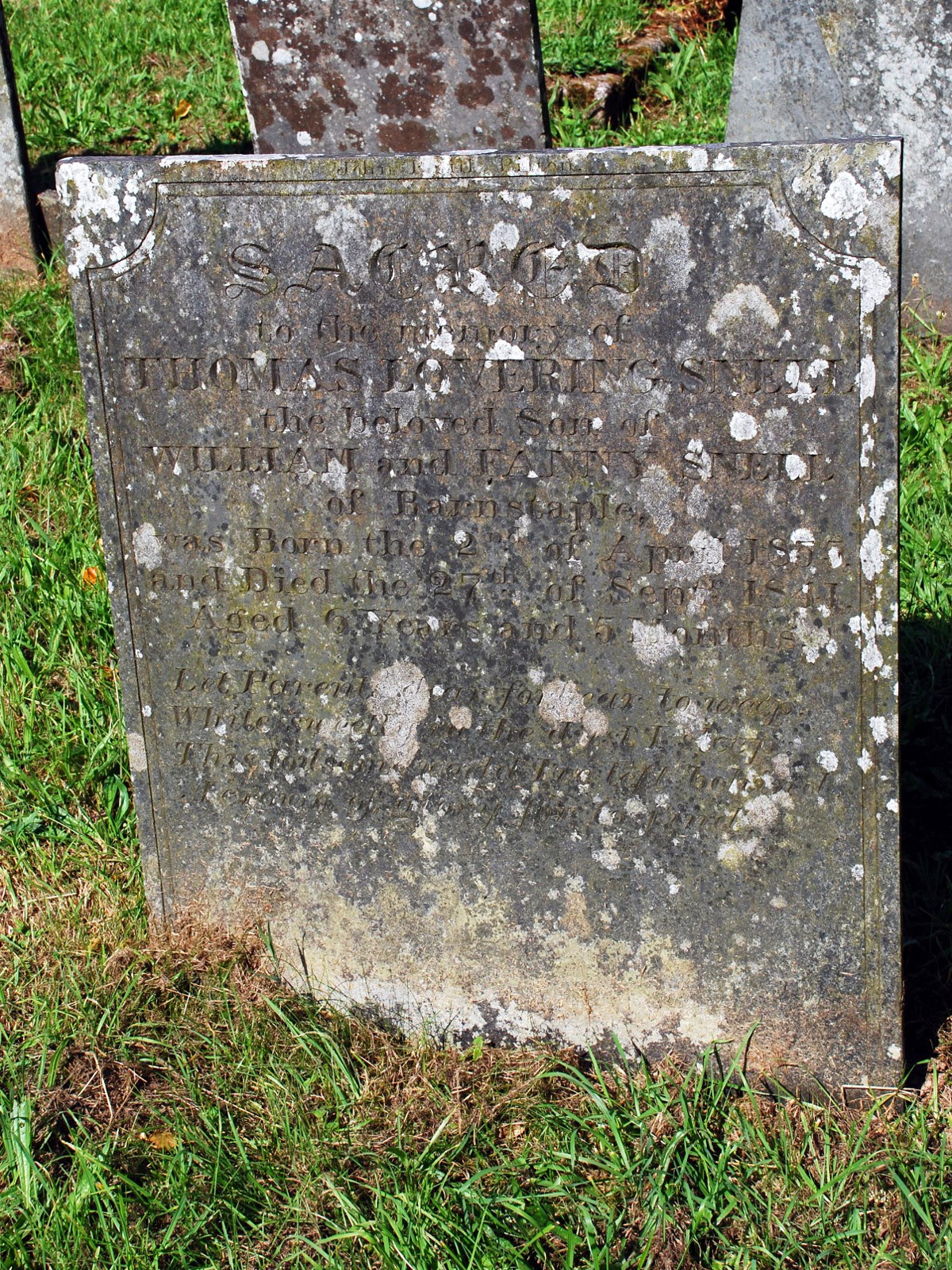
Gravestone of Thomas Lovering
Snell (1835-1841) at Tawstock
Mary Ann's oldest child, William Snell, is something of a mystery. According to the terms of his father's will, he would have received half of his father's estate as well as his father's watch when he turned 21 in 1830. A year later he married Fanny Lovering of Tawstock. Four children followed: William, Michael, Thomas Lovering, and Elizabeth.

Here begins the mystery. William Snell does not appear in the 1841 Census. His wife Fanny is a servant at the Vicarage in Bishops Tawton, Devon. Two children live with another family in Bishop's Tawton, while the youngest, Elizabeth, is living with her aunts in Tawstock. Their other child, Michael, is living with his grandmother, Mary Ann Joce. Thomas died later that year and is buried at Tawstock.

In 1851, Fanny is still a servant at the Vicarage, the children are still living with relatives or elsewhere, and William Snell is a lodger in Finsbury, Middlesex. 1851 also saw the death of William and Fanny's son Michael.

In 1861, William is back in Barnstaple, while Fanny is now living with her brother-in-law in Landkey, Devon. In 1864, William death at Landkey was announced in the North Devon Journal. Fanny died at Barnstaple nine years later.

Advertisement in Trewman's Exeter Flying Post

His brother Michael Snell seems to have been far more successful. Michael established himself as a Wine and Spirit Merchant in Barnstaple, Devon. Several flagons bearing his name survive, and advertisements appeared frequently in the North Devon Journal and Trewman's Exeter Flying Post.

Michael married Eliza Sharland Taylor, eldest daughter of Isaac Taylor and Ann Sharland, at Tiverton, Devon in May 1837. Their daughter Ellen Taylor SNELL was born the following February. Nine months later Eliza died, leaving Michael a widower with a infant child. Ellen was sent to live with her maternal grandparents but eventually returned to Barnstaple to live with her father.

In 1843, Michael married Elizabeth Bowden, third daughter of John Bowden and Mary Keen of Berrynarbor, Devon. Michael and Elizabeth had eight children, six girls and two boys, five who survived to adulthood.

Sometime after 1871, Michael retired to Lee Cottage in Berrynarbor. Elizabeth died in 1888. Michael died in 1895 at the age of 84. Their son Michael, a stockbroker, landowner and justice of the peace, continued to live in the area until his death in 1932. Inside Berrynarbor church is a commemorative plaque describing him as a "generous benefactor of this Church and Parish."


Sources:

North Devon Journal, Thursday, February 12, 1846
North Devon Journal, Thursday, April 16, 1846
North Devon Journal, Thursday, July 5, 1849
Trewman's Exeter Flying Post, Thursday, July 5, 1849
Western Times, Saturday, July 7, 1849

Sunday, January 19, 2014

The Descendants of John Lewis (1817-1897)

Advertisement in the North Devon Journal
During the mid-19th century there was a wave of emigration from Devon to Canada. Part of this exodus was my ggg-grandfather, John Lewis. My ggg-grandfather was born in Filleigh, Devon in 1817. His father, John Lewis (1782-1871), an agricultural labourer, had married Hannah Parker at Filleigh in 1815. My ggg-grandfather was their second child.

In 1839, my ggg-grandfather, then an agricultural labourer living in Charles, Devon, married Elizabeth Stevens, daughter of William Stevens and Elizabeth Huxtable of East Buckland. Elizabeth was a year older than John. Their first child, Eliza, was born the same year. William, my great-grandfather, was born two years later, and was followed by Hannah in 1843, John in 1848, and Elizabeth in 1850.

Sometime after Hannah's birth, John moved his family to North Molton, Devon. At the time of the 1851 census, he was a farmer of 56 acres living at Higher Leigh, North Molton. Like most of North Molton, Higher Leigh was owned by George Bampfylde, 1st Baron Poltimore. The following year, John and his family emigrated to Canada.

As some point prior to emigrating, my ggg-grandfather became a member of the Bible Christian church, a Methodist denomination founded by William O'Bryan in 1815. Many of the emigrants from North Devon were Bible Christian and helped spread the denomination into Canada. John was an active member of the Church and a lay preacher.


John and his family likely sailed from Bideford to Quebec City. There are two candidates for the ship they sailed on. One possibility is the barque Secret, which sailed on April 3rd and arrived at Quebec City on May 5th. An account of the departure of the Secret appeared in the North Devon Journal of April 8, 1852:
DEPARTURE OF THE 'SECRET.'—At five o'clock on Saturday morning, amidst the firing of cannon, and cheering of those on board the emigrant ship, the 'Secret,' was towed as far as the pool by the 'Princess Royal,' and in the afternoon of the same day the voyagers to Yankeeland has the honour of being joined by a little stranger who had just come into the world to make the voyage of life by commencing it on the seas, to be rocked and cradled by its waves, whilst the wild winds sing its lullaby. We refer to the fact of a Mrs. Wilton giving birth to a fine son, who, in honor of the event, was named John Secret Wilton. On Monday, she crossed the bar and crowded all sail for her destination. The afternoon being beautifully fine, several of our townsmen accompanied her to a distance of four of five miles. At last the time came for parting; and, after a few interchanges of cheering sentiments, and the sincerest expressions of goodwill, they parted company, those on board the 'Secret' firing a salute as a last farewell. We also say 'farewell;' and, whilst they think of their friends at home and anticipate the land of their hopes, we will sing—

God speed ye, brethren, o'er the main;
We never more may meet again,
But, if kind prayers avail,
This morning orisons shall rise,
And piece the circumanbient skies,—
God send a prosperous gale!

We are happy to find that so many have already started under such auspicious circumstances, and that it is our province to say "Still there is room." The 'Worthy' has a few berths to spare. A word to the wise in enough; and, therefore, to those intending to emigrate this season we have no need to say—Take time by the forelock!
The Secret made a second voyage to Quebec that year, departing Bideford on July 11th.

Another other possibility is the Worthy of Devon which departed Bideford on April 17th and arrived at Quebec in early June. On its second voyage of the year the Worthy arrived at Quebec City on July 22nd after a passage of 26 days. Both vessels were owned by Richard Heard of Bideford who also transported emigrants to Prince Edward Island. Advertisements frequently appeared in the North Devon Journal promising:
...excellence of the accommodations, the approved sailing qualities of their vessels, the ability and civility of their commanders, and the exceedingly low rate of passage required, are advantages which persons about to cross the Atlantic from these parts will be likely to appreciate.
On the return voyage the ships carried pine, oak and birch logs that Heard would then sell in his Bideford timber yard.

In October 1852, John purchased 200 acres of land (Lot 16 Concession 11) in Stephen Township, part of the Huron Tract, from the Canada Company. The Canada Company was a large British land development company that assisted emigrants by providing inexpensive transportation, implements and tools, and cheap land. Two of Elizabeth's brothers later emigrated to Stephen Township as well: John Stevens and Michael Stevens. There is evidence that John's younger brother George also emigrated with his family to Canada and settled in the Huron Tract a few years later.

Whether John occupied his property in the fall of 1852 is unclear. A number of emigrants to Canada West appeared to have found lodging and work for the winter in Toronto or Hamilton for the winter, and then headed for the Huron Tract in the spring.

Getting to the Huron Tract from Quebec in the early 1850s was a significant undertaking as the railroads were not opened until later that decade. John and his family likely travelled by a succession of steamers, the first from Quebec to Montreal, a second up the Ottawa River and through the Rideau Canal to Kingston, and a third along the north shore of Lake Ontario to Toronto or Hamilton. From there it was likely northwest to Guelph and then west along the Huron Road to Stephen Township.
 

Fryfogel Tavern on the Huron Road
The Canada Company arranged to have a number of inns built along the Huron Road to accommodate emigrants. John and his family may have spent a night at the Fryfogel Tavern located east of the Village of Shakespeare. Built in the Neoclassic style in 1845, this two story brick and fieldstone building is now a registered historic site.   

Another possibility, however, is that John and his family continued aboard steamers through the Welland Canal, along the north shore of Lake Erie to Port Stanley, and then overland, first to London, and then north along the London Road to Stephen Township.

Upon arrival the process of clearing the land and building a log cabin would begin. Animals would be brought in: a yoke of oxen, a cow, pigs, sheep and fowl. A garden would be dug and planted. Once clear of trees, the land would be first ploughed and then harrowed, and a crop sewn.

By 1861, John and Elizabeth had had at least two more children: Mary Jane, born in 1857 and Michael, born in 1859. There is a seven year gap between Mary Jane and her older sister Elizabeth, so it is possible that there were one or two other children who died very young.

Eliza is a mystery. She was living with her family in 1841 and 1851 and so presumably emigrated with them to Canada, but she does not appear with them in the 1861 Census.

The first of the children to marry was my gg-grandfather, William Stevens Lewis, who married Lydia Mary Madge in 1863. Lydia, the daughter of Walter Madge and Mary Webber, was born in Meeth, Devon in 1843 and had come to Canada in 1849. William and Lydia had three children: Mary Elizabeth, William Wesley, and Lydia Mary. Lydia died shortly after the birth of her second daughter, leaving William a widower with three small children. Less that a year afterwards he married Charlotte Jory, a young widow with two daughters. William and Charlotte went on to have five more children.


At some point William started practicing as a veterinary surgeon, and and from 1880 to 1917 he was Division Court Clerk. Like his father he was a lay preacher, and an active member of the Bible Christian Church. In 1884 the Bible Christian Church merged with the Methodist Episcopal Church and the Primative Methodist Church to become the Methodist Church of Canada. William died in 1921 at the home of his daughter Effie, the wife of Francis Clark.
 
Home of Samuel and Hannah Langford
Next to marry was John and Elizabeth's daughter Hannah. In 1865, Hannah married Samuel Langford, a widower from Cornwall, England with two children. They lived in Lambton County for over ten years then crossed the St. Clair River into Michigan where they live for a few years in St. Clair County. Six children were born in Canada and two in the United States. The youngest, unfortunately, died in 1877.

In the spring of 1881, Samuel travelled west with his eldest son to North Dakoka to begin homesteading in Griggs County. A history of Griggs Country describes Hannah's journey to join her husband later that year.
Late in August, delicate in frame, gentle by nature, but with indomitable spirit, Hannah Langford began the long journey with their eight children. She brught with them the household goods, twenty chickens, and a pure bread cow.... She came by boat to Duluth and train to Sanborn, North Dakota, where Mr. Langford met them with two wagons pulled by oxen.
Samuel Langford was also a veterinary surgeon. Samuel and Hannah had one more child, Minnie, who was born in 1885. Samuel died in 1913 and Hannah in 1923.

William and Hannah's brother John married Elizabeth Camm in 1868. Their first four children were born in Stephen Township. In 1878 he also crossed the St. Clair River into Michigan and lived in Sanilac County.

Last to marry was Elizabeth (1850-1916). In 1876 she married Roland Ferguson Johnstone (1849-1916) in Detroit, Michigan. They lived in Harbor Springs, Michigan and had no children.


According to his death certificate, Michael Lewis was murdered in 1874 at the age of 15. No newspaper account of his death survives, however, his gravestone in Exeter Cemetery bears this epitaph:

Beneath this stone our child doth lay
From us his life was taken away
In the field where he did stand
 

There should be a fourth line, however, at some point this line was physically removed from the stone.

Michael's sister, Mary Jane, committed suicide in 1878 at the age of 20.

Lewis Gravestones, Exeter Cemetery
Sometime before 1879, John moved to Lot 5 Concession 8 of Stephen Township. When Elizabeth died in 1885, she was buried beside her son and daughter in Exeter Cemetery. The three adjacent gravestones are surrounded by daylilies. John died in 1897 and was buried nearby. In his will he named his daughters Hannah and Elizabeth, and his sons William and John. 

William Wesley and Edith Lewis
After the death of his mother, my great-grandfather, William Wesley Lewis, spent considerable time at the farm of his maternal grandparents. In 1888 he travelled to Manitoba in order to homestead, journeying by train to Brandon and then walking with a team of oxen to the site of his future farm west of Hamiota. His first home was a sod shanty with a sod roof, and his first crop of potatoes was planted on the roof. In 1890, he married Edith Smith, daughter of Henry and Elizabeth Smith in Brandon. Edith had been born in Dolton, Devon. Wesley and Edith had two boys and four girls including my grandmother Hazel who was born in 1900.

In 1920 Wesley and Edith moved to Winnipeg where Wesley worked for the railroad. The Hamiota property was rented out until 1926 when Wesley asked his son Sidney to move back to the homestead.

Edith died in 1954 followed by Wesley in 1960 at the age of 93. Several of their descendants still live in the Hamiota area.

William Wesley Lewis with his daughters
Nora and Hazel

Thursday, January 2, 2014

A Child Arsonist at Dodscott

West Dodscott, St Giles in the Wood, Devon

Dodscott is a small hamlet in the parish of St Giles in the Wood, Devon, about one kilometre east of the village, and was listed in the Domesday Book of 1086. The hamlet historically consisted of  three farms with the unimaginative names of East Dodscott, West Dodscott and Great Dodscott. In the 16th century Great Dodscott had likely been the home of Thomas Chafe (1585-1648) whose effigy is found inside the church of St Giles in the Wood. Chafe was the brother-in-law of Tristram Risdon (1580-1640), author of Survey of the County of Devon.

During the 19th century all three farms (indeed most of St Giles in the Wood) were part of the Rolle Estates and were leased to tenants. The same family would often occupy the farm through several generations. East Dodscott, for example, had been occupied from before 1742 to 1786 by my ggggg-grandfather Michael Cooke (1707-1777), and then by my gggg-grandfather George Cooke (1742-1821).

In 1868 Dodscott suffered two incidents of arson. Arrests were quickly made in both cases. The alleged perpetrators? Two fourteen and one eleven year old girl.

William Squire had occupied Great Dodscott since the death of his father Robert Squire in 1858. Shortly after he returned home from Stevenstone on the morning of Wednesday, September 9, 1868, Squire discovered that a linhay (a shed with an open front) was on fire. A lack of water meant that the fire "spread with great fury" to the other outbuildings and to the farmhouse. Fortunately, Squire was able to save most of his household goods. Suspicion fell upon two fourteen year old girls with a donkey and cart who Squire had seen at the gate to his farm: Elizabeth Copp and Polly Diment.

Elizabeth, daughter of William Copp, was born in Black Torrington in 1854. Her father was a miller at Stonyford, a kilometre south of Dodscott. Mary, also known as Polly, was born in Great Torrington in 1854, the daughter of Elizabeth Diment. Both girls had been frequent visitors to South Dodscott.

Despite protesting their innocence, and despite "assisting in the removal of the household goods," Elizabeth and Polly were taken into custody on the Thursday. Their
"distressed" parents bailed them out on the Friday, and they appeared before the magistrates in Great Torrington the next day. The Bench adjourned the case for two weeks as the only evidence was that the two girls had been in the vicinity. Why the girls had been incarcerated given the slight evidence was also questioned.

Two weeks later the bench ruled that there was not enough evidence to commit the case to trail, and the charges were dismissed.

Following the fire, William Squire, his wife Fanny, and their four children moved in with William's aunt and uncle, William and Fanny Snell of West Dodscott. With them was their eleven-year-old servant, Selina Matthews.

Selina, the daughter of Thomas and Mary Mathews, was born in St Giles in the Wood in 1857. Her father was an agricultural labourer. Like many girls from poor families, Selina had entered domestic service at a very young age.

On November 4, 1868, at about four in the afternoon, a fire broke out in the loft above the stable at West Dodscott. Luckily, Snell was able to rescue the horses and prevent the fire from spreading. Suspicion, however, immediately fell upon Selina.

Selina had left the house for a few minutes before the fire, and on her return had been the one to alert Fanny Snell about smoke coming from the stable. The constabulary was summoned and when Selina was searched a box of matches was found.

Selina was taken into custody. The following day she made this statement to Eliza Babbage, the wife of Police Sergeant George Babbage:

I went out to give the pigs some corn. I was going into the stable, but was afraid the horses would kick me. I went into the shippen, took up a handful of straw, and there was a little hay in the rack. I set fire to it, and went in upstairs to make up the beds. I looked out of the window and saw smoke and fire—smoke first, and fire after. I shouldn't have done it if I hadn't been told by Polly Diment to burn Black Fan and old Will.
Black Fan and Old Will were taken to mean Fanny and William Squire, but Selina may possibly have meant Fanny and William Snell who were considerably older. Selina told Police Sergeant Babbage that she had set the fire because Polly Diment, a suspect in the South Dodscott's fire, had told her to do so. Polly strongly denied the accusation.

Selina appeared before the magistrates a few days later. The Bench committed her for trial at the Lent Assizes.

At her trial on March 11, 1869, Selina said she was sorry she did it, and began to cry. The judge in his charge to the jury said, "there could be no doubt that prisoner set fire to the stable, and it was for them to consider whether it was done with a felonious intent." The jury found the prisoner guilty with a recommendation to mercy. Selina was given a deferred sentence of two months hard labour.

Two years later Selina was a servant in the household of Thomas Shearm of Beaford.

In 1877, Selina gave birth to a son, Thomas James Matthews. The reputed father was James Hearn of Great Torrington who had promised to marry her, and had gone so far as to have banns published. James, however, had absconded, and Selina was forced to apply for a court order. The Bench made an order for two shillings a week.

In 1881, Selina was a servant in the household of Joseph Row of St Giles in the Wood. Thomas James was living with his grandfather Thomas Matthews. Thomas James also fell afoul of the law. In 1896 he was charged with "feloniously wounding Annie Hooper, with intent to murder her, and to do her grievous bodily harm." Thomas pleaded guilty and was sentenced to seven years. Annie had been Thomas's "sweetheart" but when she broke off the relationship he cut her throat with a razor.

In 1884, Selina, then an inmate of the Torrington Union Workhouse, gave evidence at an inquest into the accidental death of a infant.

Sometime before 1891, Selina "married" George Buse, a labourer who lived in Great Torrington. While no record of the marriage has been found, Selina and George had several children: John Henry in 1890, Norah Ellen in 1891, Alice Maud in 1893, Kate in 1894, Albert William in 1895 and Walter Cyril in 1897.

Selina died in Great Torrington in 1923 and was buried in Torrington Cemetery.

Sources:

North Devon Journal, Thursday, September 17, 1868
Western Times, Tuesday, September 22, 1868
North Devon Journal, Thursday, October 1, 1868
North Devon Journal, Thursday, November 12, 1868 

Exeter and Plymouth Gazette, March 12, 1869
North Devon Journal
, Thursday, January 10, 1878
North Devon Journal, Thursday, January 31, 1884
North Devon Journal, Thursday, June 25, 1896
North Devon Journal
, Thursday, May 31, 1923