Tuesday, February 1, 2022

The Impossible and the Improbable: Rachel Quackenbush

Baptism of Rachel Quackenbus, June 4, 1738 from the Register of Baptisms, Marriages,
Communicants & Funerals begun by Henry Barclay at Fort Hunter, January 26th 1734/5
.
Source: New York Historical Society

One of Sherlock Holmes most memorable lines is: “When you have eliminated all which is impossible, then whatever remains, however improbable, must be the truth.” When researching family history in Colonial New York, eliminating the impossible is a reasonable strategy to follow.

On June 21, 1765, Rachel Quackenbush, a widow, married William Heer, a widower, at the Reformed Dutch Church of Stone Arabia in the Mohawk Valley region of New York. William Hare (c. 1731–1773), the son of John Hare of Fort Hunter, was a Captain in the British Indian Department under Sir William Johnson. He married Elizabeth Clement in 1759 and had two children: John, born in 1760, and Peter born in 1762. Elizabeth is believed to have died in childbirth in 1764.

Rachel is something of a mystery. It is uncertain if Quackenbush was her maiden name or the surname of her first husband, although it seems that in the marriage records of the Reformed Dutch Church the maiden name was consistently used.

Detail from Map of the N.W. Parts of New York, 1750
Source: Library of Congress
By 1765 there were numerous Quackenbush families living in the Mohawk Valley region—descendants of Pieter and Maritje Quackenbosch who emigrated from Holland in 1653 and settled in Beverwyck (Albany). Rachel, however, was not a common family name. In her exhaustive The Quackenbush Family in America, Gail Richard Quackenbush listed only three Rachels born around the time of William Hare's birth.

The first is the Rachel Quackenbush who married Isaac Gallier at Stone Arabia on February 16, 1765. She is emphatically not the Rachel who married William Hare at Stone Arabia four months later. Isaac Collier (1742-1818) and Rachel had four children baptised at Stone Arabia in the years following their marriage. This Rachel was likely the daughter of Jeremias and Susanna Quackenbush who was baptised at Fort Hunter on February 24, 1745.

The second is Rachel, daughter of Abraham Quackenbush and Maria Bowen, who was baptised at Fort Hunter on June 5, 1738. If this is the Rachel Quackenbusch who married Wiljam Nukerk at Schoharie on July 12, 1762 then it is possible that three years later she married William Hare. The evidence for this is circumstantial. William's sister Catharine was baptised at Fort Hunter in 1739, which suggests that the two families were at least acquainted, and both William Newkirk and William Hare were fur traders at Fort Niagara.

Mark Peckham, Fort Hunter
Source: Schoharie Crossing State Historic Site
William Newkirk, the son of Gerret Newkirk and Anna Vischer, was baptised at Kingston, Ulster, New York on October 12, 1735. His brother, Gerret Cornelius Newkirk (1729–1821) is thought to have married Neeltje Quackenbush (1732-1808), the sister of Rachel.

William was at Fort Niagara in April 1762 when the the rum that he and others had in good faith purchased to trade with the indigenous population was confiscated on orders of Major General Sir Jeffery Amherst, Governor of the Province of Quebec. A letter to Sir William Johnson protesting the confiscation was signed by Collin Andrews, William Newkarke and ten others: "... this Rum is taken from us without a Receipt and put in the Kings Store, with strict orders not to let an Indian have a Drop." The traders were concerned that without rum there would be no trade.

A letter from Major William Walters at Fort Niagara to Johnson explained why the rum had been confiscated: "I am to acquaint you that I Received an order from General Amherst not to suffer the Traders to sell any Rum or spirituous Liquor to the Indians on any pretense."

Three months after his marriage, William Newkirk was murdered by two Delaware warriors. The circumstances were described in a letter from Johnson to Amherst dated November 12, 1762:

Just now One Allen from Niagra Arrived here in Company with two Seneca Indians; he Informs me, that about a Fortnight ago, he being in Company with One William Newkirk of the Mohawk Country, & his own Servant, were met on the Banks of the Seneca Lake, near to Castle of that Nation, called Canussadagey1 by Two Indians of Kanestio, a Village towards the Ohio, who Shook hands with Newkirk, and after passing them by, Immediately Faced about, and Fired upon them, by which Newkirk & the Servant were Killed, and Allen's Horse Shot under him, & Himself made Prisoner; That the Indians of the Seneca Castle freed him, and after Expressing great Concern for what had happened, they sent two Indians with him hither, one of them Charged with Several Belts of Wampum, Excusing themselves from having any part therin, or being Privy thereto.

Efforts to bring the perpetrators to British justice were unsuccessful. The murders may have been a factor when early in 1764, during Pontiac's War, Sir William Johnson ordered an attack made against the Delaware. A force led by Andrew Montour, William Hare, and John Johnston burned Kanestio and several other Delaware villages on the Susquehanna, Chemung and Tioga Rivers.

Finally, there is the possibility that William married the Rachel Quackenbush who had been a child captive during King George's War (1744–1748).

Len Tantillo, Saratoga 1745
Source: L. F. Tantillo Fine Art

Rachel, the daughter of Jacob Quackenbush and Geertruy Van der Werken, was baptised at Schnectady on April 13, 1740. When Rachel was five years old, she and her family were taken captive by the French and their indigenous allies during an attack on Saratoga in November 1745. The attack was led by Lieutenant Paul Marin de La Malgue who commanded a force of 280 French and 229 Abenaki, Kahnawake Mohawk, and Kanesatake Mohawk against the undefended settlement. Marin's expedition destroyed Saratoga, killing some of the inhabitants, and taking 50 Anglo-Dutch and 60 African slaves as captives to Canada.

Accounts of the attack on Saratoga appear in David Preston's Colonial Saratoga: War and Peace on the Borderlands of Early America,
Samuel Drake's A Particular History of the Five Years French and Indian War, and in John Henry Brandow's The Story of Old Saratoga And History of Schuylerville. Brandow describes the aftermath of the attack:

Thus what we saw to be a busy, thriving hamlet on the 27th of November was a scene of blackened ruins and utter soliture on the 28th. The prisoners, men, women, and children, many of them half clothed and barefooted, were collected, bound together and head toward the frowning north, doomed to a fate which, to many of them, was worse by far than death. Some died in prisons. A few were ransomed from the Indians and returned, but most of them never saw the old home-land again.
The captivity of Rachel's family is well documented due the journals kept by a few of the prisoners of war at Quebec's Casernes prison. The most relevant of these are those written by Captain William Pote Jr. and the Reverend John Norton. Norton was captured when Fort Massachusetts surrendered to the French in August 1746, and was held at the Casernes from September 1746 until July 1747. In 1748, he published his journal as The Redeemed Captive. Captain Pote was master of the merchant vessel Montague when it was boarded in the Annapolis Basin on May 15, 1745. He was imprisoned at the Casernes from July 1745 until July 1747, having been brought there by his Maliseet captors by canoe. His journal was discovered in Geneva, Switzerland in 1890 and published in 1896.

Len Tantillio, Quebec, New France c. 1745
Source: Minnesota Marine Art Museum
Rachel's parents, her eight-year-old sister Machtel, her 18-year-old brother Isaac, her uncle Gerardus Van de Werken, and her grandparents, Gerrit Van de Werken and Maritie DeVoe, were brought to the Casernes in January 1746. Rachel and her 14-year-old sister Maria, however, were held captive at the Abenaki settlement of Wobinak on the banks of the Becancour River, about 20 kilometers southeast of Trois-Rivières.

Conditions in the Casernes, a former military barracks, were stark but tolerable. Prisoners were provided bedding and clothing, and the food (mainly bread, salt beef, salt pork, dried cod, and dried peas) was adequate, but many prisoners still succumbed to disease. Pote recorded over 75 deaths in the two years he was a captive, including the death of Rachel's uncle on December 2, 1746. In the entry for December 7, Norton recorded that Rachel's sister Martha [Machtel] Quaquinbush "a girl taken at Sarratago" died "of a long and tedious sickness."

After an accidental fire severely damaged the Casernes in April 1747, the captives were moved to a hastedly constructed camp outside the walls of Quebec where they were housed in tents.

Jacob and Isaac Quackenbush, father and son, died on the same day in May 1747. Pote provides additional details:
May ye 26 Died Jacob Quacinbush and his Son Isaac, aged about 20 Year of age a Likely Young man who has been Sick But a few Days, ye wife Said Jacob Quacinbush is Now Sick at ye hospital and has Lost Since In this place, her husband and Son aforsd and a Dughter aged about 12 Years and her Brother aged about 30, and has now a Daughter of about 18 years of age with ye Indians, and her father and mother with us at this time In Prison aged about 75 Years Each
Geertruy recovered from her illness and in July received an unexpected visitor. Her daughter Maria had escaped from her Abenaki captors and had made her way to Quebec. Pote writes:
7th Fair this Day Came Into our Camps a Girl about 16 Years of age ye Daughter of widow Quacinbush She made her Escape from ye Indians in whos hands She have been these 20 months by Getting a Connew and Crossing ye River at a place Called ye 3 Rivers about midway Betwen this and montrial from whence She have Travelling this 4 or 5 Days and ye french assisted her till She arrived to this place where she was Conducted to a Gentlemans who Clothed her and brought here here to See her mother but She is to Remain in ye Town.
The Intendant of New France, Gilles Hocquart, intervened and Maria was able to accompany her mother and grandparents when the French repatriated prisoners-of-war that summer. On July 25, 1747, 172 men, women, and children embarked aboard the La Vierge-de-Grace, a French vessel bound for Boston under a flag of truce. The arrival of the La Vierge-de-Grace on August 16, 1747 was reported in the Boston Gazette, accompanied by a list of names of the freed captives.

Francois-Pierre Rigaud de Vaudreuil
(1703-1779) Source: Musée National
des Beaux-arts du Québec
Geertruy, her parents, and Maria likely returned to Albany where, four years later, Maria married Albert Van der Werken (1727-1796).

Rachel, however, remained behind in New France. Within a few months of her capture, Rachel had been ransomed from the Abenaki by Francois-Pierre Rigaud de Vaudreuil, the future Governor of Trois Rivieres, and likely placed in the care of Charlotte Taschereau.

Rachel was baptised into the Catholic Church at Trois Rivieres on April 9, 1746 as Marie Charlotte Archamboe (Archambault). The baptismal record notes that she was English by nationality, taken at Saratoga in November, and about 5 years old. Rigaud and Taschereau were named as her godparents.

In March 1747, Rachel was brought to the Casernes to see her parents. Pote recorded the visit in his journal:

March ye 16th Came to Prison two Gentlemen and two Ladys, and Brought with ym ye Daughter of one Quacinbush, yt was Taken Near albeney, this Child had been with ye French, Ever Since She was Taken with her Parents, which is about 18 months, there was her Father & mother Granfather and Grandmother In this prison, they Endeavourd to make her Speak with ym. But She would not Speak a word Neither In Dutch nor English.

A second visit occurred in July 1747, as preparations were being made to release the Casernes prisoners:

July ye 18th ... Quacinbushs Child who has Lived with a Gentlewoman In this town about 18 months was this Day brought to our Camps her mother Endeavoured by all possible means to have her Delivered up but ye Gentleman that Came with her would not Consent and Demanded a Sum of money for her Redemption that they had paid the Endians Capt Doane offered to Be the womans Security and that the money Should be paid at our arrivel at Boston but Could not prevail by any means I observed the Child was So taken up with the French that She would not Come nigh her mother but Seemed as much afraid of her as though She had been an Indian. So that I Believe She will Stay hear behind if we go.
In 1750, Lieutenant Benjamin Stoddard was sent by Governor George Clinton of New York to Canada to repatriate any remaining British prisoners of war. Rachel Quackenbus appears on the return of prisoners dated June 26, 1750 with the comment: "Has abjured2 and desires to remain in the Colony; Mr Stoddert has spoken to her repeatedly, without being able to persuade her to accompany him."

Two years later, Nathaniel Wheelwright and Phineas Stevens were sent to Canada by Massachusetts Lieutenant Governor Spencer Phips on a similar mission. Once again Rachel refused to leave. In their report, Stevens and Wheelwright state that Rachel had been: "Ransomed from the Indians by Monsieur Rigaud with whom she is absolutely resolved to stay it being quite to her mind."

Although a marriage or burial record for Rachel has not been found, it is highly unlikely that she returned to the Mohawk Valley and married not once but twice.

Of the three Rachels born in the Mohawk Valley region around the time of William Hare's birth, the most plausible candidate for his second wife is the Rachel who was born in 1738 and married William Newkirk in 1762. While it cannot be proven, the evidence suggests that was the case, as it is neither impossible nor improbable.

Notes:

1Kanadaseaga
2To abjure is to renounce Protestantism and become Catholic.
 

Sources:

A Documentary History of the State of Maine, vol. 23. Portland, 1916.  catalog.hathitrust.org/Record/007474281

Brandow, John Henry. The Story of Old Saratoga And History of Schuylerville. Albany, 1900. archive.org/details/storyofoldsarato06bran

Documents Relative to the Colonial History of the State of New York, vol. 10. Albany, 1858. catalog.hathitrust.org/Record/006784538

Dobbelaer, Avril. Indian Captivity: A Tool in the Battle for Souls and Power. Senior thesis. University of North Carolina at Asheville, 2008 toto.lib.unca.edu/sr_papers/history_sr/srhistory_2008/dobbelaer_avril.pdf

Drake, Samuel G. A Particular History of the Five Years French and Indian War in New England and Parts Adjacent. Boston, 1870. archive.org/details/particularhistor00drak

Gray, Colleen. Captives in Canada, 1744-1763. 1993.
Master's theses, McGill University. escholarship.mcgill.ca/concern/theses/cn69m4994

Norton, John. The Redeemed Captive, being a narrative of the taking and carrying into captivity the Reverend Mr. John Norton, when Fort Massachusetts surrendered to a large body of French and Indians, August 20th, 1746. Boston, 1748. archive.org/details/cihm_11372/

Pote, William. The Journal of Captain William Pote, Jr. During His Captivity in the French and Indian War from May, 1745 to August, 1747. New York, 1896. archive.org/details/journalofcaptain00pote

Preston, David L. Colonial Saratoga: War and Peace on the Borderlands of Early America. National Park Service, 2018. oah.org/site/assets/files/10292/sara_nhp_-_colonial_saratoga_war_and_peace_on_the_borderlands.pdf

Quackenbush, Gail Richard. The Quackenbush Family in America. Wolfe City, Texas: Henington Publishing, 1987.

Skilton, Susan Kay. "Correcting the Identification of Rachel Quackenbush, Child Captive in the French and Indian War." The New York Genealogical and Biographical Record, vol. 148, no. 3, July 2017, pp. 165-172.

Sullivan, James, ed. The Papers of Sir William Johnson, 14 vols. Albany: The University of the State New York, 1921-1965. ancestry.ca/search/collections/20216/

Wednesday, January 19, 2022

A Name of Respectability: William Hare (1731-1773)

Map of the Country of the Six Nations, 1771
Source: New York Public Library
The frontier settlements of the Mohawk Valley region of New York were home to a significant number of families that remained loyal to the British Crown during the American Revolution. The Hare family, for example, had eight members who "joined the British Standard" and served in either Butler's Rangers or in the Indian Department.
Warrensburg Patent, 1738. Source:
Montgomery County Clerk's Office

The patriarch, John Hare settled in the vicinity of Fort Hunter in what is now Montgomery County sometime before his daughter Catharine was baptised at Fort Hunter on 15 Jul 1739. It is possible that the family was one of the twelve Irish Protestant families that William Johnson (1715–1774) had recruited and brought to America in 1738 to settle on land owned by his uncle, Captain Peter Warren of the Royal Navy.

Hare researchers have tended to focus on three of John's sons: Captain Peter Hare (1748–1834), who served as a company commander in Butler's Rangers during the Revolutionary War, Captain John Hare (c. 1734–1777) of the Indian Department who was killed at the Battle of Oriskany, and Lieutenant Henry Hare (c. 1740–1779) of the Indian Department who was hanged as a spy at Canojaharie. However, a fourth brother, James Hare, also served with the Indian Department for seven years as a Volunteer. In addition, John Hare's son William (1764–1832) enlisted as a Volunteer in Butler's Rangers as did Henry's son John (1766– ?).

Also with the Rangers were Lieutenant John Hare (1760– ?) and Peter Hare (1762–1797), sons of William Hare and Elizabeth Clement.

William Hare (c.1731–1773), the eldest child of John Hare, saw action several times during the Seven Years War, first as a Corporal in the New York Provincial Regiment, then as a Lieutenant in Roger's Rangers, and finally as a Lieutenant in the British Indian Department.

In 1755, William appears on the muster rolls of Captain William McGinnis's company of the New York Provincials, along with his father and two brothers. At the Battle of Lake George on September 8, 1755, McGinnis's company and Nathaniel Folson's company of New Hampshire Provincials were dispatched from Fort Edward to reinforce William Johnson's forces to the north. McGinnis and Folson encountered and captured the French baggage train, then ambushed a body of withdrawing French militia accompanied by Abenaki, Kahnawake Mohawk, and Kanesatake Mohawk warriors.

Illustration from Tuttle's Popular
History of the Dominion of Canada
William McGinnis was mortally wounded during this engagement and the company was taken over by his brother Robert McGinnis. William Hare was promoted to Corporal in September 1755 but does not appear on the muster rolls in 1756.

William was appointed a Lieutenant in Captain Harry Isaac Wendell's company of Roger's Rangers upon its formation on 25 Mar 1758. In April 1758, William was slightly wounded during a raid on German Flatts by Indigenous warriors allied with the French. In August 1758, he led a detachment of the Rangers at the Battle of Fort Frontenac.

On 9 Oct 1758, William married Elizabeth Clement at Schenectady. Elizabeth is believed to be the daughter of Peter Clement (b. 1681) and his second wife, Anne Vedder. According to their marriage record both William and Elizabeth were de woostyn (of the wilderness).

Upon Captain Wendell's resignation in May 1759, William left Rogers' Rangers and was commissioned as a Lieutenant in the Indian Department on the recommendation of Sir William Johnson on 31 May 1759. William was with Johnson at the Battle of Fort Niagara in July 1759 and during the Montreal Campaign the following summer.

Plan of the Fort and Attack on Niagara, 1759
Map reproduction courtesy of the Norman B. Leventhal
Map & Education Center at the Boston Public Library
William is named a number of times in the journal1 kept by Johnson in 1759. On 11 Aug 1759, soon after arriving at Oswego, Johnson wrote that he had sent "Captain Fonda, Lieutenant Hare, an interpreter, and others to Onondaga, to call the young men of that nation here, to go upon service." At the end of the month, William was present at Johnson's meeting with the Seneca and Onondaga at Oswego. In early September he was sent to the Cayuga to attend the Ceremony of Consolation for the sachem Ottrawana's daughter, and to return with their warriors. Later that month, William was placed in command of one of two scouting parties sent to Fort La Galette (Oswegatchie) on the St Lawrence River.

William was discharged on 8 Nov 1760, the same day as John Butler who seventeen years later was given permission to raise a regiment of rangers based at Fort Niagara.

William and Elizabeth's first child, John, was baptised at Schenectady on 27 Feb 1760. Their second child, Peter, was baptised there on 1 Jan 1762.

Sir William Johnson in 1763, based
on a lost portrait by Thomas McIlworth
William again served with the Indian Department during Pontiac's Rebellion (1763-1766) and held the rank of Captain. Letters in The Papers of Sir William Johnson show that William was one of the leaders of the 1764 expedition against the Delaware at Kanestio and along the Susquehanna, Chemung and Tioga Rivers commanded by Captain Andrew Montour. In a letter dated Diogoa [Tioga] April 7th 1764, Monture, Hare, and John Johnston reported to Sir William Johnson that they had moved "against our Enemy at Kanisteo and Along the Susquehanna Destroying & Burning All their Towns Villages and Settlements With there Creatures Such as Horses, Cattle..."

Elizabeth Clement is believed to have died in 1764. On 13 Jun 1765, William married Rachel Quackenbush at Stone Arabia. The marriage record notes that both William and Rachel were widowed.

In his 1845 History of Schoharie County and Border Wars of New York, American historian Jeptha Root Simms wrote:

The name of Hare was one of respectability in the Mohawk valley, before the revolution. Members of the Hare family were engaged for years in sundry speculations with Maj. Jelles Fonda, who, as already observed, carried on an extensive trade with the Indians and fur traders at the western military posts; his own residence being at Caughnawaga.

Petitions signed by William and other traders show that he was licensed to trade at Niagara in 1766 and in 1767. Frontier traders such as William were mainly interested in furs, but would also trade for ginseng. In 1769, William wrote to Jelles Fonda, a merchant at Caughnawaga: "I have given a Notice to all the sinecas Nation to Bring on all the Roots they Can possibly get which they have promised to Do." In the same letter William requested blankets, beads, rum and muskets, as well as foodstuffs and "2 pair Womens Cloath shoes."

William is also named in several letters written by British trader Ferrell Wade to Sir William Johnson in the summer of 1771. Wade and his partner, Peter Keiuser, traded rum, blankets, knives, kettles, and other goods for furs with the Mississauga at Toronto. Billy Hare, as Wade called him, may have been similarly engaged.

George Catlin, "Portage around the Falls of Niagara at Table Rock,"
c. 1847. Courtesy National Gallery of Art, Washington. As a trader at
Niagara, William Hare would be familiar with scenes such as this.

William Hare died of an illness in 1773. A letter dated 3 Jul 1773 to William Johnson from his son-in-law Daniel Claus refers to William's death.

William's sons would later join Butler's Rangers. John was commissioned a Lieutenant on 25 Dec 1779. He was with Captain William Caldwell at the raid on Wawarsing on 12 Aug 1781. Lieutenant John Hare, aged 28, appears on the 30 Nov 1783 "Return of Loyalists" at Niagara, the 20 Jul 1784 "List of Persons Who Have Subscribed Their Names in Order to Settle and Cultivate the Lands Opposite to Niagara, the 1785 "Return of the Loyalist Settlers at Niagara," and the 1786 Niagara Provisioning List. His date of death is not known.

Peter Hare attempted to join his brother at Niagara in 1780, but was "forced" instead to enlist in the King's Rangers commanded by Major James Rogers. A year later Governor Frederick Haldimand ordered that Peter be transferred to Butler's Rangers. He appears on the 1783 Niagara Return and is recorded as having been a Volunteer on the 1784 List. Peter appears on the 1785 Return, the 1786 Provisioning List, and the 1787 "List of Disbanded Troops at Niagara." Peter was granted 200 acres in Saltfleet Township in 1792 but the land reverted to the Crown in 1797 following his death.

It is not known when Rachel Quackenbush died or if she remarried after the death of William. It is also not known if she came to Canada like her stepsons, or remained in New York.

1 The journal covers the period from the surrender of Fort Niagara on 25 Jul 1759 to 14 Oct 1759. Although none of Johnson's journals have survived, excerpts from two of them were printed in William Stone's 1845 The Life and Times of Sir William Johnson and reprinted in Volume 13 of The Papers of William Johnson, published in 1962.

Sources:

Cash, Sherri Goldstein. “Roots in the Valley: Ginseng and the New York-Iroquois Borderlands, 1752–1785.” New York History, vol. 99, no. 1, Fenimore Art Museum, 2018, pp. 7–37. https://www.jstor.org/stable/26905088

Crowder, Norman. Early Ontario Settlers: A Source Book. Baltimore: Genealogical Publishing, 1993. ancestry.ca/search/collections/48451/

Hamilton, Milton W. Sir William Johnson, Colonial American, 1715-1763. Port Washington, New York: Kennikat Press, 1976. archive.org/details/sirwilliamjohnso00hami_0/

Library and Archives Canada. Land Petitions of Upper Canada, 1763-1865. RG 1 L3

Loescher, Burt Garfield. The History of Roger's Rangers, 4 vols. San Francisco, 1946. archive.org/details/historyofrogersr01loes

New York Colonial Muster Rolls, 1664-1755, vol. 1. Baltimore: Genealogical Publishing Company, 1999. ancestry.ca/search/collections/48344/

Simms, Jeptha Root. History of Schoharie County And Border Wars of New York. Albany: Munsell & Tanne, 1845. catalog.hathitrust.org/Record/008731951

Smy, William. An Annotated Nominal Roll of Butler's Rangers 1777-1784. Welland, Ontario: Friends of the Loyalist Collection at Brock University, 2004.

Smy, William A., editor. The Butler Papers: Documents and Papers Relating to Colonel John Butler and His Corps of Rangers. Brock University Library Archives & Special Collections, 1994. dr.library.brocku.ca/handle/10464/9242

Stone, William L. The Life and Times of Sir William Johnson, 2 vols. Albany: J. Munsell, 1865. catalog.hathitrust.org/Record/000361699

Sullivan, James, ed. The Papers of Sir William Johnson, 14 vols. Albany: University of the State of New York, 1921. ancestry.ca/search/collections/20216/

The Documentary History of the State of New-York, vol. 1. Albany, 1849. catalog.hathitrust.org/Record/009115618

Saturday, August 21, 2021

An Officer Indefatigable: James Andrews (1735-1780)

Ontario off Fort Niagara, 1780. Peter Rindlisbacher.
Source: Marine Museum of the Great Lakes at Kingston

Zeal. Diligent. Indefatigable. Esteemed. These words often appeared in letters that mention James Andrews. Andrews served as commander of four different vessels on the Great Lakes during the Revolutionary War but died when the Ontario sank during a sudden storm on October 31, 1780.

Andrews was born around 1735 in County Tyrone in the northern part of Ireland, however, it has also been suggested that he was from Argyllshire in Scotland. In 1756, Andrews joined the Royal Navy as a volunteer or "young gentleman" and served as a midshipman during the Seven Years War. In 1763 he passed his examination for lieutenant. In 1770, he was serving as a Master's Mate and Acting Lieutenant, but decided to leave the Royal Navy and seek employment on the Great Lakes.

HMS Royal William. John Cleveley the
Elder, 1760. Source: Royal Ontario Museum

In a letter to Governor Frederick Haldimand1 dated October 3, 1778, Andrews mentions having "ample testimonials of my character from Captain Pigot."  This suggests that Andrews may have be at the Siege of Louisbourg in 1758 when Hugh Pigot (1722-1792) commanded HMS York, and at the Siege of Quebec in 1759 when Pigot commanded HMS Royal William.

Andrews's decision to become a mariner on Lake Erie was likely influenced by his brother Collin, a fur trader at Detroit. Collin was at Detroit as early as 1761 as his arrival at Niagara from Detroit was noted on August 6, 1761 in the journal of Sir William Johnson2. In 1762, Collin was one of several merchants at Detroit who petitioned Johnson to be allowed in sell rum to the Indians. In 1767, he was arrested by Indian agent Jehu Hay for wintering with the Indians and for providing lodging for Indians at the fort. Captain George Trumbull, commanding officer at Detroit, intervened and dismissed the charges. In September 1770, Collin wrote to Sir William Johnson thanking him for lending £30 to his brother and paying off his brother's debt. Collin does not appear to have married, and died soon after the Revolutionary War.

James Andrews joined the Naval Department at Detroit and was given command of the General Gage on Lake Erie. The Gage was a topsail schooner of 154 tons launched at Detroit in 1771. Although built to carry 14 guns, the boat was primarily used to ferry troops, provisions and supplies for the government, and goods for merchants and private citizens. Later in her career the Gage was reclassified as a brig when her rigging was changed from fore-and-aft to square.

In a letter dated June 17, 1773, Andrews wrote to Major Henry Basset, commanding officer at Detroit, complaining about the lack of armament:

Tis also my duty as master of His Majesty's Schooner, the General Gage to acquaint you of her defenceless state having on board only eight useless Muskets without Pistol, Sword or Pike & only about two pounds of Powder, for the carriage guns. I therefore request Sir, that you will be pleased to order such quantity of small arms and ammunition as you shall Judge necessarie, and as soon as may be convenient, at least before we sail again for Ft. Erie. I need not Sir, further inforce the expediency of this to you, who is perfectly acquainted how very essential the Vessels are to the well being of Detroit & its dependencies.

Basset, unfortunately, was only able to provide the Gage with twelve muskets and bayonets. Later than year, however, he wrote Andrews a letter of introduction to Haldimand who was temporarily acting as Commander-in-Chief, North America:

The Bearer is a Gentleman who behaves with great propriety, is a good Sea Officer & is very much esteemed here. As such I beg leave to introduce him to your Excellency. The King's Vessels have brought up all provisions, stores &c. and are laid up for the winter. The Capt. has applied for my permission to to bring up his family, which I have granted, provided he's at Fort Erie by the first opportunity in Spring.
According to an unsigned letter in the Wisconsin Historical Society's Draper Manuscript Collection, Andrews was still in command of the Gage three years later. The letter, written by a rebel spy and dated April 2, 1776, describes the defences of Detroit and notes that there "are very few seamen and not one Gunner, they are generally dissatisfied with the Service, and will make a poor resistance."

Sir Frederick Haldimand
Joshua Reynolds, 1778.
Source: National Portrait Gallery
A "Return of Officers on the Great Lakes" dated October 1777 shows Andrews had been given command of the smaller Earl of Dunmore; a 106-ton topsail schooner "mounting 12 Guns and 4 Swivels." Haldimand's predecessor, Governor Guy Carleton, had placed Alexander Grant in charge of the Naval Department on the Great Lakes earlier that year, and Grant had taken over as captain of the Gage. Like the Gage, the Dunmore had been built at Detroit in 1771 with a frame of red cedar, and remained in service on Lake Erie after the war. A muster roll dated September 25, 1777 to March 24, 1778 shows a compliment of 14.

Dunmore had been previously commanded by Thomas Robison who had been given command of the snow Haldimand on Lake Ontario, and was the senior naval officer on the lake. When Robison retired from the Naval Department in November 1777 to become a merchant at Niagara, Andrews saw an opportunity to advance his career. In April 1778, Henry Hamilton, Lieutenant Governor and Superintendent of Indian Affairs at Fort Detroit3 wrote a letter of recommendation addressed to Carleton, unaware that Haldimand had recently taken over as Governor:

I take the Liberty of recommending to your Excellency's favor & protection Captain James Andrews who has since my arrival at this place acted with the greatest zeal, activity and diligence – as to his capacity in his Profession I can only say he has the reputation of a very intelligent & experienced officer. Should your Excellency be pleased to require an account of the navigation of the Lakes or other circumstances relating to his Profession, I have reason to think he will acquit himself to your Excellency's satisfaction & his own credit.

On May 25, 1778, Lieutenant Colonel Mason Bolton, the commanding officer at Niagara, wrote to Andrews saying that Governor Haldimand had reappointed Alexander Grant the Commanding Officer of the Naval Department upon the Lakes, and stating that Andrews would have command on Lake Ontario. Bolton therefore appointed Andrews "commander of His Majesty's Snow Haldimand and the Naval Department on Lake Ontario." Andrews moved from Detroit to Niagara and took up residence with his family at Navy Hall on the west side of the Niagara River.

The Haldimand, Roland Stevens
The Haldimand was a 150-ton snow (rhymes with cow) built at Oswegatichie (Ogdenburg) on the St. Lawrence River in 1771. A snow is a square-rigged vessel with two masts and a trysail-mast on the quarterdeck immediately behind the main mast. A "Return of His Majesty's Armed Vessels" dated January 1, 1779 shows she had crew of 34 men and was armed with 16 four pounders. Her deck was 23.2 metres in length and she had a beam of 7.3 metres. The Haldimand's main task was to transport troops, goods and provisions from Carleton Island to Niagara. She also carried private cargo for merchants at Niagara and Detroit, and Loyalist refugees and prisoners from Niagara to Carleton Island.

In a letter to Bolton dated August 27, 1778, Haldimand informed Bolton that he received a letter from Andrews, "wherein he desires to be appointed Commandant of Lake Ontario." Haldimand tells Bolton, "...you will acquaint him that from the favourable representation which have been made of him to me I consider him as the Commandant of the King's Vessels upon the Lake and depend upon his abilities and diligence for the care and preservation of them in all circumstances."

On the same day that Haldimand wrote to Bolton, Andrews had written a letter to Haldimand from Carleton Island describing his naval experience:

In May 1756, I entered a Volunteer in the Navy and served as Midshipman during the War. In 1763 I passed my examination for an officer, and in the year 1770 I served as a Masters Mate and acting Lieutenant. It being then a dead Peace, and no prospect of active service for promotions, and having an increasing family, I with great reluctance quitted my old favourite service and obtained the command of his Majesty's vessel on Lake Erie at the commencement of the rebellion of the colonies, Capt Lermoult and Lieut. Governor Hamilton gave me a commission. In October 1776 His Excellency General Carleton was pleased to send me a commission and in October 1777, he was pleased to order Colonel Bolton to give me the command on Lake Ontario.

Andrews further states that he served 14 years in the Royal Navy and "near eight years that I have commanded one of His Majesty's vessel of these Lakes."

A General Map of the Middle British Colonies, 1771
Source: Library of Congress

Andrews' formal commission as "Master and Commander of His Majesty's Naval Armaments upon the River And Lakes within the Province And Frontiers thereof" is dated October 13 1778. "His Majesty's Naval Armaments" on Lake Ontario, however, were few in number. In addition to the Haldimand were the snow Seneca, built at Oswegatichie in 1777 and commanded by Jean-Baptiste Bouchette, and the sloop Caldwell, built at Niagara in 1774 and commanded by William Baker, as well as two gunboats and a row galley.

The Haldimand Papers also contain references to the sloop Mohawk, notably in October 1780 when Sir John Johnson of the King's Royal Regiment of New York requested that the Mohawk join the Caldwell at Oswego in support of his raid on the Schoharie and Mohawk valleys. The Mohawk also appears in letters written to Haldimand by Captain Fraser at Carleton Island and Brigadier General Powell at Niagara following the loss of the Ontario. In the Haldimand Papers is a diagram of a vessel launched at Niagara on December 23, 1778 that is most likely the Mohawk.

Silhouette of James Andrews
Source: John Ross Robertson
Collection,Toronto Public Library
Following his appointment in May 1778, Andrews immediately set to work, and made several recommendations. Andrews pointed out the need for gunners and boatswains, for barracks and for a rigging and sail loft at Niagara, and requested that orders be given to enlarge the wharf at Navy Hall, "there being too little Water at the present Wharf to Careen large Vessels at, and it being too small for three Vessels to Winter at." Andrews also sought to have a vessel built at Niagara to replace the Haldimand.

The poor state of the Haldimand was the subject of several letters. On December 18, 1778, Andrews wrote to Bolton, "The Hull of the Snow Haldimand is in general in a very defective state; particular parts are too decayed and rotten, that I do not think she can be navigated next summer, without these being repaired." Two weeks later, Master Shipbuilder Jonathan Coleman reported to Bolton that he had examined the Haldimand and "find her to be in a very rotten decay'd state and condition."

Some repairs were made and the Haldimand continued in service the following spring. Writing to Governor Haldimand from aboard ship on May 1, 1779, his aide-de-camp Captain Dietrich Brehm reported, "the Haldimand being very bad and decayed by Capt Andrews's account who Commands her." Brehn goes on to describe Andrews as a "diligent good Seaman, and an Officer indefatigable for the good of the Services and therefore your Excellency will doubtless send him a Commission, or otherwise disputes may arrive between him and Mr. Bouchett, who thinks to have the Command, by promises of General Carleton."

Andrews remained in command of the Haldimand until the launch of the Ontario in the spring of 1780. In a letter to his brother Collin at Detroit dated July 16, 1779, he describes a typical voyage to Carleton Island:

Sail tomorrow with Mrs. Hay4, your old acquaintance Miss Molly Johnson5and Retinue, Prisoners, Loyalists, Horses, and the Lord knows what else.

The brig-sloop Ontario was built at Carleton Island and launched on May 10, 1780. In August 1778, Lieutenant John Shank (1740-1823) of the Royal Navy had established a shipyard at North Bay on Carleton Island. At the same time construction began on Fort Haldimand on the bluff overlooking North Bay. The shipyard initially produced whaleboats used in British raids that ascended the Oswego River. Work then began on three gunboats which were completed by the spring of 1779. Finally, construction began on the replacement for the Haldimand.

Plan of Carleton Island, 1810
Library and Archives Canada
Although classified as a brig-sloop, the 226-ton Ontario was rigged as a snow with a trysail mast. She had length of 24.5 metres with a 7.6 metre beem, and mounted 16 six pounders and six four pounders for a total of 22 guns.

Over the next few months Ontario made several voyages between Carleton Island and Niagara. On October 31, 1780, she sailed from Niagara with a detachment of the 34th Regiment of Foot commanded by Lieutenant Southwell Royce. With the detachment were the wives and children of some of the soldiers. Also aboard was Lieutenant Charles S. Colleton of the Royal Artillery, four Haudenosaunee, a civilian passenger, several other soldiers, and Lieutenant Colonel Mason Bolton who had been granted leave to return to England. It is also possible that the Ontario was transporting a number of prisoners of war.

In his letter to Governor Haldimand on the sinking, the new commanding officer at Niagara, Brigadier General Henry Watson Powell, states a sudden violent storm struck from the northeast on the evening of October 31. In Legend of the Lake, Arthur Britton Smith speculates that this storm was connected to the Great Hurricane of 1780 that killed well over 22,000 in the Lesser Antilles and wrecked numerous Royal Navy ships. The Great Hurricane, however, was last observed on October 20 southeast of Cape Race, Newfoundland, and dissipated well before the Ontario sailed.

A more likely explanation is that Ontario was struck by an early "November gale." A few weeks after the sinking, Hannah Lawrence Schieffelin6 described in her journal her experience aboard the Mohawk during another storm:

With a favourable gale at first we bounded over the mighty map of waters that composes the Lake Ontario, and after three days sail came near our destined port [Niagara], when suddenly the wind blew with such violence in a contrary direction, that our Captain, who was a Frenchman of small knowledge in maritime affairs, left the vessel to the mercy of the winds and waves, and descended with his Men into the Cabin where they united the efficacy of alternate prayers and strong liquor to support their spirits, having first lashed fast the helm, and closed up the hatches. To add to our despondence, we knew that a new Ship, called the Ontario, commanded by a deserving officer of the name of Andrews, had perished but a fortnight before in the same place, with above ninety souls on board, on the very night in which she had left Niagara, having received on board Colonel Bolton, who had been relieved, at his own desire, by General Powell, and embarked with the joyful hope of revisiting his Friends, who he was destined to behold no more. It was supposed the port holes had been left open after firing the salute which occasioned the fatal catastrophe. This was announced to the Garrison by an Indian's finding the gratings of the hatches which was all the discovery that every was made.... The tumultuous waves rolled over the vessel, and dashed through the crevices of the Cabin into the bed where I lay. The return of day revived the hopes of our terrified Commander and brought some abatement of the storm, the mariners resumed their exertions, and finding we were near to Carleton Island, entered once more that harbour.

Governor Haldimand received news of the sinking in letters from both Brigadier General Powell at Niagara, and Captain Alexander Fraser, the officer commanding at Carleton Island. On November 8, 1780 Fraser wrote:

I am exceedingly sorry to inform Your Excellency that the new Vessel (the Ontario) is in all probability lost, and every person on board of her have perished. Amongst the rest Colonel Bolton, Lieut. Royce with the Detachment of the 34th which were at Niagara, Lieutenant Colleton of the Royal Artillery, and several other Passengers, together with Captain Andrews and all the Officers and Crew of the vessel. She sailed on the 1st Inst. in the afternoon. A most violent storm came on the same evening from the north east, wherein she is supposed to have overset or foundered near a place called Golden Hill, about thirty miles from Niagara, as her Boats, the Grateings of her Hatchway, the Binnacle, Compasses, Land glasses, & several Hats, Caps & different wearing apparel, & blankets were picked up along the shore by Col. Butler on his way from Oswego to Niagara. This account is brought by the Mohawk which is just arrived from above having search'd all the South side of the Lake without having made any other discovery of the Ontario. I have thought necessary to dispatch a boat to Canada immediately to bring Your Excellency as early tiding as possible of this misfortune, as it must affect the arrangements in this quarter. Captn Andrews is an irreplaceable loss to the Department he belonged to.
The following year, Francis Goring, a merchant at Niagara, wrote to his uncle about the sinking of Ontario:
A very malancholy misfortune happened nigh here last fall. On the 31st Oct. a New Vessel called the Ontario sailed from here in the afternoon, and about 12 O-clock at Night a violent storm arose in which the vessel was lost and every soul on board Perish'd in number about 120, among which was Lt. Col. Bolton, who commanded this post, Lt. Collerton of Artillery, Lt. Royce of the 34th Reg't. About a week ago six of the Corps [copses] were picked about 12 miles from her and buried, which is all that has ever been seen. This was the finest snow that every sailed these Lakes and Carried upwards of a thousand Barrels.

The location of the wreck of the Ontario was unknown until 2008, when it was found by shipwreck enthusiasts Jim Kennard and Dan Scoville using side scaning sonar and a remote underwater vehicle. Ontario was found largely intact lying on its port side in 150 metres of water, partially buried in silt, and covered in quagga mussels. Both masts were still standing and the crow's nests were intact. Part of the bowspirit remained. Several of the guns were visible, as were the two large anchors and the ship's bell.

Limnaid off Wolfe Island. Peter Rindlisbacher.
Construction of Ontario's replacement began almost immediately. Limnaid was launched in September 1781 and remained in service until 1793. In Greek mythology, a limnad was a type of naiad, specifically a naiad that lived in freshwater lakes.

The Haldimand, which had been laid up at Carleton Island after the launch of the Ontario, was returned to service while a replacement was built. She was finally taken out of service at Carleton Island in September 1782 and converted into a "sheer hulk" used in the refitting of other ships. A wreck in Carleton Island's North Bay has been identified as the Haldimand. Her keel and lower rib sections sit in about three metres of water. Underwater excavation in the summers of 1974 and 1975 located an ornate brass tomahawk head, a naval cutlass, clay pipes, and brass buttons from several British regiments including Butler's Rangers and the 8th Regiment of Foot.

Andrews was survived by his wife, Elizabeth Phillips, and their four children: Elizabeth, Isabella, Angelique, and Collin. Elizabeth Phillips, the daughter of John Phillips (1710-1773) and Anne Engs (1715-1775), married Andrews about 1767. Elizabeth's parents were both born in Boston, and had married there in 1734, so it is likely that Elizabeth was also born there. Both of Elizabeth's parents died at Quebec.

After her husband's death, Elizabeth and her children were allowed to continue living at Navy Hall. In April 1781, Haldimand wrote to Brigadier General Powell:

The merits of the late Captn Andrews and the necessity of his widow strongly induce me to comply with your request in her favor, and some mode of relief shall be considered of for her. To assist in which, be so good as to learn from her what her views are with respect to her place of residence, disposal of her family &c., and in the meantime please to give her fifty pounds Halifax currency and draw upon Mr Dunn for it.

On May 24, 1781, Elizabeth wrote to Powell acknowledging the kindness of Haldimand and proposing to retire to L'Assomption near Montreal as the place best suited for the "education, maintenance, and welfare of her "four small children." In is interesting to note that Elizabeth's oldest daughter, Elizabeth, was about twelve so could hardly have be considered small. Elizabeth had settled at L'Assomption by July 1781 and in a letter to Haldimand's military secretary asked for a continuance of rations.

In July 1783 Elizabeth was at Detroit and later that year wrote to Haldmand reminding him of his promise to provide her a yearly pension. The following year, Elizabeth she returned to Niagara. A letter written by Haldimand's military secretary requested that her furniture be shipped to Niagara from Carleton Island. In November 1784, Haldimand directed Thomas Dunn, Paymaster General of the Marine Department, to pay Elizabeth £25 per year retroactive to the date of her husband's death.

In 1791, Elizabeth petitioned the Land Board of Hesse on behalf of her son, Collin, who was not yet "of age." In 1787, Collin had been granted 114 acres on Lake Erie to the east of the Detroit River. Elizabeth requested a certificate confirming the grant. A certificate was issued the following year, and in 1798, Collin received patent to Lot 85, Concession 1, in Colchester Township, Essex.

In 1793, Elizabeth submitted an Upper Canada Land Petition and was granted 2000 acres in Humberstone Township which she promptly sold to Queenston merchant and land speculator Robert Hamilton. Her four children later submitted petitions of their own and received 1200 acres each. In 1797 Elizabeth and her married daughter Isabella successful petitioned for an exchange of two town lots in Niagara. Elizabeth sold her town lot in October 1806 and moved to York to live near her daughter Angelique. After the War of 1812, Elizabeth made a claim for losses totalled £25 for her "entire wearing apparel" and a "large silver butter boat." An 1818 Plan of the Town of York shows Elizabeth owning a town lot adjacent the town lot of Angelique's husband.

Elizabeth's eldest daughter, Elizabeth Phillips Andrews was baptised at Holy Trinity, Gosport, Hampshire on June 26, 1769. She married Walter Butler Sheehan (1764-1806) about 1790. Walter, the son of William Sheehan and Anne Butler, was the nephew of Lieutenant Colonel John Butler, Commander of Butler's Rangers. During the Revolutionary War, Sheehan was detained by the American rebels along with his mother, aunt, and cousins until they were freed as part of a prisoner exchange in April 1780.

In 1780, Sheehan was commissioned an Ensign in the 8th Regiment of Foot. In 1783 he purchased a Lieutenancy in the 34th Regiment of Foot. Both regiments were stationed at Fort Niagara. Sheehan sold his commission in 1787. He briefly served as Sheriff of the District of Nassau, as well as Clerk of the Land Board for Nassau.

Sheehan-Puisaye House, Niagara-on-the-Lake
About 1794, Sheehan built a 1 1/2 story Georgian clapboard house in Newark (Niagara-on-the-Lake). In 1799, the house was purchased by Joseph-Genevieve de Puisaye (Comte de Puisaye), a minor French nobleman who brought a group of French royalists to Upper Canada from England. Puisaye returned to England in 1802 and the house was converted into a store. During War of 1812 the house was used as a hospital survived the burning of Newark in December 1813. The house was moved to its present location on the Niagara Parkway in the 1960s.

The 1792 Return of Land Granted compiled by Deputy Surveyor Augustus Jones shows that Sheehan had received 800 of the 2350 acres he was entitled to. Much of the acreage granted to Walter and Elizabeth was immediately sold to others including Robert Hamilton. Sheehan also received a "gift" of 1200 acres on the Grand River from Joseph Brant but it was not until after Sheehan's death in 1806 that his sons settled the Sheehan Tract in what is now Dunn Township.

Elizabeth and Walter had seven children, six of whom were baptised at Niagara by Rev. Robert Addison.

Isabella Andrews was baptised at Gosport, Hampshire on 9 May 1771, and died on December 5, 1837 in Exeter, Devon. She married twice. Her first husband was Henry Ford who died in 1793. Little is known about Ford, however, there are several references to him commanding vessels on Lake Erie during and after the Revolutionary War, including the sloop Felicity and the schooner Dunmore.

One interesting source of information about Ford is a letter dated October 15, 1793 written to George Washington by Timothy Pickering. Pickering served in George Washington's cabinet as Postmaster General and at the time of the letter was commissioner to the Haundenosaunee.

It may be proper for me to say, that I think Captain Ford a man of honour. He is a very sensible man; and whatever information he communicates from Mr Shehan may be the more relied on, as they married sisters, and the families lived under one roof. Capt. Ford has come to the States for the recovery of his health.
Isabella and Henry had two daughters:  Isabella Ann and Eliza Archange.

Three years after Ford's death, Isabella married Lieutenant George Hill (1758-1824). George had been commissioned an ensign in the 5th Regiment of Foot in 1783 and had been promoted to Lieutenant in 1786. The 5th was posted to Canada from 1787 to 1797, and was at Fort Niagara from 1790 until the fort was turned over to the Americans in 1796.

At the time of his marriage George was Fort Niagara's adjutant. He was promoted to Captain in September 1796 at Quebec before the regiment returned to England in 1797. From 1800 to 1802 the regiment was at Gibralter, and from 1802 to 1803 at Guernsey. In 1803, George transferred to the York Rangers with the rank of Major. When the York Rangers disbanded in 1805, George transferred to the 85th Regiment of Foot which had been in Jamaica since 1802. In 1808 the regiment was withdrawn from Jamaica and in 1809 participated in the disastrous Walcheren Campaign in the Netherlands. George died in September 1809, possibly from Walcheren Fever.

Both of Isabella's daughters married while in Jamaica. Isabella Ann married Charles William Hall (1768-1832) at St Andrew Parish on September 13, 1806. Her sister, Eliza Archange married Edward Pinnock Wallen (1770-1822) at St Catherines parish on September 9, 1806.

Angelique Andrews was born about 1773, and died in Toronto on December 22, 1842. She married James Givins (1759-1846) at Niagara on December 29, 1797. Givins had first come to Canada in 1775 with Henry Hamilton who had been appointed as Lieutenant Governor of Detroit.  While at Detroit, Givins learned to speak the Ojibwe language (Anishinaabemowin). He participated in Hamilton's attack on Fort Vincennes in 1778 but was captured when American forces retook the fort in February 1779. He spent most of the next two years as a prisoner in Williamsburg, Virginia before being freed in a prisoner exchange.

Givins was commissioned a lieutenant in the Queen's Rangers in 1791, and served at an aide-de-camp to Lieutenant Governor John Graves Simcoe. In 1797, he was appointed Assistant Superintendent of Indian Affairs for the Home District. Givins held various positions within the Indian Department until 1837. In 1803 when the Queen's Rangers were disbanded  he was made a captain in the 5th Regiment of Foot. Givins left the military shortly afterwards. At the outbreak of the War of 1812 he was given the rank of major and appointed aide-de-camp to General Isaac Brock. He was present at the Battle of Detroit in October 1812 and commanded a band of Mississaugas during the Battle of York on April 27, 1813.

Pine Grove, J. Ross Robertson
Collection, Toronto Public Library
In 1802, Givins built Pine Grove on the outskirts of the Town of York. According to J. Ross Robertson, when he visited the house in 1888 the floor boards still bore blood stains from when Angelique treated wounded Mississauga warriors during the Battle of York. In the aftermath of the battle, William Dummer Powell, a prominent citizen of York, found Angelique, "in great distress having been driven from her home by a party of plunderers who had threatened her life." After the war, Givins claimed more that £388 in damages including "the whole of the wearing apparel of Mrs Givins & 7 children," and one "Childs Cott with Dimity Curtains."

It is not clear when Collin, the only son of George and Elizabeth Andrews, was born. Collin is thought to have been sent to school in Scotland after the war. Collin was not yet "of age" at the time of his mother's 1791 petition, which suggests he was born after 1770. In his own petition dated September 29, 1796, Collin writes that he "had been hitherto prevented from applying for Land by reason of his absence from the Province in acquiring his Education." In March 1801, his sisters petitioned for his grant to be split between Elizabeth and Isabella stating their "late and only brother Collin died in possession of about 1100 acres in Townsend."

Although the General Gage, Earl of Dunmore, Haldimand, and Ontario never fired their guns in anger, these vessels and their commander played a critical role in supplying British forces at Fort Niagara and Fort Detroit during the Revolutionary War. And although she never met James Andrews, Hannah Lawrence Schieffelin provided a fitting epitaph in a letter to her father written shortly after her arrival at Niagara:

This Gentleman bore a distinguished character, as a good seaman, and as an honest man, and his loss is greatly regretted.

Notes:

1 Lieutenant General Frederick Haldimand (1718-1791) was Governor of the Province of Quebec from 1778 until 1786. He temporarily served as Commander-in-Chief, North America from 1773 to 1774.
2 Sir William Johnson, 1st Baronet (1715-1774) was Superintendent of Indian Affairs for the Northern District from 1756 until his death. His son, Sir John Johnson, 2nd Baronet (1741-1830) commanded the King's Royal Regiment of New York during the Revolutionary War.
3 Henry Hamilton (1734-1796) was appointed Lieutenant Governor and Superintendent of Indian Affairs at Fort Detroit in 1775. In February 1779 he was captured by George Rogers Clark at the Siege of Fort Vincennes and taken to Williamsburg, Virginia. Based mostly on hearsay evidence, Hamilton was accused by Virginia Governor Thomas Jefferson of paying for scalps, and encouraging his indigenous allies to kill women and children. As a result he was treated as a criminal rather than as prisoner of war, and spent several months in irons. He was finally freed during a prisoner exchange in 1781. In reality, Hamilton had tried to mitigate the brutality of Indian raids by having British officers accompany the war parties and by telling his indigenous allies not to "redden your axe with the blood of Women and Children or innocent men. I know that men, kill men and not children. I speak to you who are men."
4 Julie-Marie Réaume (1748-1795) was the wife of Jehu Hay, an Indian Department official and militia officer at Detroit.
5 Molly Brant (1736-1796), step-sister of Joseph Brant and consort of Sir William Johnson, served as an intermediary between British officials and the Haudenosaunee.
6 Hannah Lawrence (1758-1838) was the wife of Jacob Schieffelin (1757-1835), an Indian Department official at Detroit. Hannah was from a Quaker family living in New York, and wrote seditious poetry about the British occupation under the pen name of Matilda. In 1780, she met and married Jacob who had escaped and made his way to New York after being taken prisoner at the Siege of Fort Vincennes in February 1779. Hannah accompanied her husband when he returned to Detroit after their marriage.


Sources:

Addyman, John. "HMS Ontario Back to Life: A Collaboration of Science, Technology, and Art," Sea History, No. 173 (Winter 2020-21, pp. 24-28. issuu.com/seahistory/docs/sh_173_winter-2020-21?fr=sYTE0ZTM0NDk2MQ

Blair, Fred. "Silver, Booze and Pantaloons: The American Looting of York in April 1813." The Fife and Drum, Vol. 24, No. 1 (April 2020) fortyork.ca/images/newsletters/fife-and-drum-2020/fife-and-drum-apr-2020.pdf

Library and Archives Canada. Haldimand Papers, MG21.

Library and Archives Canada. Land Petitions of Upper Canada, 1763-1865.

Library and Archives Canada. War of 1812: Board of Claims for Losses, 1813-1848, RG 19 E5A.

Malcomson, Robert. "Not Very Much Celebrated: The Evolution and Nature of the Provincial Marine, 1755-1813. Northern Mariner, Vol 11, p. 25-37. cnrs-scrn.org/northern_mariner/vol11/nm_11_1_25to37.pdf

Malcomson, Robert. Capital in Flames: The American Attack on York, 1813. Annapolis: Naval Institute Press, 2008.

Mayers, Adam. "Bloodstained Floor Told the Tale," Toronto Star, May 3, 2007.

McCarthy, Dennis and Kathi McCarthy, "Oswegatchie's First War Ship," Les Novelles du Fort (Fort de la Présentation Association), Vol. 15, Issue 2 (Fall 2020) p. 2.

Pippin, Douglas James, "For Want of Provisions: An Archaeological and Historical Investigation of the British Soldier at Fort Haldimand (1778--1784)" PhD dissertation, Syracuse University, 2010.

Robertson, John Ross. Robertson's Landmarks of Toronto: A Collection of Historical Sketches of the Old Town of York From 1792 until 1833, and of Toronto from 1834 to 1895, Volume 2. Toronto: J. Ross Robertson, 1896.

Schieffelin, Hannah Lawrence. "Narrative of Events of Observations That Occurred during a Journey through Canada in the Years 1780-81," The New York Public Library Digital Collections. 1780 - 1781. digitalcollections.nypl.org/items/206cada0-7454-0133-1907-00505686d14e

Segelken, Roger. "Recovering History's Relicts," Empire Magazine, Syracuse Post-Standard, March 28, 1976, pp. 6-9.

Smith, Arthur Britton. Legend of the Lake: The 22-gun Brig-sloop Ontario, 1780. Kingston: Quarry Press, 1997 (2nd Edition 2010)

Taylor, Bill. "Finding HMS Ontario's Grave," Toronto Star, June 14, 2008.

Friday, July 9, 2021

Young in Years, Old in Crime

1828 Map of Van Dieman's Land

My great-grandfather Charlie Jacques (1869-1938) brought his family to Canada in 1907. He was born in Keighley, Yorkshire but moved with his mother and siblings to Sutton, Surrey after the death of his step-father. Charlie was likely named after his uncle, Charles Jacques (1822- ?), but apart from a baptism at Keighley I knew little about Charles. I could find no burial, no marriage, and he doesn't appear in any census records. Recently, however, I stumbled across the following article that appeared in the Bradford Observer on 12 July 1838:

BRADFORD COURT HOUSE
Young in Years, Old in Crime.— Charles Jaques, seemingly about 14 years of age, and who states himself to be the the son of a gardener at Keighley, and Harper Broomhill Nichol, about the same age, cart driver, of Halifax, were brought up charged with robbing Mary Liversedge, the wife of William Liversedge of Horton, on Saturday night last, in the Market Place in this town. It appeared that complainant on Saturday night was by the side of a wheelbarrow purchasing some gooseberries, for which she paid with copper, and she then had a purse in her pocket containing seven half crowns, and a gold wedding ring. Almost immediately she missed her purse and seeing a boy slip round the barrow, and made his way into the crowd, she felt convinced that he had robber her of her purse. She could not, however, see him again. On Monday morning she renewed her search and found her ring, which had been sold on Saturday night. In the meantime, however, from information received by the Constables, two boys (the prisoners) had been taken into custody on Saturday night in a lodging house, and by a clear and direct train of evidence, the robbery has been brought home to the two boys. In order that the ends of justice may not be frustrated, and that no undue prejudice may be excited against the prisoners, whose trial must necessarily immediately take place, we forbear giving even an outline of the evidence. Jacques has been twice previously committed from this town, for a robbery at Mr. Monkman's, the tobacconist, and another at Mr. Beddoes, for which last he was convicted, and endured three months' imprisonment, and only left the House of Correction on Saturday, the 23rd of June, and came into Bradford on Friday last. Nichol has been frequently convicted from Halifax, and is well known to the bench of sessions.

The article opened a floodgate of information. Charles, the son of David Jacques (1793-1831) and Elizabeth Corlass (1794-1856), was baptised at Keighley, Yorkshire on 7 Jul 1822.  In the 1822 Baines Directory entry for Keighley, David Jacques appears under the heading Gardeners, Nursery and Seedsmen as "Jacques Dvd. (dealer in British wines) Spring gardens." David was born on Belle Isle in Lake Windermere where his father had been gardener to John Christian Curwen (1756-1828).

On July 14, 1838 at the Bradford Sessions, Charles Jacques, aged 15, and Harper Broomhill Nichol, aged 16, were convicted of stealing a velvet purse containing seven half crowns and a gold ring. They were sentenced to be transported for seven years. The Court noted that Charles had a previously conviction for felony dated 2 Apr 1837.

Euryalus Towing the Royal Sovereign
Charles and Harper were received at the prison hulk Euryalus on August 22, 1838. Euryalus, moored in the Medway at Chatham in Kent, had been converted to a hulk for boys about 1825. Conditions were brutal. Convicts performed manual labour and were forced kept below desks for 23 hours a day. Gang violence and physical abuse from the guards were common.

The prison hulk register for Euryalus shows that Charles could read and write, and had been once convicted and once imprisoned.
 

Before she became a prison hulk, HMS Euryalus had a storied history. Named after one of the Argonauts, she was a 36-gun frigate that was launched in 1803 and decommissioned in 1825. Euryalus saw service during the Napoleonic Wars and the War of 1812. At the Battle of Trafalgar, Euryalus engaged the French fleet while towing the badly damaged Royal Sovereign. After the death of Admiral Nelson, Adminal Collingwood transferred his flag from Royal Sovereign to Euryalus. During the War of 1812, Euryalus was present at the bombardment of Fort McHenry. This bombardment inspired Francis Scott Key to write a poem that later became the words to the Star-spangled Banner.

Between 1804 and 1853, the British Government transported about 76,000 convicts to Van Diemen's Land (Tasmania). Charles and Harper were two of 170 convicts transported on the barque Pyramus which departed England on November 16, 1838. The Pyramus arrived at Hobart in Van Diemen's Land (Tasmania) on 24 Mar 1839. after a voyage of 122 days  

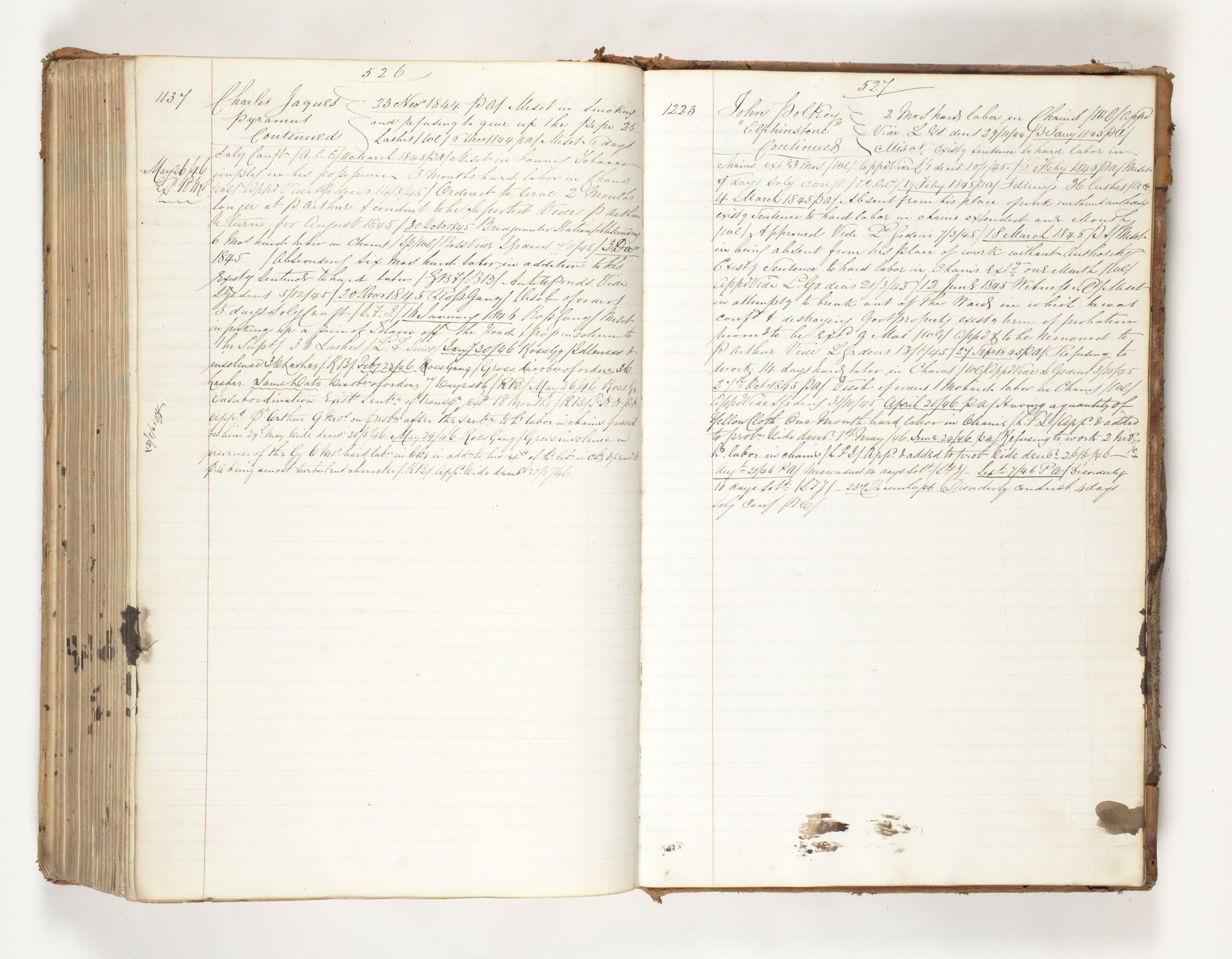
Conduct Record for Charles Jacques
Source: Libraries Tasmania CON32-1-4

Tasmania’s convict records are part of the UNESCO Memory of the World International Register and can be assessed through Libraries Tasmania. Of particular interest are the conduct records (CON 31, CON 32, CON 34) and the descriptive lists (CON18) in which Charles was described as 16 years old, four feet eight and a half inches tall, with brown hair and blue eyes.

For the first few years of his sentence Charles was assigned to various work gangs or to a free settler in a form of indentured servitude. He was not, however, a model prisoner. His conduct record shows numerous infractions for which he was brutally punished. In August 1839 he was "absent from his work without leave," and spent six days in a cell on bread and water. Later that month he was given 24 lashes for "misconduct." Over the next three years he was punished for absconding, insolence, insubordination, and for stealing a shirt. In July 1841 he was "returned to government, his master not requiring his services," and was at the Launceston prisoner's barracks later that year.

The Ploughing Team, Port Arthur
Source: State Library Victoria
In September 1842, while at Hobart, his sentence was extended by 18 months for absconding. That November he was sent to the Port Arthur penal settlement. In November 1844 he received 25 lashes for "smoking and refusing to give up the pipe." The following March he was given "three months hard labour in chains" for possessing tobacco. Two incidents of absconding in 1845 resulted in an additional twelve months hard labour in chairs. In January 1846 he was given 36 lashes for "idleness and insolence." In May 1846 his sentence was extended again by 18 months for gross insubordination. He was described as "being a most turbulent character,"

Charles was described as "being of most turbulent character," but on July 5, 1848, after a decade spent as a prisoner, Charles was given his certificate of freedom.

In contrast, Harper Broomhill Nichol's conduct record shows few infractions, and he was freed at the end of his seven year sentence.

Tasmanian convicts are often untraceable once they were freed. Many left Tasmania for South Australia, changed their names, and generally kept a low profile. One possibility for Charles is a marriage between Charles Jacques and Jane Evans that occured at Kooringa in South Australia on 20 Aug 1849. Kooringa was the location of the Burra Burra Cooper Mine. The following April, Robert Jacques was born, named after his uncle Robert Evans who had witnessed his parents marriage. Jane, born about 1831, and her brother had arrived in South Australia from Swansea, Wales in October 1848. What became of Charles, Jane and their son afterwards is not known.