Friday, July 9, 2021

Young in Years, Old in Crime

1828 Map of Van Dieman's Land

My great-grandfather Charlie Jacques (1869-1938) brought his family to Canada in 1907. He was born in Keighley, Yorkshire but moved with his mother and siblings to Sutton, Surrey after the death of his step-father. Charlie was likely named after his uncle, Charles Jacques (1822- ?), but apart from a baptism at Keighley I knew little about Charles. I could find no burial, no marriage, and he doesn't appear in any census records. Recently, however, I stumbled across the following article that appeared in the Bradford Observer on 12 July 1838:

BRADFORD COURT HOUSE
Young in Years, Old in Crime.— Charles Jaques, seemingly about 14 years of age, and who states himself to be the the son of a gardener at Keighley, and Harper Broomhill Nichol, about the same age, cart driver, of Halifax, were brought up charged with robbing Mary Liversedge, the wife of William Liversedge of Horton, on Saturday night last, in the Market Place in this town. It appeared that complainant on Saturday night was by the side of a wheelbarrow purchasing some gooseberries, for which she paid with copper, and she then had a purse in her pocket containing seven half crowns, and a gold wedding ring. Almost immediately she missed her purse and seeing a boy slip round the barrow, and made his way into the crowd, she felt convinced that he had robber her of her purse. She could not, however, see him again. On Monday morning she renewed her search and found her ring, which had been sold on Saturday night. In the meantime, however, from information received by the Constables, two boys (the prisoners) had been taken into custody on Saturday night in a lodging house, and by a clear and direct train of evidence, the robbery has been brought home to the two boys. In order that the ends of justice may not be frustrated, and that no undue prejudice may be excited against the prisoners, whose trial must necessarily immediately take place, we forbear giving even an outline of the evidence. Jacques has been twice previously committed from this town, for a robbery at Mr. Monkman's, the tobacconist, and another at Mr. Beddoes, for which last he was convicted, and endured three months' imprisonment, and only left the House of Correction on Saturday, the 23rd of June, and came into Bradford on Friday last. Nichol has been frequently convicted from Halifax, and is well known to the bench of sessions.

The article opened a floodgate of information. Charles, the son of David Jacques (1793-1831) and Elizabeth Corlass (1794-1856), was baptised at Keighley, Yorkshire on 7 Jul 1822.  In the 1822 Baines Directory entry for Keighley, David Jacques appears under the heading Gardeners, Nursery and Seedsmen as "Jacques Dvd. (dealer in British wines) Spring gardens." David was born on Belle Isle in Lake Windermere where his father had been gardener to John Christian Curwen (1756-1828).

On July 14, 1838 at the Bradford Sessions, Charles Jacques, aged 15, and Harper Broomhill Nichol, aged 16, were convicted of stealing a velvet purse containing seven half crowns and a gold ring. They were sentenced to be transported for seven years. The Court noted that Charles had a previously conviction for felony dated 2 Apr 1837.

Euryalus Towing the Royal Sovereign
Charles and Harper were received at the prison hulk Euryalus on August 22, 1838. Euryalus, moored in the Medway at Chatham in Kent, had been converted to a hulk for boys about 1825. Conditions were brutal. Convicts performed manual labour and were forced kept below desks for 23 hours a day. Gang violence and physical abuse from the guards were common.

The prison hulk register for Euryalus shows that Charles could read and write, and had been once convicted and once imprisoned.
 

Before she became a prison hulk, HMS Euryalus had a storied history. Named after one of the Argonauts, she was a 36-gun frigate that was launched in 1803 and decommissioned in 1825. Euryalus saw service during the Napoleonic Wars and the War of 1812. At the Battle of Trafalgar, Euryalus engaged the French fleet while towing the badly damaged Royal Sovereign. After the death of Admiral Nelson, Adminal Collingwood transferred his flag from Royal Sovereign to Euryalus. During the War of 1812, Euryalus was present at the bombardment of Fort McHenry. This bombardment inspired Francis Scott Key to write a poem that later became the words to the Star-spangled Banner.

Between 1804 and 1853, the British Government transported about 76,000 convicts to Van Diemen's Land (Tasmania). Charles and Harper were two of 170 convicts transported on the barque Pyramus which departed England on November 16, 1838. The Pyramus arrived at Hobart in Van Diemen's Land (Tasmania) on 24 Mar 1839. after a voyage of 122 days  

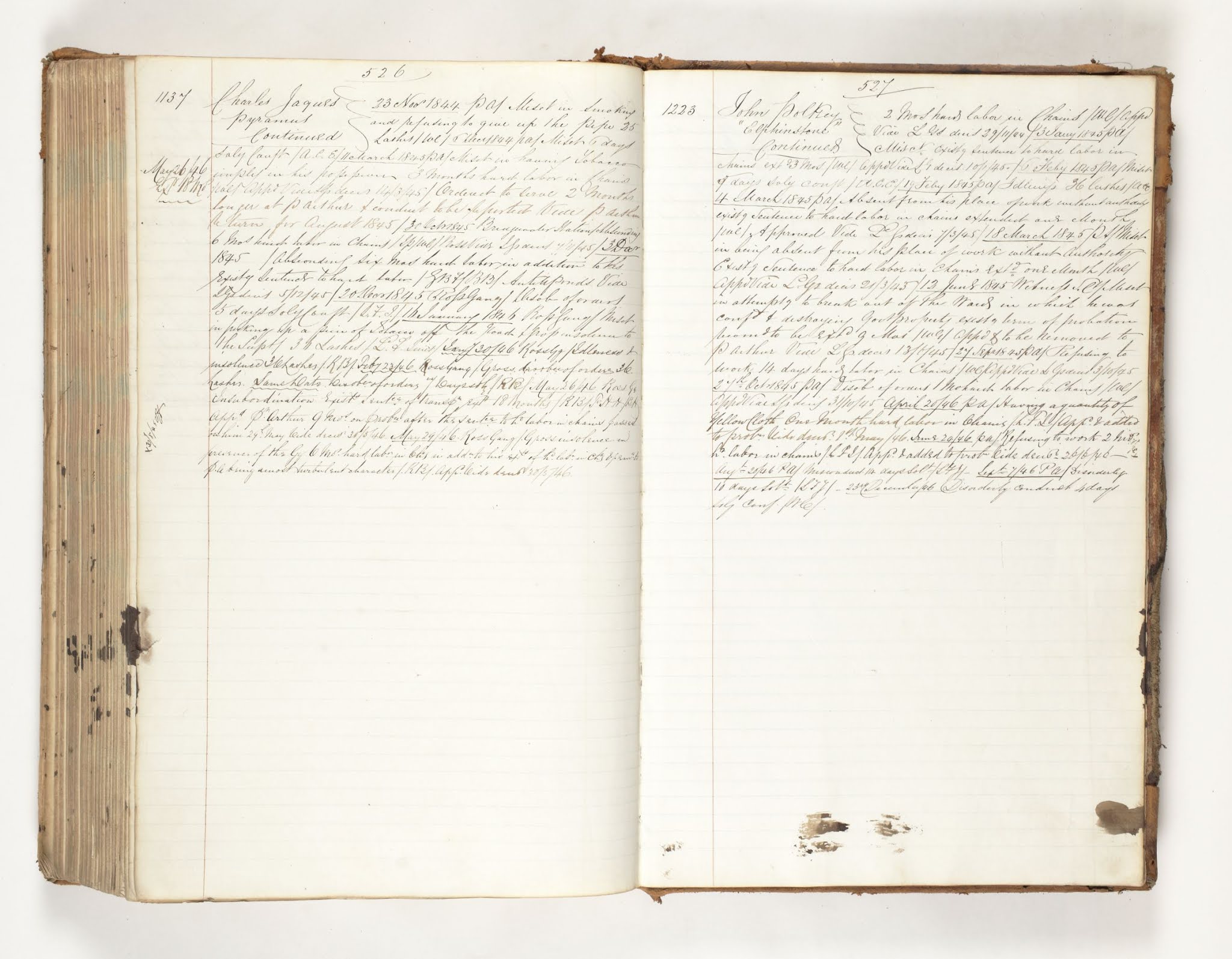
Conduct Record for Charles Jacques
Source: Libraries Tasmania CON32-1-4

Tasmania’s convict records are part of the UNESCO Memory of the World International Register and can be assessed through Libraries Tasmania. Of particular interest are the conduct records (CON 31, CON 32, CON 34) and the descriptive lists (CON18) in which Charles was described as 16 years old, four feet eight and a half inches tall, with brown hair and blue eyes.

For the first few years of his sentence Charles was assigned to various work gangs or to a free settler in a form of indentured servitude. He was not, however, a model prisoner. His conduct record shows numerous infractions for which he was brutally punished. In August 1839 he was "absent from his work without leave," and spent six days in a cell on bread and water. Later that month he was given 24 lashes for "misconduct." Over the next three years he was punished for absconding, insolence, insubordination, and for stealing a shirt. In July 1841 he was "returned to government, his master not requiring his services," and was at the Launceston prisoner's barracks later that year.

The Ploughing Team, Port Arthur
Source: State Library Victoria
In September 1842, while at Hobart, his sentence was extended by 18 months for absconding. That November he was sent to the Port Arthur penal settlement. In November 1844 he received 25 lashes for "smoking and refusing to give up the pipe." The following March he was given "three months hard labour in chains" for possessing tobacco. Two incidents of absconding in 1845 resulted in an additional twelve months hard labour in chairs. In January 1846 he was given 36 lashes for "idleness and insolence." In May 1846 his sentence was extended again by 18 months for gross insubordination. He was described as "being a most turbulent character,"

Charles was described as "being of most turbulent character," but on July 5, 1848, after a decade spent as a prisoner, Charles was given his certificate of freedom.

In contrast, Harper Broomhill Nichol's conduct record shows few infractions, and he was freed at the end of his seven year sentence.

Tasmanian convicts are often untraceable once they were freed. Many left Tasmania for South Australia, changed their names, and generally kept a low profile. One possibility for Charles is a marriage between Charles Jacques and Jane Evans that occured at Kooringa in South Australia on 20 Aug 1849. Kooringa was the location of the Burra Burra Cooper Mine. The following April, Robert Jacques was born, named after his uncle Robert Evans who had witnessed his parents marriage. Jane, born about 1831, and her brother had arrived in South Australia from Swansea, Wales in October 1848. What became of Charles, Jane and their son afterwards is not known.

Friday, July 2, 2021

Demons in Human Form: Adin Beebe and Philip Crysler

Thomas Cole, View on the Schoharie, 1826, Fenimore Art Museum

After the first shots of the Revolutionary War were fired at Lexington and Concord, a significant number of American colonists adopted what could be described as wary neutrality. In the case of the colonists living on the North Branch of the Susquehanna River in present-day Wyoming County, Pennsylvania, this neutrality lasted for almost two years.

But by early 1777, many of them had decided that they had to demonstrate their opposition to the Revolution. On March 31, 1777, John Butler, the Deputy Superintendant of the Indian Department, wrote from Fort Niagara that he had "received letters from seventy of the inhabitants of the Susquehanna by one Depue, expressing a desire of entering into His Majesty's service as Rangers." One of the these letters was likely authored by my fifth great-grandfather, Joshua Beebe.

244 years later it is difficult to know why Joshua became a Loyalist. Joshua, the son of Joshua Beebe (1713-1797) and Hannah Brockway (1718-1819), was born in East Haddam, Connecticut in 1738. About 1760, he married Mary Secord who had been born in New Rochelle, New York in 1736. The births of Joshua and Mary's two oldest children, Adin (1761-1843) and Secord (1764-1859), were registered in Ashford, Connecticut.

According to family tradition Charlotte (1767-1852) was also born in Ashford, while Amasa (1769-1852) and Asa (1772-1861) were born in York, in southern Pennsylvania. No primary sources have been found to support this but York appears in Roy Beebe's An Ordinary Family: Extra-Ordinary Times, and in Ken Annett's article on the Beebe family published as part of his Gaspe of Yesterday series. In her article, "In Search of Mary Beebe," Alex Newman speculates that Joshua and Mary had settled on the Susquehanna as early as 1769 but had fled to the safety of York during the First Pennamite War.

The Susquehanna River at Mehoopany
Joshua and Mary's daughter Sarah was born on January 6, 1775. Sarah is known to have been born on the Susquehanna, which suggests that Joshua and Mary had settled there in 1774 at the same time as Mary's brothers Peter and James Secord. James and Peter farmed near Mehoopany, while another brother, John Secord, was located downriver near Tunkhannock. All four appear on the 1776 tax assessment list for the "Up the River" district.

In a letter dated April 1, 1871, John Secord Beebe (1813-1872), a grandson of Joshua and Mary wrote to his half-brother William Thomas Beebe (1840-1918) and described the general location:
The Secords with your grandfather Beebe moved to the Susquehanna the river after winding throug[h] the mountains came into a flat country called Wyoming leading down to the Chesapeak Bay. They were amongst the first that settled on the [illegible word] lands amongst the mountains, one of there farms was the first as they came to the mouth that is to say the country was flat or more level from that toward the Chesapeak each one of the four of them had taken as heads of family one of those [illegible word] flats being a large flat on one side and mountains on the other, opposite your grandfathers farm in the river was an island by some called Long Island whilst others called it Peach Island.
The North Branch of the Susquehanna River rises at Lake Otsego in New York. It flows southwest and crosses into Pennsylvania twice before merging with the Chemung River at Tioga Point. The river then flows southeast through the Endless Mountains in Pennsylvania. After emerging from the mountains the Susquehanna turns to the southwest and flows through the area known as the Wyoming Valley until it merges with the west branch at Sunbury.

Johannes Ettwein's 1768 Map
of the North Branch. Source:
Unity Archives, Herrnhut, Germany
In the 18th century, the area in which Joshua and his brothers-in-law settled was claimed by both Connecticut and Pennsylvania. Disputes arose over land ownership between the "Yankees" who purchased their property from Connecticut's Susquehanna Company, and the "Pennamites" who had acquired title from Pennsylvania. The skirmishes and mutual harassment that occurred are referred to as the Yankee-Pennamite Wars.

By the start of the Revolutionary War, the Wyoming Valley was firmly under the control of the settlers from Connecticut. In January 1774, the Wyoming Valley had been incorporated into a town named Westmoreland and annexed to Connecticut's Litchfield County. This was done despite Pennsylvania having formed Northumberland County in 1772. In December 1775, an attempt by Pennsylvania to forcibly evict the Yankee settlers failed, and in October 1776, Westmoreland was formally established as a county of Connecticut.

Most of those who had settled "up the river," however, had either acquired their land from Pennsylvania or were squatters. The tension between Yankees in the Wyoming Valley and those upriver was such that at a meeting held in January 1776 in Wilkes-Barre it was resolved that a committee:
... proceed up the river and let the people known that the inhabitants of Westmoreland are not about to kill and destroy them and take any of their effects as reported, but they may keep their effects and continue in peace on reasonable terms provided they conform to the laws of the Colony of Connecticut and the Resolves of the Continental Congress, and confirm their intentions by signing the subscription paper for that purpose that said committee will produce.

Undoubtedly, Joshua's decision to remain loyal was influenced by his wife Mary's brothers. All three became rangers in the Indian Department at the same time of Joshua. In October 1775, James Secord had been appointed captain of the Ninth Company, 24th Regiment, Connecticut Militia, but was replaced the following June because he was "suspected and accused of Tory proclivities."

Tioga Point

In March 1776, John Secord had been arrested and accused of spying, providing intelligence to the enemy, and helping escaped British officers to make their way to Niagara. John petitioned the Continental Congress complaining of the infringement of his rights. Congress referred his case to the Governor of Connecticut, and John was freed. John subsequently abandoned his farm near Tunkhannock and moved further upriver to Tioga Point at the confluence of the Susquehanna and Chemung Rivers.

In the spring of 1777 Joshua Beebe and his 15-year-old son Adin, left their farm on the Susquehanna and headed for Fort Niagara. They were part of a substantial group that included James Secord and his sons Solomon, Steven, and David; Peter Secord and his son Cyrus; John Secord and his son John; Abraham Wartman and his son Adam; and Jacob Bowman with his son Adam.

John Butler noted the arrival of the Susquehanna Loyalists at Niagara in a letter to Governor Guy Carleton on April 8, 1777:

Since my letter to Your Excellency of the 31st ulto, several people have arrived from the Susquehanna, who inform me of more being on their way and more to follow them in a few days.

Joshua and Adin appear on "A List of Persons Employed in the Indian Department" dated Niagara, June 15, 1777. The following month Butler brought his rangers to Oswego to rendezvous with Brigadier General Barry St. Leger. St. Leger's expedition left Oswego on July 26 and travelled overland to Fort Stanwix which was besieged beginning on August 2. On August 6, Joshua, Adin, and the other rangers were part of the ambush of American reinforcements known as the Battle of Oriskany.

The Siege of Fort Stanwix was lifted on August 22 after the British received misleading intelligence that an American relief column commanded by Major General Benedict Arnold was approaching. A few days later at Oneida Lake, St. Leger gave leave to the Susquehanna rangers "to go home for their families and to bring off some cattle."

Joshua was with the group that went home since his son Joshua was born the following year. Joshua and Adin evaded capture that winter when a Patriot force commanded by Nathan Denison arrested "sundry Tories" and sent 17 of them to prison in Connecticut. Among the prisoners were Jacob and Adam Bowman who were released in 1780 but then recaptured a few weeks later.

In September 1777, John Butler received permission to form the provincial regiment known as Butler's Rangers. Butler's instructions from Governor Carleton were to place volunteers who could speak one or more of the Haudenosaunee languages and were "acquainted with their customs and manner of making war" into the first two companies. Most of the Susquehanna loyalists were transferred from the Indian Department into Butler Rangers. When Joshua and Adin returned to Fort Niagara they were placed in the company commanded by John Butler's son, Capt. Walter Butler.

On May 1, 1778, the two companies of Butler's Rangers left Fort Niagara for Tioga Point. On June 28 the Rangers, accompanied by a few hundred Haudenosaunee warriors,  set off by canoe down the Susquehanna, past the farms of Joshua and his neighbours. On July 1, the Rangers captured Fort Wintermoot and Fort Jerkins, and on July 3, at the Battle of Wyoming, routed a Patriot force of 360 commanded by Nathan Denison and Zebulon Butler. Forty Fort surrendered to Butler the following day.

At some point shortly before or after the Battle of Wyoming, Mary Secord and her children abandoned their farm on the Susquehanna and travelled upriver to Tioga Point. In her claim for losses, Mary reported crops left in the ground ("wheat, corn, potatoes and turnips") confirming an early summer departure. John Secord Beebe's letter provides additional details:

On their march up the river on there way to Canada they came to a place called Tellga point being a point of land formed by another river coming into the main river. There they encamped for several days. There your grandfather bade his wife and family farewell, bound to N. Y. on business of importance from which he never returned. There also was your father born 3 or 4 days after his father left.
According to his baptism record, Joshua and Mary's son Joshua was born on 29 Jul 1778. Tioga Point was where Mary's brother John had settled after he left his farm near Tunkhannock. Joshua, John Depue, and Thomas Hill had been sent with dispatches for General Sir Henry Clinton in New York.

In her Claim for Losses, Joshua's widow, Mary described what happened:

I Mary Pearson late Mary Bebee Widow to the deceased Joshua Bebee Farmer residing at Susquehannah in the Province of Pennsylvania was driven from our Property since the late unhappy Dissentions in America on account of my Loyalty to His Majesty and attachment to the British Government and my Husband and Son joined the British Army under Colonel Butler at Niagara 1st April 1777 and was sent with Dispatches from Niagara by the order of Colonel Boulton and Colonel Butler to the Royal Army at New York and delivered his Charge and took the Small Pox and died.

The "Evidence of Mary Pearson" was heard at Quebec on July 31, 1787. The commission added the following information:

Her late Husband Joshua Beebe was born in America, in 1775 he was settled on the Susquehanna, he never joined the Rebels, but joined Butler’s Rangers in 1777, he went with an Express to New York from Susquehanna and died of the Small Pox in 1778 – Claimant came into Canada in 1778 and is now married to Christopher Pearson. She has 7 Children by Beebe in Canada, Eden [Adin] at Niagara 23 years – Seacord [Secord] 21, Charlotte 20 married to S. Chatterton at Chaleur, Emeiser [Amasa] 18 – Easse [Asa] 15 – Sarah 12 – Josh 10
Finally, there is the certificate of John Depue attached to the Upper Canada Land Petition of Elias Smith:
I do hereby Certify that Elias Smith, now of this place in the Year 1778 when I was on Express with a packet in company with Jonathan Bebe and Thomas Hill from Niagara to New York was recommended to him as being a true subject to His Majesty and that we might rely on him for any assistance we might want (he then living on Cortland Manor) in order to forward us through safe and on our applying to him he then did furnish us with provision, and kept us concealed in the woods till he got a Young Woman to go to New York (as it was impossible for a Man to go through the American lines without being strictly examined) and return back that me might know which to go to avoid the Guard. We then thought it most safe to divide the letters, and Jonan Babe & Thos Hill went and got th[r]ough safe.

The Haldimand Papers include a State of Subsistence prepared by Walter Butler dated 24 Dec 1780 that records Joshua Beebe's death on 28 Oct 1778.

Mary and her children would have been escorted to Fort Niagara in August or early September, well before the retaliatory Hartley Expedition reached Tioga Point in late September. Fort Niagara, however, was ill-equipped to support large number of refugees.

On November 11, 1778, the commanding officer of Fort Niagara, Lieutenant Colonel Mason Bolton, wrote to Governor Frederick Haldimand:

I have sent down to Montreal a considerable number of families who have suffered a great deal of distress on account of their attachment to Government. Many of them have not only been driven from their lands, but plundered of everything they had in the world and came in here in a ragged, starving condition. I have ordered some blankets, &c, to be bought for sufficient to serve them to Canada and thought it best to remove them from this post where provisions are of so much consequence.

Two days earlier, Thomas Carleton, Quartermaster General, had written to Haldimand from Montreal that, "22 families of loyalists (111 persons) are on their way from Niagara; some have arrived, and in want of clothing." Later that month Carleton had reported an additional 12 families (84 persons) from Niagara and that had he billeted them "on the inhabitants" of Point Claire on the Île de Montréal.

It is quite possible that Mary and her children were with the second group as "Widow Beebe" with six children were recorded in billets at Point Claire in July 1779. They would have travelled by boat and batteau to Montreal once news of Joshua's death had reached Niagara. As a soldier in Butler's Rangers, Adin remained behind.

Return of Loyalists
October 24, 1779
In the summer of 1779, Mary and her children were sent downriver to the newly constructed refugee camp at Machiche on the north side of the St. Lawrence River west of Trois-Rivières. Here they would remain until June 1784.

At Machiche, refugees were housed in one of at least twenty square timber building measuring eighteen by forty feet. Each building had a double chimney and was divided into two rooms. The Beebe family would have occupied one room while another family occupied the second. Beds, blankets, bedclothes, cooking utensils, shoes, and clothing were provided.
Cast iron stoves were installed, several acres of gardens were planted, and a number of masonry ovens were built. By the time of Mary's arrival a schoolhouse had also been constructed and a schoolmaster had been appointed.

On August 15, 1781, Mary had her five youngest children baptised at Trois-Rivières. On October 1 of the same year she married Christopher Pearson (1736-1827), a widower with two daughters.

Joseph Bouchette's 1815 Plan of the District of Gaspe. Source:
 Norman B. Leventhal Map & Education Centre, Boston Public Library

In February 1784, and again in May, a notice was published in the Quebec Gazette offering free land and passage to Loyalists willing to settle on the Baie des Chaleurs. In June 1784, 315 refugees and discharged British soldiers boarded the brigs Polly and St. Pierre, the snow Liberty, the Hoy St. Johns and four whaleboats, and sailed for Paspébiac on the Gaspe Peninsula. The family of Christopher Pearson which now included Mary and her children were recorded aboard the Polly.

Charles Robin (1743-1824)
Paspébiac was the location of a fishing station operated by Charles Robin, a native of Jersey who had come to the Gaspe in 1766. In 1777 it was home to several families of Acadians who Robin had recruited from the thousands who had been deported to France during the Seven Years War. Further to the west was the settlement of Bonaventure which had been established by Acadian refugees in 1760. Accompanying the loyalists aboard the Polly was Major Nicholas Cox, the Lieutenant Governor of Gaspe.

Cox relates how the Polly was twice driven back to Bic by a gale that continued for five days. When the fleet reached Paspébiac, Cox had representatives from each ship sent ashore "to view the land," however, the Loyalists, "could agree about any one thing." The ships then headed for the Acadian settlement of Bonaventure where they was safe harbour for the ships and shelter for the women and children. While at Bonaventure, Cox convinced the loyalists to settle the unoccupied land to the west of Paspébiac, which became known as Little Paspébiac:

My coming here has opened the eyes of the Loyalists, and they are now convinced that this land is not so good as at Paspebiac ... I believe that they would have been glad to have taken possession of their [the Acadians] improvements but after convincing them of the impossibility of interfering with the inhbitants or their land, they have agreed to return to Little Paspebiac.
The Acadians had earlier impressed Cox as a "sober industrious people" who "are improving and cultivating the land which produces exceedingly fine wheat, barley and oats," so he was reluctant to displace them. Cox also received several letters from Charles Robin expressing concern about the impact the loyalist settlement would have on his "interests" at Paspébiac. In one letter, Robin wrote:
Give me leave also to recommend to your attention the old settlers of this place who have already improved the lands about their houses in confidence that their labour and industry would not be taken from them.
Cox's solution was to reserve 1000 acres for Charles Robin and 50 acres for each of the Acadian families at
Paspébiac. On 3 Aug 1784 the loyalists drew for their lots. Christopher Pearson received 600 acres as the father and step-father of seven children. Secord Beebe, who was 19 years of age, received 100 acres in his own name.

1785 Survey of Little Paspebiac. Source: Library and Archives Canada

Mary remained in what became known as New Carlisle for the rest of her life. Secord Beebe left New Carlisle for the Wentworth Valley in Cumberland County, Nova Scotia. Charlotte Beebe married Samuel Chatterton, a discharged soldier of the 31st Regiment of Foot who had arrived at New Carlisle aboard the Liberty. Amasa Beebe never married but became Protonotary of the District Court of Gaspe. Asa married twice, while his sister Sarah married Andrew Caldwell. Sarah's 1823 gravestone is the oldest monument in New Carlisle's Presbyterian burial ground. Joshua Beebe married three times and died in 1844. His third wife, Mary Watt, was 35 years younger than Joshua and also younger than the five children of his first marriage.

While the exact date of her death is not known, two letters from Adin Beebe to his brother Amasa show that Mary lived past well her 100th birthday. In his letter of 1838 Adin writes, “In yours of 1836, I find that our mother is still living."  In his letter of 1843, however, he reflects on the “demonstrated frailty of man” and gives "thanks to those whom I esteem for the attention they paid our deceased mother.”
 

Adin Beebe continued serving with Butler's Rangers until the end of the Revolutionary War. As a member of Captain Walter Butler's company he was likely at the Cherry Valley Massacre in November 1778 when Butler and the Mohawk war leader Thayendanegea (Joseph Brant) failed to prevent Seneca warriors from slaying thirty non-combatants. He may also have been at the Battle of Newtown in August 1779 when the Haudenosaunee and Butler's Rangers made an unsuccessful stand against the Sullivan Expedition

Assuming Adin stayed in Walter Butler's company, he may have been one of 150 Rangers who participated in the Battle of Johnstown on October 25, 1781, and could have been present when Butler was killed at West Canada Creek on October 30, 1781. A letter written by Lieutenant Alexander McDonell of the Rangers describes what happened:

We had no other encounter until the 30th at Canada Creek, which we had scarce crossed when the rebels appeared on the opposite side. They expected to overtake us before we could ford the creek, which is very deep and rapid. As soon as they perceived us, they gave a general discharge. We returned the compliment and kept up a pretty brisk exchange of such favours for near ten minutes, when the gallant Captain Butler was unfortunately shot through the head by a rifle ball. The loss of this active and promising Officer cannot be too much lamented.
On the Return of Loyalists at Niagara dated November 30, 1783, Adin appears as a corporal in Lieutenant Colonel's John Butler's Company. By the time Butler's Rangers disbanded the following summer he had been promoted to Sergeant. Rather than rejoin his family on the Baie des Chaleurs, Adin decided to "settle and cultivate the Crown Lands opposite to Niagara," and was granted 300 acres fronting on Lake Ontario in Louth Township.

Adin married sometime between July 1784 and December 1786.  It is clear from Adin Beebe's Upper Canada Land Petitions "that his wife is Daughter of Philip Chrysler." The consensus amoung Beebe researchers is that her name was Dorothy. The name Dorothy, however, does not appear in any primary sources. The 1783 return shows Philip Crysler and his wife Elizabeth had a daughter Elizabeth, aged 18, a daughter Margaret, aged 16, and a daughter Lehen [Magdalena), aged 7. Elsewhere in the return are 14 year old Heironymus Crysler and 15 year old John Crysler who had both joined Butler's Rangers. The births of all five are recorded in the records of St Paul's Evangelical Lutheran Church in Schoharie, New York.

The most likely candidate for Dorothy is Margaret who was born on November 1, 1766. Most children of German descent were given two personal names, however, in the St Paul's Evangelical Lutheran records, only one name typically appears. Margaret, therefore, may very well have been Margareth Dorothea.

1790 map showing the Schoharie River and the headwaters
of the Susquehanna. Source: Harvard University Library


Philip Crysler, the son of Hieronymus Krausler (1713-1751) and Maria Margareth Braun (? - 1753), was born in the Schoharie Valley about 1741. His grandparents had been among the nearly 3,000 German Protestant refugees (Palatines) who had arrived in New York from London in 1710. Philip married Elisabeth Braun on November 19, 1762, and moved northwest to New Dorlach in 1769.

Philip enlisted in the King's Royal Regiment of New York on August 15, 1777 during the Siege of Fort Stanwix. He appears on the regiment's muster roll dated January 21, 1778 at Laprarie near Montreal. The following year he transferred to Butler's Rangers.

In October 1780, Philip took advantage of a large scale raid by British forces on the Schoharie Valley to bring his family from their home in New Dorlach to Niagara. The joint raid by the King's Royal Regiment of New York, Butler's Rangers, and regulars from the 8th and 34th Regiments, was commanded by Sir John Johnson. Accompanied by Mohawk, Seneca, and Cayuga warriors, the expedition left Oswego on Lake Ontario on the 2nd and arrived at the head of the Schoharie Valley on the 16th. Gavin Watt in The Burning of the Valleys writes that the following day Johnson's forces, "marched 12 miles, fought several skirmishes, invested a fort and created a conflagration beyond imagination. For men who had already traversed a wilderness over rough trails and on very short rations, it had been exhausting."

"Murder of Catharine Merckley" in History of
the Schoharie Valley
by Jeptha Simms

Early the following morning, while Johnson's force prepared to advance to the Mohawk River, Philip Crysler accompanied by two Rangers, and 17 Mohawk warriors led by headed west to New Dorlach. As Philip helped his family prepare for the trip to Niagara, the rest of the party went to  the farm of Michael Merckley. 13-year-old John Merckley and his sisters Anna and Elizabeth were taken prisoner as was their cousin Martin and a young lodger. When Merckley and his niece Catharine arrived home they were shot dead and scalped. The warriors then proceeded to the farm of Sebastian Frantz. Sebastian avoided capture but his son John was seriously wounded, and his wife and other children were taken prisoner. One child, Henry, later escaped which so angered his captor that John was killed and scalped.

Hearing gunfire, Elizabeth Crysler urged Philip to "put on his Indian clothing" and save the Frantz family as they had helped her in the three years Philip had been absent. Although he was unable to save John, Philip convinced the Mohawk warriors to leave the rest of the Frantz family unharmed. Mrs. Frantz never recognized the "blue-eyed Indian" as her neighbour.

Accompanied now by the Crysler family, the raiding party headed to a nearby mill where a number of the owner's slaves were captured. They then began the arduous journey back to Fort Niagara. Within a few miles John Merckley and the lodger began crying and were inconsolable. One of the Mohawk warriors dragged the boys out of sight before killing and scalping them.

19th century historians Jeptha Simms and William E. Roscoe both accuse Philip of planning the attack on the Merckley farm. In his 1845 History of Schoharie County, Simms speculates that Philip was taking revenge on Michael Merckley because Philip's daughter had been impregnated by Merckley's son but had refused to take responsibilty. In his 1888 account, Roscoe describes Philip and his brothers as "demons in human form, whose brutal acts outvied those of the uncivilized barbarian, and are a stain upon the history of civilized mankind."

Map of the Niagara District, Upper Canada, 1815
Source: Library and Archives Canada
Butler's Rangers was disbanded in June 1784. While most of the Rangers were granted land west of the Niagara River as a reward for their service to the Crown, Philip joined the Loyalists who were settling on the St. Lawrence River west of Montreal. Philip appears on the 1784 Williamsburgh Return with the remark, "Gone to Niagara for his family." Also on this return is Philip's brother, John Crysler, who had been a Lieutenant in the Indian Department at Niagara.

In the 1787 Return of Loyalists & disbanded troops settled in the District of Niagara, "Eden Bebie" is listed as a head of household with one woman. He had eight acres of land cleared and five bushels of wheat sown. Adin's daughter Lucretia was born about 1788, followed by Druscilla a year later. Amasa Beebe was born in 1791. Joshua was born in 1795, Solomon in 1798, and Asa about 1801.

A "Return of Land Granted" prepared by Deputy Surveyor General Augustus Jones in 1792 shows that Adin had only received 300 acres of the 600 acres he was entitled to. In 1794, after the Province of Quebec had been divided in Upper and Lower Canada, Adin received a commission as a Lieutenant in the Lincoln Militia, having previously been an ensign in the Nassau Militia. He served as Town Clerk of Louth from 1793 to 1795 and again from 1799 to 1804.

During the War of 1812, Adin's sons Amasa and Joshua served in the 1st Regiment of Lincoln Militia.  Initially, Amasa and Joshua were with the 2nd Flank Company and were likely present at the Battle of Queenston Heights in October 1812. When the Volunteer Battalion of Incorporated Militia was created to replace the flank companies, Amasa and Joshua transferred to Capt. Jacob Ball's company.

Adin died in Louth on November 7, 1843 at the age of 82. He was predeceased by his wife, his daughter Druscilla, and his sons, Joshua and Asa. He was buried three days later in a small family graveyard located close to the shore of Lake Ontario. Any gravestones that existed disappeared in the late 1800s, and when the Queen Elizabeth Way was constructed in 1939, any trace of the cemetery was destroyed.

Sources:

Annett, Ken. "The Beebe Family." Gaspe of Yesterday, Vol. 4, p. 27-52. http://gogaspe.com/host/annett/volume4/103%20The%20Beebe%20Family.pdf

Beebe, Adin. Letter to Amasa Beebe, July 16, 1838. Public Archives of New Brunswick, MC 1.

Beebe, Adin. Letter to Amasa Beebe, September 28, 1843. Public Archives of New Brunswick, MC 1

Beebe, John Secord. Letter to William Thomas Beebe, April 1, 1871. Collection of Roy L. Beebe.

Beebe, Roy L. An Ordinary Family: Extra-Ordinary Times. Xlibris, 2016.

Beebe, Solomon. Letter to Amasa Beebe, June 17, 1844. Public Archives of New Brunswick, MC 1.

Chrysler, Don. The Blue-Eyed Indians: The Story of Adam Crysler and His Brothers in the Revolutionary War. Self-published, 1999. http://sites.rootsweb.com/~nyschoha/crbook.html

Crowder, Norman. Early Ontario Settlers: A Source Book. Baltimore: Genealogical Publishing, 1993. https://www.ancestry.ca/search/collections/48451/

Cruickshank, Ernest Alexander. The Story of Butler's Rangers and the Settlement of Niagara. Welland, Ontario: Lundy's Lane Historical Society, 1893.

Flowers, A. D. The Loyalists of Chaleur Bay. Vancouver: Precise Instant Printing, 1973.

Kuhl, Jackson. "The Incredibly Convoluted History of Westmoreland County, Connecticut." Journal of the American Revolution, October 2014. https://allthingsliberty.com/2014/10/the-incredibly-convoluted-history-of-westmoreland-county-connecticut/

Jones, J. Kelsey. Loyalist Plantations on the Susquehanna. Unpublished, 2013. https://docplayer.net/100900251-Loyalist-plantations-on-the-susquehanna-j-kelsey-jones-updated-2009.html

Library and Archives Canada. Haldimand Papers. MG21, Volumes B164, B166, B168, B188, B202.

Library and Archives Canada. Land Petitions of Upper Canada, 1763-1865.
RG 1 L3.

National Archives of the United Kingdom. American Loyalist Claims, 1776–1835. AO 12–13. https://www.ancestry.com/search/collections/3712/

Moulton, R. Kirk. "The Early Sicard-Secor Families of New York: Origins of United Empire Loyalist William Secord." The New York Genealogical and Biographical Record, Volume 150 Number 4 (October 2019).

Moyer, Paul Benjamin. Wild Yankees: Settlement, Conflict, and Localism along Pennsylvania's Northeast Frontier, 1760-1820. Dissertations, Theses, and Masters Projects. Paper 1539623949 (1999).
https://dx.doi.org/doi:10.21220/s2-mpyc-bz95

Ousterhout, Anne M. "Frontier Vengeance: Connecticut Yankees vs. Pennamites in the Wyoming Valley," Pennsylvania History, Summer 1995, Vol. 62 Issue 3, pp. 330–363. https://journals.psu.edu/phj/article/view/25244

Miner, Charles. History of Wyoming: In a Series of Letters, From Charles Miner, to His Son William Penn Miner. Philadelphia: J. Crissy, 1845.

Roscoe, William E. History of Schoharie County, New York, 1713-1882. Syracuse: D. Mason & Co. 1882.

Siebert, Wilbur H. "The Temporary Settlement of Loyalists at Machiche," Transactions of the Royal Society of Canada, III, Vol. 8, 407-14, 1914

Siebert, Wilbur H. "The Loyalist Settlements on the Gaspe Peninsula," Transactions of The Royal Society of Canada, III, Vol. 8, 399-405, 1914.

Simms, Jeptha. History of Schoharie County, and the Border Wars of New York. Albany: Munsell & Tanner, 1845.

Smy, William A., editor. The Butler Papers: Documents and Papers Relating to Colonel John Butler and His Corps of Rangers. Brock University Library Archives & Special Collections, 1994. https://dr.library.brocku.ca/handle/10464/9242

Watt, Gavin K. Loyalist Refugees: Non-Military Refugees in Quebec 1776-1784. Milton, Ontario: Global Heritage Press, 2014.

Watt, Gavin K. The Burning of the Valleys: Daring Raids from Canada against the New York Frontier in the Fall of 1780. Toronto: Dundurn Press, 1997.


Saturday, April 24, 2021

The New York Volunteer: John Secord (1762 - ?)

Detail from the 1859 Tremaine Map of Brant County

In her acclaimed book Liberty's Exiles, American Loyalists in the Revolutionary World, Maya Jasanoff describes the Loyalists as "ordinary people whose lives were overturned by extraordinary events." During the American Revolution, sixty thousand "ordinary people," sided with Britain and as a result abandoned their homes and sought refuge in other parts of the British Empire. Among them were ten members of the family of Daniel Secord (1698- ?) and Catherine Mabie (1703- ?) of Westchester, New York—three of their sons and seven of their grandchildren.

Two sons and five grandchildren joined Butler's Rangers based at Fort Niagara on Lake Ontario: Peter Secord (1726-1818), John Secord (1725-1804), their sons Silas (1755- ?) and John (1757-1830)  and their nephews Solomon (1755-1799), Stephen (1757-1808), and David (1759-1844). John and Peter's brother James Secord (1732-1784) served in the Indian Department at Fort Niagara, while their nephew, Daniel Secord (1756- ?), son of their brother Daniel (1723-1818), joined Brant's Volunteers, also based at Fort Niagara.

The final member of this family to remain loyal was John Secord, another child of Daniel Secord and his wife Elinor. John was born in Dutchess County, New York in 1762, and at the age of 15 joined the New York Volunteers, a loyalist provincial regiment commanded by Lieutenant Colonel George Turnbull (1728-1810). The New York Volunteers were sent to East Florida in October 1778. They saw action at the Capture of Savannah in December 1778, and at the Siege of Savannah in October 1779. John appears as a private on the muster roll of Captain John Coffin's Company dated at Savannah, Georgia on 29 Nov 1779.

The Stand of the Continentals
at Camden
by Graham Turner
The Volunteers were at the Siege of Charleston in the spring of 1780 and at the Battle of Camden in August 1780. In April 1781, the Volunteers fought at the Battle of Hobkirk's Hill. John appears as a corporal on both 1781 muster rolls for Captain Coffin's Company. In August 1782, the New York Volunteers returned to New York several months before the British evacuation of Charleston. When the Revolutionary War ended, the New York Volunteers and other Loyalist units were evacuated from New York. The Volunteers were transported aboard the Ranger and arrived at the mouth of the Saint John River (New Brunswick) in late September 1783. They were disbanded on 10 Oct 1783. John was a sergeant at the time of his discharge.

John married in New Brunswick and had at least five children. His wife's name is not known. In 1793, he moved west to Upper Canada (Ontario) and settled in Gainsborough Township in the Niagara Peninsula. Unfortunately, the lot alloted to him (Lot 9 Concession 1 on the north bank of the Welland River) had been alloted to Isaac Vrooman several years earlier. In his 1794 Upper Canada Land Petition, John claims he, "
erected thereon a Small house (there being no improvement on the Lot when he took possession)" and further claimed that Vrooman only began to clear land after Secord had settled. Vrooman disputed this, stating that Secord arrived a year after Vrooman had begun "improving" the property. The Executive Council apparently decided in favour of Vrooman, and John moved west to Burford Gore (Oakland Township). On 17 May 1802, he was granted title to Lot 9 Concession 2 in Burford Gore (Oakland Township), as well as 200 acres in Townsend Township, Norfolk County.

In 1809, John petitioned for his name to be added to the list of Loyalists "in order than his children may be entitled to partake of His Majesty's bounty in land."

John served in the 1st Regiment of Oxford Militia before the War of 1812. He appears as a private on the 1803 muster roll of the Burford Company, and as a Lieutenant on the 1807 muster roll. On 11 Jul 1812 he was commissioned a Captain, however, does not appear on any of the surviving muster rolls from the war.

John Secord's will is dated 6 Feb 1813. In his will he names his sons: James, John and Asa, and his grandchilden: Amy and Mariah Doyle, and William and Joseph Ellis.

1812 Return of Bingham's
Rifle Company
James saw active service during the War of 1812 with the 1st Regiment of Oxford Militia. He appears on the muster rolls for Lieutenant B. Brewster Bingham's Rifle Company during the fall of 1812, and again on the muster rolls for Bingham's company in 1814. James was undoubtedly present at the Battle of Malcolm's Mills on 6 Nov 1814 when the Oxford, Middlesex, and Norfolk militias unsuccessfully tried to block an American force of 700 mounted riflemen under the command of Brigadier General Duncan McArthur. The battle took place less than 1.5 kilometres from James's home.

James Secord's Upper Canada Land Petition is dated 13 Apr 1819. He was awarded 200 acres as the "
Son of John Seacord Serjeant of the New York Volunteers Loyalist."

In 1823, James sold the east half of Lot 9 Concession 1 Oakland to his brother Asa, and the west half to Asa in 1828. Between 1830 and 1832 James sold off Lot 24 Concession 12 in Townsend. James never married.

Apart from being named in his father's will, nothing else is known about John Secord. He is sometimes confused with his cousin John Secord, the son of Daniel Secord.

Deborah Ellis née Secord's gravestone
at Mount Pleasant Pioneer Cemetery,
Brantford, Brant, Ontario

John’s daughter Deborah Secord (1790-1866) married John Ellis (1780-1864). John Ellis was the son of Henry Ellis and had emigrated with his family to Upper Canada from Pennsylvania in 1798. Henry leased 200 acres from the Haudenosaunee in 1801. Deborah and John had at least nine children. Their son, David Duncomb Ellis (1833-1909) married Bessie Whale, daughter of the portrait and landscape painter Robert Reginald Whale (1805-1887). Deborah was granted land as the daughter of a Loyalist in 1822.

Mary Secord married John Doyle, son of Benjamin Doyle and Catherine Summers, and was granted land as the daughter of a Loyalist in 1816. Their two children, Amy and Mariah (1809-1879), were named in the will of their grandfather. Mariah married Roswell Stevens (1808-1880) and converted to Mormonism in 1834. Mariah and Roswell moved from Mount Pleasant in 1835 to Missouri and then to Nauvoo, Hancock, Illinois. They left Nauvoo in 1846 with the Mormon Battalion and eventually settled in Alpine, Utah. Mariah divorced Roswell in 1852 and married Morris Charles Phelps (1805-1876), becoming the third wife in a polygamous marriage. Mariah and Morris had no children. They were living in Montpelier, Bear Lake Idaho in 1870.

Asa Secord's gravestone
at Oakland Cemetery,
Oakland, Brant, Ontario

Asa Secord was born in Upper Canada about 1795 and died 82 years later in 1877. He was bequeathed Lot 24 Concession 12 in Townsend but transferred the property to his brother James in exchange for the use of the Oakland property.

Asa is believed to have served in the militia during the War of 1812. He appears on the list, published in 1876, of War of 1812 militiamen who applied for the twenty dollar gratuity voted by Parliament in 1875. The "corps or division in which he served" is recorded as Gore, however, there was no militia unit by that name, as the Gore District of Upper Canada was not formed until 1816. Asa's name does not appear on the surviving muster rolls of the 5th Lincoln Regiment or the 1st Oxford Regiment.

Asa married twice and had an impressive number of children — 18 in total. All survived to adulthood. The youngest, Anna Darling Secord was born when Asa was 74. Asa married his first wife, Jeannette Brown, daughter of Archibald Brown, about 1824. Their first child, Sarah, was born about 1826. Sarah married Smith Beebe in 1848. Smith was the great-grandson of Mary Secord, although it is unlikely that Sarah and Smith realized they were 3rd cousins.

During the 1837 Upper Canada Rebellion, Asa Secord was suspected of helping to secure gunpowder for the rebels led by Dr. Charles Duncombe. He was arrested, but was granted bail on 27 Dec 1837. In March 1838 a conditional pardon was extended to minor participants in the Rebellion.

Jeannette died about 1848 after the birth of her tenth child. Asa's second wife, Sarah Elizabeth Darling, was thirty years younger than Asa, and the same age as his daughter Sarah. Their first child, Clara, was born in 1850.

Asa Secord (1795-1877)

Around 1850, Asa sold off the east half of Lot 9 Concession 2 in two 50 acres parcels. Both the 1859 Tremaine Map and the 1875 Illustrated Historical Atlas of the County of Brant show Asa on the west half of Lot 9 Concession 2. The 1875 map shows that Asa's farmhouse was located at the north end of his property. 

Asa died on 7 Oct 1877. At least four of his sons emigrated to the United States and settled in Michigan, while his son Edward (1865-1937) moved west to Manitoba and then Saskatchewan. By 1891, only Asa and Sarah's son Charles, born in 1854, was still living in Oakland. Charles remained in Oakland for the rest of his life and was buried at Oakland Cemetery near his parents in 1937. The only other children known to have been buried at Oakland were Asa and Jeannette's daughters Sarah (1826-1892), who married Smith Beebe (1825-1877), and Elizabeth (1828-1891), who married William Wheeler (1826-1917).


Sources:

Bell, David. American Loyalists to New Brunswick: The Ship Passenger Lists. Halifax: Formac Publishing, 2015.

Jaeger, Sharon. The Work of Our Hands: Mount Pleasant, Ontario, 1799~1899: A History. Heritage Mount Pleasant, 2004.

Library and Archives Canada. RG 1 L 3. Land Petitions of Upper Canada, 1763-1865.

Library and Archives Canada. RG 9 1B7. War of 1812: Upper Canada Returns, Nominal Rolls and Paylists. 

Moulton, R. Kirk. "The Early Sicard-Secor Families of New York: Origins of United Empire Loyalist William Secord." The New York Genealogical and Biographical Record, Volume 150 Number 4 (October 2019).

Muir, Robert Cuthbertson. The Early Political and Military History of Burford. Quebec: La Cie D'imprimerie Commerciale, 1913.

Rammage, Stuart A. The Militia Stood Alone: Malcolm Mills, 6 November 1814. Summerland, British Columbia: Valley Publishing, 2000.

Rammage, Stuart. Oakland Township: Two Hundred Years, Volume 1. Unpublished manuscript, 1993. Retrieved from http://images.ourontario.ca/brant/details.asp?ID=75674

Read, Colin. The Rising in Western Upper Canada, 1837-8: The Duncombe Revolt and After. University of Toronto Press, 1982.


Thursday, March 18, 2021

Robert Reginald Whale: A Self-Taught Artist

The Dampier Children, 1845, Private Collection

When one thinks of occupations in 19th century rural Canada, artist is not an obvious choice. Despite this, Robert Reginald Whale, who emigrated from England to Canada West (Ontario) in 1852, was a prolific painter who was able to support himself and his family through the sale of his artwork.

Robert was born in Altarnun, Cornwall, on the edge of Bodmin Moor, and was baptised at St Nonna's Church in Altarnun on 20 Mar 1805. He was the sixth of seven children of Christopher Whale (1763-1838) and Grace Burnard (1767-1830). Christopher was a tenant farmer at either Higher or Lower Tregunnon at the time of Robert's birth.

Robert demonstrated a talent for drawing and painting at an early age. According to his obituary in the Brantford Weekly Expositor, his first commission was at the age of eleven. A few years later, when Albany Saville (1783-1831) hired Robert's older brother John to paint rooms at Oaklands near Okehampton, Devon, Robert accompanied his brother and was given permission to copy works from Saville's collection which included portraits by Sir Joshua Reynolds (1723-1792).

Bessie Limbrey Whale
(1837-1862)
Vancouver Art Galley

In 1836, Robert married Ellen Heard (1837-1862) of Bideford, Devon. After their marriage, Robert and Ellen lived in Bideford. Their first child, Bessie Limbrey Whale was born in 1838, followed by Mary in 1841, and Ellen in 1843. Robert and Ellen had a total of ten children, Their two youngest were born in Canada. Robert Heard Whale, born in 1859, was named after his brother Robert Heard Whale who had died in Bideford in 1844.

Ellen's ancestry is a bit of a mystery. In the Whale Family fonds at the National Gallery of Canada is a sextant belonging to Ellen's purported father, William Heard, a mariner who transported emigrants to Quebec.  Ellen's baptism at Bideford on 12 Jun 1816, however, shows that she was the base child of Mary Heard, daughter of John Heard (1749-1816) and Elizabeth Limbrey (1752-1830). Was Ellen Heard's father a mariner named William Heard? It is interesting to note that Ellen's marriage to Robert was witnessed by Mary's brother Thomas Sams Heard (1791-1869), and that Bessie Whale's middle name was Limbrey.

John Lucius Dampier
(1793-1853)
Truro City Council

In 1846 the Royal Cornwall Polytechnic Society awarded Robert a silver medal for one of his landscapes which contained, "excellencies of no ordinary degree." Also exhibited was a portrait of a group of children. This may have been the portrait of a brother and two sisters admiring a watercolour that was painted in 1845 for John Lucius Dampier (1793-1853) and sold at auction by Christie's in 2011. Portrayed is Dampier's children: William Thomas (1829-1904), Jane (1837-1905), and Emily (1838-1920). Dampier was a barrister and Vice-Warden of the Stannaries of Cornwall. A portrait of Dampier held by Truro City Council is unsigned but was most likely painted by Robert. 

Other early patrons were Welsh industrialist and Member of Parliament John Henry Vivian (1785-1855), and his brother Lieutenant General Sir Richard Hussey Vivian, 1st Baron Vivian (1775-1842). Hussey Vivian had served with distinction during the Peninsula Wars and had commanded the 6th Calvary Brigade at the Battle of Waterloo.

Ellen Whale (1841-1908)
Private collection

In 1851, Robert and his family were living at 12 Bridgeland Street in Bideford. The house later became the masonic hall and is a Grade II* listed building. A domestic servant, Mary Shaxon, is listed with the family. On 28 May 1851, six of Robert and Ellen’s seven children, were baptised at St Mary’s, Bideford.

The exception was their daughter Mary who had been baptised at Luxulyan, Cornwall. Robert and his young family had briefly lived in Luxulyan, the home of Sir John Colman Rashleigh (1772-1847), 1st Baronet of Prideaux House. Sir John, an advocate for parliamentary reform during the 1820s, had been an early patron of Robert’s and is thought to have sponsored his trips to London to develop his artistic talent by copying works in private collections and at the National Gallery.

John Constable
The Cornfield, 1826
National Gallery

Robert painting almost exclusively in oils and worked quickly. In his portraits the sitter is often highlighted against a shadowed background and looks directly out of the frame. While Robert's portraits were strongly influenced by the work of Joshua Reynolds, his landscapes were undoubtedly inspired by John Constable (1776-1837). Like Constable, Robert often placed small figures in his landscapes. Robert's 1862 View of Hamilton has a number of similarities to Constable's The Cornfield which was first exhibited at the Royal Academy in 1826 and was presented to the National Gallery in 1837.

In the spring of 1852, Robert and his family left England for the Province of Canada. His decision to leave was no doubt influenced by his brother John who several years earlier had emigrated with his family to Canada and had settled in Burford near Brantford.

View of Hamilton, 1862, Art Gallery of Hamilton

Bideford in the early 1850s was the main port of departure for emigrants from North Devon. The North Devon Journal announced the sailing of two ships for Quebec in April 1852. The barques Secret and Worthy of Devon were both owned by timber merchant Richard Heard (1790-1872), who may have been a distant relative of Ellen's:

EMIGRATION.—We are happy in being able to announce that the tide of emigration is not likely to abate this year as far as Bideford is concerned. The labouring classes are flocking by scores to secure their berths, and a full complement of passengers is expected, both for that fine old ship the 'Secret' and her younger sister in the trade, the 'Worthy of Devon.' Already the 'Secret' has made a move, having been hauled out from her berth, and is now lying abreast of the quay, presenting her broadside to the High-street, and smilingly welcomes the Sons of Hope on board, to tread her decks once more on her passage over the broad Atlantic.

The departure of the Secret "with a fair wind" on the evening of April 5th was noted in the North Devon Journal. On Thursday, April 22nd the Journal reported: "the Worthy of Devon went over the bar on Tuesday evening last, with the hearty wishes of all assembled for their future prosperity."

In May, the Journal announced the arrival of the Secret at Quebec:

Good News for the Friends and Relatives of Emigrants.—It will be very gratifying to the friends of those who emigrated in the Barque 'Secret,' from Bideford, to learn that that favourite ship has had a most prosperous and speedy passage to Quebec, at which place she arrived on the 6th of May, and landed all her passengers in good health and excellent spirits, who expressed themselves very highly pleased with the ship and commander. She made the passage out in an almost incredibly short time; and but for the ice she would have reached Quebec in 21 days after she Bideford.

A month, the Journal reported the safe arrival of the Worthy of Devon at Quebec: "The whole of the passengers expressed themselves much pleases with their find ship and the kindness of the commander. They experienced much stormy weather during the voyage, but all went on well on board, and the voyage terminated without any accident to any of the passengers."

Three Children, Glenhyrst Art Gallery

Robert made his home in Burford near his brother, becoming one of the first professional artists to work in rural Canada. Robert and Ellen's second youngest, Charles Christopher Whale, was born shortly after their arrival. 1852 also saw the death of his son, William Bartlett Whale who had been born in Bideford the previous year.

Charlotte Whale
(1845-1875)
Private collection

Robert and Ellen had made the undoubtedly difficult decision to leave one of their children behind in England. Occasionally, when a family emigrated from England, a sickly child would be left behind in the care of friends or relatives. This is likely what happened with Charlotte Richards Whale.

Charlotte was born in Bideford on 19 Mar 1845 and was baptised there in May 1851. She does not appear with the family in the 1851 Census but is listed as a visitor in the household of George and Mary Richards in Bideford.

The 1861 Census shows 16-year-old Charlotte Whale as a visitor in the household of George and Mary Richards. In 1866, Charlotte married Thomas Martin Murphy. Murphy died two years later and in 1870 Charlotte married Frederick Hill. The 1871 Census shows Charlotte and Frederick living in Bideford. With them is Mary Richards. Charlotte died in Bideford on 20 Jan 1875 and was buried there on 25 Jan 1875.

View of Hamilton, 1853
National Gallery of Canada

Robert wasted little time upon arriving in Canada. He exhibited at the Provincial Agricultural Fair in Toronto in September 1852 and received a number of prizes. His 1853 View of Hamilton was likely exhibited at the 1854 Provincial Agricultural Fair in Hamilton. Robert continued exhibiting at the Provincial until 1867 and was also a frequent exhibitor at local fairs where he would often win the prize money.

In 1862, Robert won a silver medal for one of three landscapes sent to the International Exhibition in London, England. A few years later he created a multi-panel panorama of the 1857 Indian Mutiny that was shown throughout Canada West. Each of the twenty oil on canvas panels measured eight feet by six feet. Illuminated by oil lamps, and accompanied by music and a narrator, the "Great Panorama of the Mutiny in India" drew crowds wherever it was shown. Admission was 15 cents for adults and 10 cents for children.

The Canada Southern Railway at Niagara, Glenhyrst Gallery

Robert painted numerous views of Niagara Falls. Several of these paintings depict a steam engine and coaches passing in front of the falls, and have a distinct "folk art" quality to them. Many of these landscapes were hurriedly produced, then copied and sold to tourists who had arrived by train to visit the falls. Some are almost identical such as The Canada Southern Railway at Niagara and The Michigan Central Railway at Niagara where the only significant difference is the lettering on the coaches.

William Hamilton Merritt
1793-1862
St. Catharines Museum

Portraits by Robert were commissioned by local dignitaries such as Sir Allan Napier MacNab and William Hamilton Merritt. Robert's portrait of Merritt, father of the Welland Canal, was adapted for an 1974 stamp commemorating the canal. Robert's portrait of MacNab, Premier of the Province of Canada from 1854 to 1856, graces the entrance of Dundurn Castle in Hamilton as does two of Robert's landscapes.

A number of writers have attributed a portrait of Dr. Charles Duncombe to Robert, however, this is problematic as Duncombe, a leader of the Upper Canada Rebellion, fled to the United States in December 1837 and never returned.

Robert was a charter member of the Ontario Society of Artists founded in 1872. At the Society's first exhibition in 1873, he won first prize for "Portrait of a Lady." In 1881, Robert became an Associate Member of the Royal Canadian Academy of Arts and contributed works to their exhibitions until 1886.

John Hicks Whale
(1829-1905)
National Gallery of Canada

In the summer of 1870 Robert visited England and was reunited with his daughter Charlotte. His nephew and son-in-law John Hicks Whale (1829-1905) wrote to his wife Mary that her father wore himself out painting portraits and almost neglected to visit his sisters.

After Ellen's death from cancer in 1871. Robert went back to England and remained there until September 1876. On his return to Canada he lived with his nephew and daughter in Brantford until his death on July 1, 1887. Robert was buried at the Congregational Cemetery in Burford.

Two of Robert's children, John Claude Whale (1849-1905) and Robert Heard Whale (1859-1909) were also artists, as was his nephew John Hicks Whale. Robert Heard Whale studied at the Royal Academy in London, and at the Academie Julien in Paris under Jean-Joseph Benjamin-Constant and William-Adolphe Bouguereau. After the death of his father he emigrated to Capetown, South Africa.

Robert's paintings can be found at the National Gallery of Canada, the Art Gallery of Ontario, the Art Gallery of Hamilton, Museum London, the Sherbrooke Museum of Fine Arts, the Montreal Museum of Fine Arts, the McCord Museum, and the Vancouver Art Gallery. The largest collection is at the Glenhyrst Gallery in Brantford.

Gravestone at Burford Congregational Cemetery
Sources:

Beatty, Linda Belshaw. "Whale, Robert." Dictionary of Canadian Biography, Vol. 11. University of Toronto/Université Laval. 1982. http://www.biographi.ca/en/bio/whale_robert_11E.html

Harper, J. Russell. "A Study of Art at the Upper Canada Provincial Exhibitions: Ontario Painters, 1846-1867." National Gallery of Canada Bulletin, Vol. 1 (May 1963).

Lefler, Ruth. "Whale of an Artist," The Brantford Expositor, March 29, 2019.

National Gallery of Canada. Robert Whale Family fonds.

"Obituary," The Brantford Daily Expositor, July 8, 1887.

Robinson, Mel. "Burford's First Movies," Burford Times, February 15, 1995, p. 13. https://images.ourontario.ca/brant/2350886/image/1060640