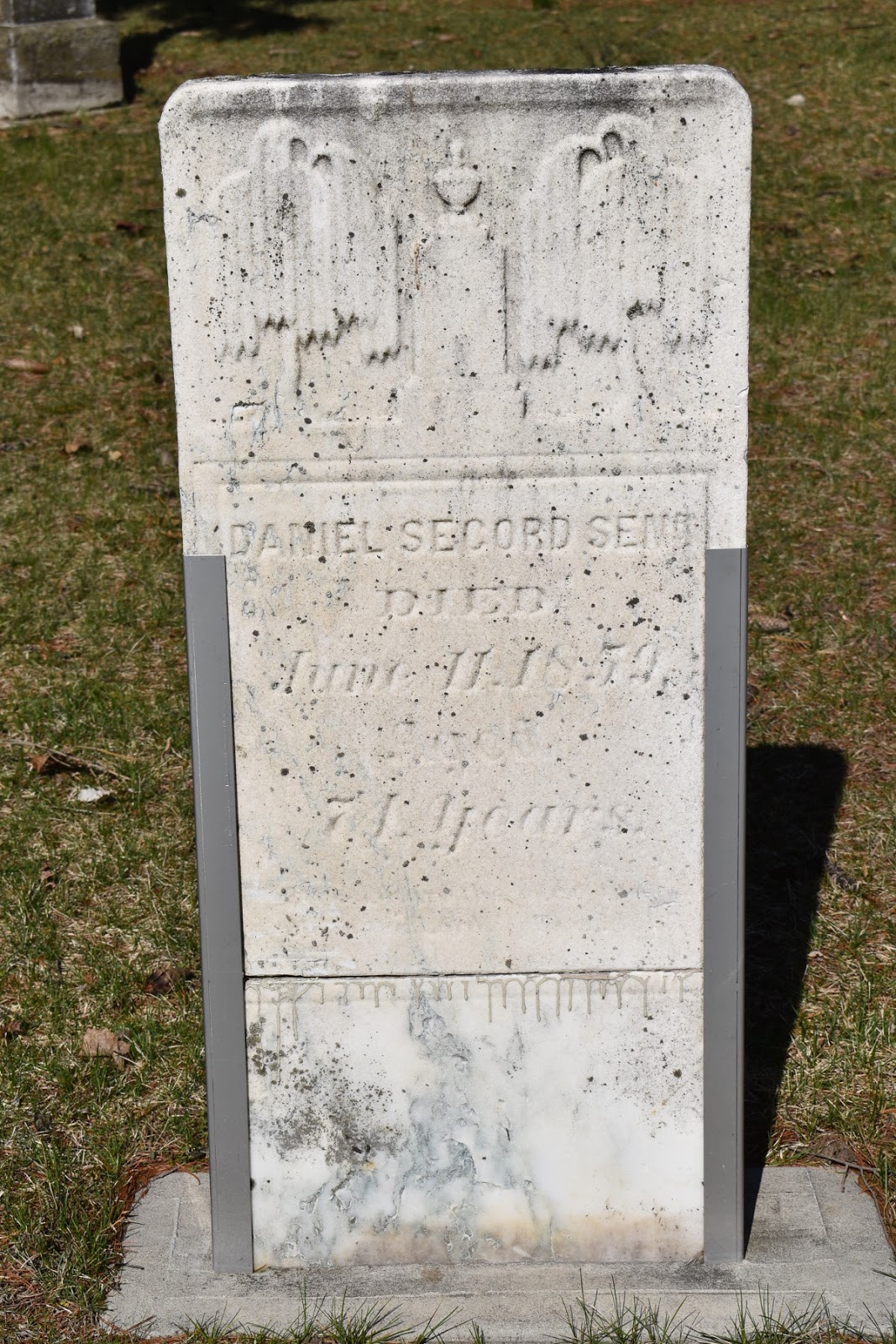
Sunday, August 23, 2020

And Only One Pair of Shoes (Part 1)

In her 1861 letter to Rev. Egerton Ryerson, Elizabeth Spohn describes the arrival
of "five women, thirty-one children, and only one pair of shoes" at Fort Niagara
during the Revolutionary War.
James hesitated a moment. "I was three years old at the beginning of the war, when my mother escaped with us to Niagara. There were five women with thirty-one children. I was the youngest. We made it to a shelter at Fort Niagara in November of '76. A terrible winter. It was a nightmare. We nearly froze to death and arrived half-starved. Mother says we almost died—the lot of us."

Connie Brummel Crook, Acts of Courage

Elizabeth Bowman stirred her large, cast-iron stew pot, looked into the fire, and sighed. It hardly seemed possible. The war was over. Her family had lost everything and for what? She remembered vividly the autumn night when rebels had sacked her home on the Susquehanna River and carried off her husband and oldest boy. So great had been her terror that her youngest had been born prematurely within the half hour. She and her seven remaining children had been left with literally nothing; it it had not been for friendly Indians, they would have starved that winter. In the spring, she had led her brood to the Mohawk River where they had attempted, with several other husband-less Loyalist families, to grow corn and potatoes. The British commandant of Fort Niagara had had them brought off in the fall, five women and thirty-one children with only one pair of shoes among them.

Bruce Wilson, As She Began

Quite a few authors1 have used the story of five women, thirty-one children and only one pair of shoes to illustrate the hardships faced by Loyalist women during the American Revolution. The story has its origins in a letter written in 1861 by Elizabeth Spohn to the Reverend Egerton Ryerson. The letter, which was later included in Ryerson's The Loyalists of America and their Times, is an account of the struggles of Elizabeth's Loyalist grandparents, Jacob and Elizabeth Bowman. Elizabeth describes how her grandfather and uncle were captured, imprisoned, released, and captured again; and how her grandmother and her seven other children eventually arrived at Fort Niagara.

Elizabeth Spohn's letter first appeared in print in 1875 when Ryerson, a Methodist minister, politician, and public education advocate, asked the Christian Guardian to publish the letter along with her obituary. Ryerson also appears to have shared the letter with Dr. William Canniff who included snippets of it in his 1869 History of the Settlement of Upper Canada:

The Rebels, on one occasion, entered a house and stripped it of everything, even the bed on which lay a woman on the point of confinement. But a single sheet was left to cover the woman upon a winter’s night, who, before morning became a mother. In 1776, there arrived at Fort George, in a starving state, Mrs. Nellis, Mrs. Secord, Mrs. Young, Mrs. Buck and Mrs. Bonnar [sic], with thirty-one children, whom the circumstances of the rebellion had driven away.

In the process of researching the experiences of the Secord and Beebe families during the Revolutionary War, I have often encountered references to this letter. It would appear that a plethora of genealogists and family historians have treated the Spohn letter as a definitive source of information about the Bowman family. In doing so they have ignored available primary sources and the historical context. They have forced the facts to fit the narrative, rather than adapt the narrative to reflect the facts.

It should be obvious that a letter written eighty years after the events it describes would have errors. Even Elizabeth Spohn recognized this:

I have no memorandum to refer to. I have just related the tale I have often heard my parents tell, without any exaggeration, but with many omissions.
Part 2 of "And Only One Pair of Shoes" will take a critical look at Elizabeth Spohn's account, and will place her narrative in the context of several primary and secondary sources. But first, the letter as it appeared in Ryerson's The Loyalists of America and their Times, published in 1880:
Ancaster, July 23rd, 1861

Rev. and Dear Sir,—

    I have long wished some person would give the world a true history of that much-traduced and suffering people, the U.E. Loyalists; and I assure you that when your circular came I was greatly rejoiced to learn that they would at least get justice from such an able source as yourself; and if the plain narrative of the sufferings of my forefathers will assist you in the least in your arduous and praiseworthy undertaking, I will be exceedingly gratified.

    My great-grandfather emigrated from Germany in the reign of Queen Anne. He settled near the Mohawk river, at a creek that still bears his name (Bowman's Creek). My grandfather, Jacob Bowman, joined the British army in the French war; at the conclusion of peace he was awarded 1,500 acres of land on the Susquehanna river, where he made improvements until the revolutionary war broke out. The delicate state of my grandmother obliged him to remain at home, while nearly all that remained firm to their allegiance left for the British army.

He was surprised at night, while his wife was sick, by a party of rebels, and with his eldest son, a lad of sixteen years of age, was taken prisoner; his house pillaged of every article except the bed on which his sick wife lay, and that they stripped of all but one blanket. Half an hour after my grandfather was marched off, his youngest child was born. This was in November. There my grandmother was, with an infant babe and six children, at the commencement of winter, without any provisions, and only one blanket in the house. Their cattle and grain were all taken away.

My father, Peter Bowman, the eldest son at home, was only eleven years old. As the pillage was at night, he had neither coat nor shoes; he had to cut and draw his firewood half a mile on a hand-sleigh to keep his sick mother from freezing; this he did barefooted. The whole family would have perished had it not been for some friendly Indians that brought them provisions. One gave my father a blanket, coat and a pair of mocassins. A kind squaw doctored my grandmother, but she suffered so much through want and anxiety that it was not until spring that she was able to do anything. She then took her children and went to the Mohawk river, where they planted corn and potatoes; and in the fall the commander of the British forces at Niagara, hearing of their destitute situation, sent a party with some Indians to bring them in. They brought in five families: the Nellises, Secords, Youngs, Bucks, and our own family (Bowman), five women and thirty-one children, and only one pair of shoes among them all. They arrived at Fort George on the 3rd of November, 1776; from there they were sent first to Montreal, and then to Quebec, where the Government took care of them—that is, gave them something to eat and barracks to sleep in. My grandmother was exposed to cold and damp so much that she took the rheumatism, and never recovered.

In the spring of 1777 my father joined Butler's Rangers, and was with Colonel Butler in all his campaigns. His brother, only nine years old, went as a fifer.

But to return to my grandfather, Jacob Bowman: his captors took him and his son to Philadelphia, where he was confined in jail eighteen months. An exchange of prisoners then took place, and they were sent to New York; from there he, with his son and Philip Buck, started for their homes, not knowing that these homes they never would see again, and that their families were far away in the wilds of Canada. The third evening after they started for their homes, they came to a pond, and shot some ducks for their supper. The report of their guns was heard by some American scouts, who concealed themselves until our poor fellows were asleep, when they came stealthily up and fired. Six shots took effect on my uncle, as he lay with his hat over his ear. Five balls went through it, and one through his thigh. My grandfather and Buck lay on the opposite side of the fire. They sprang into the bushes, but when they heard the groans of my uncle, grandfather returned and gave himself up. Buck made his escape. They then marched off, carrying the wounded boy with them.

They were taken to the nearest American station, where grandfather was allowed the privilege of taking care of his wounded son. As he began to recover, grandfather was again ordered to abjure the British Government, which he steadfastly refused to do. He was then taken to Lancaster jail, with Mr. Hoover. They were there fastened together by a band of iron around their arms, and a chain with three links around their ankles, the weight of which was ninety-six pounds; and then fastened by a ring and staple to the floor. In that condition they remained either three years and a half or four years and a half, until the flesh was worn away and the bones laid bare four inches.

Men, women, and children all went to work, clearing land. There were none to make improvements in Canada then but the U.E. Loyalists, and they, with their hoes, planted the germ of its future greatness. About this time, my father with his brother returned from the army; they helped their father two years, and then took up land for themselves near Fort Erie.

My father married the daughter of a Loyalist from Hudson, North River (Mr. Frederick Lampman); he was too old to serve in the war, but his four sons and two sons in-law did. They were greatly harassed, but they hid in the cellars and bushes for three months, the rebels hunting them night and day. At length an opportunity offered, and they made their escape to Long Island, where they joined the British army. One of his sons, Wilhelmus Lampman, returning home to see his family, was caught by the rebels within a short distance of his father's house, and hanged, because, as they said, he was a Tory.

At the restoration of peace, the whole family came to Canada. They brought their horses and cattle with them, which helped to supply the new country. They settled in the township of Stamford, where their descendants are yet.

My father settled on his land near the fort; he drew an axe and a hoe from Government. He bought a yoke of yearling steers; this was the amount of his farming utensils. Mother had a cow, bed, six plates, three knives, and a few other articles. It was the scarce year, on account of the rush of Loyalists from the States, who had heard that Canada was a good country, where they could live under their own loved institutions, and enjoy the protection of England.

The amount of grain that the U.E. Loyalists had raised was hardly sufficient for themselves; still they divided with the new comers, as all were alike destitute. After planting corn and potatoes, they had nothing left. My father cleared two acres, on which he planted corn, potatoes, oats, and flax; his calves were not able to work, and he had to carry all the rails on his shoulders until the skin was worn off them both. This was the way he made his first fence. In the beginning of May [1789], their provisions failed; none to be had: Government promised assistance, still none came. All eyes turned toward their harvest, which was more than three months away; their only resource was the leaves of trees. Some hunted ground nuts; many lived on herbs; those that were near the river, on fish. My father used to work until near sun-down, then walk three miles to the river, get light wood, fish all night, in the morning divide the fish, carry his share home on his back, which they ate without bread or salt. This he did twice a week, until the middle of June, when the moss became so thick in the river that they could not see a fish; still they worked on, and hoped on every day. My father chopped the logs and they had milk for their breakfast, then went to work until noon; took their dinner on milk; to work again till night, and supped on milk. I have frequently heard my mother say she never was discouraged or discontented; thankful they were that they could eat their morsel in peace.

Their only crime was loyalty to the Government which they had sworn fealty to. The God of Heaven saw all this, and the sword of vengeance is now, in 1861, drawn over the American people (now they know how to appreciate loyalty), and will perhaps never be sheathed again until they make some restitution for the unheard-of cruelties they inflicted upon those most brave and loyal people.

At the close of the war they were liberated. Grandfather was sent to the hospital for nearly a year, but his leg never got entirely well. As soon as he was able to walk, he sent for his family (it had been eight years since he saw them): they had suffered everything but death. Coming in the boats from Quebec, they got out of provisions and were near starving. He never had his family all together again. He drew land near the Falls of Niagara, where he went to work in the woods, broken down with suffering, worn out with age; his property destroyed, his land confiscated, and his family scattered; without money or means, and worse than all, without provisions. Still, to work they went with willing hands and cheerful hearts, and often did he say he never felt inclined to murmur. He had done his duty to God and his country; his own and his family's sufferings he could not help. Theirs was not a solitary case; all the Loyalists suffered. The Government found seed to plant and sow the first year; they gave them axes and hoes, and promised them provisions. How far that promise was fulfilled, you well know; they got very little; they soon found that they had to provide for themselves.

As soon as the wheat was large enough to rub out, they boiled it, which to them was a great treat. Providence favoured them with an early harvest; their sufferings were over, and not one had starved to death. They now had enough, and they were thankful. Heaven smiled, and in a few years they had an abundance for themselves and others.

I have no memorandum to refer to. I have just related the tale I have often heard my parents tell, without any exaggeration, but with many omissions. I have not told you about my father's sufferings in the army, when, upon an expedition near Little Miamac, he and some others were left to carry the wounded. They got out of provisions: went three days without anything to eat, except one pigeon between nine. I will give you his own words. He says: "The first day we came to where an Indian's old pack-horse had mired in the mud; it had lain there ten days in the heat of summer; the smell was dreadful; still some of our men cut out slices, roasted and ate it; I was not hungry enough. The next day I shot a pigeon, which made a dinner for nine; after that we found the skin of a deer, from the knee to the hoof. This we divided and ate. I would willingly, had I possessed it, have given my hat full of gold for a piece of bread as large as my hand. Often did I think of the milk and swill I had seen left in my father's hog-trough, and thought if I only had that I would be satisfied."

Such were some of the sufferings of my forefathers for supremacy. They have gone to their reward. Peace to their ashes!

Elizabeth Bowman Spohn

P.S.—One thing more I must add: My father always said there never was any cruelty inflicted upon either man, woman or child by Butler's Rangers, that he ever heard of, during the war. They did everything in their power to get the Indians to bring their prisoners in for redemption, and urged them to treat them kindly; the officers always telling them that it was more brave to take a prisoner than to kill him, and that none but a coward would kill a prisoner; that brave soldiers were always kind to women and children. He said it was false that they gave a bounty for scalps. True, the Indians did commit cruelties, but they were not countenanced in the least by the whites.

E.S.

1 See also Peter Newman, Hostage of Fortune: The United Empire Loyalists and the Making of Canada; Helen Matthews, Mark of Honour; Merril D. Smith, Women's Roles in Eighteenth-Century American; Alexander Cain, I See Nothing But the Horrors of a Civil War; Walter S. Herrington, Heroines of Canadian History; Janice Potter-MacKinnon, While the Women Only Wept: Loyalist Refugee Women; Don Gillmor and Pierre Turgeon, Canada: A People's History;  Janet Carnochan, History of Niagara; and Gavin Watts, Fire and Desolation: The Revolutionary War’s 1778 Campaign as Waged from Quebec and Niagara Against the American Frontiers.

Wednesday, June 24, 2020

The Cemetery on the Nith: George and Edward Burgess

Edward Burgess 1788-1841

One of the earliest New Brunswickers to settle in Blenheim Township was Edward Burgess. Edward brought his young family to Upper Canada from New Brunswick about 1820. Twelve years later he was joined in Blenheim Township by his brother George.

Edward Burgess was born about 1788 in Norton, Kings, New Brunswick, the youngest child of John Burgess (1750-1789) and Jane White (1752-1797). John died shortly after Edward's birth, while Edward's mother died when he was eleven.  About 1809, Edward married Rachel Doyle (1791-1861), daughter of Hugh Doyle (1750-1824). In 1816, Edward received a grant of 260 acres in Sussex Parish, on the same day his brother John received his grant.

Edward and Rachel had ten children, all of whom survived into adulthood. Their oldest, Hugh, was born about 1809 in Sussex, while their youngest, Rachel Mary, was born in Blenheim on 13 Jan 1832. Two of Edward and Rachel’s children married cousins, children of Edward's brother George.

On 20 Jul 1820, Edward sold his grant of 260 acres to James Secord for £200. Edward and Rachel appear on the passenger manifest for the brig Nancy which arrived at New York from Saint John on 12 Aug 1820. No children are listed on the manifest, however, it is known that their son John Chalmers Burgess was born in New Brunswick in 1819, while their next child, Samuel Goselin Burgess, was born in Upper Canada in 1822.

Edward died in 1841 and was buried at Riverside Cemetery beside the Nith River. Rachel married John Beriah Tree (1781-1880) on 15 Jul 1843 and was living in East Zorra, Oxford in 1852 with her husband and two youngest sons. When she died in 1861 in East Zorra, she was buried at Riverside. None of their children were buried at Riverside, however, two sons are buried at nearby Drumbo Cemetery.

George Burgess 1782-1863
Edward's brother George, was born in New York City in October of 1782. He was baptised at Trinity Church on 27 Oct 1782, the same place his sister Elizabeth had been baptised two years earlier on 13 Aug 1780.

George married Elizabeth Wilcox (1791-1855) about 1810 in Norton, Kings, New Brunswick.  Their first child, John Henry Burgess, was born in 1812. George and Elizabeth had eleven children. All except the youngest were born in New Brunswick.

George was granted 324 acres in Sussex Parish, Kings, New Brunswick in 1813. After the birth of his son Thomas in 1831 but before the birth of his daughter Maria in 1834, he moved his family to Upper Canada.

The 1857 Tremaine Map shows various members of the Burgess family owning Concession 6 Lot 12 south of the village of Drumbo as well as the SE 1/4 of Concession 6 Lot 13 and the NW 1/4 of Concession 5 Lot 12.

George Burgess died in Blenheim in 1863 and was buried beside his wife Elizabeth at Riverside. Three children of George and Elizabeth are also buried there. Two sons and a daughter are buried at Drumbo Cemetery.

Edward and George’s father, John Burgess, was born in Monmouth, New Jersey about 1750. John was a Loyalist who during the Revolutionary War served in the New Jersey Volunteers, a British provincial military unit raised in New York in 1776 by Cortlandt Skinner. John served in the 1st Battalion and likely joined when the battalion was in Monmouth, New Jersey in early 1777.

When the British Army pulled back to New York later that year, the New Jersey Volunteers were assigned garrison duty on Staten Island.

On August 22, 1777, John was captured during the Battle of Staten Island, a failed raid by Continental Army troops commanded by Major General Sullivan. John was one of 80 prisoners taken when Sullivan’s forces attacked the 1st Battalion from behind at dawn.

Edward Moran, Sandy Hook Lighthouse,
Oil on Canvas, 1876
John spent the next two years in prison. Upon his release he returned to New York and to active duty with the New Jersey Volunteers. John was stationed at the Sandy Hook Lighthouse until the Spring of 1780 when his company returned to Staten Island.

John's marriage to Jane White likely occurred prior to his enlistment. Their first child, Sarah, was born about 1778, possibly while her father was a prisoner. Their daughter Elizabeth was born in New York in 1780, followed by George in 1782. John and Jane's youngest children, John and Edward, were born in New Brunswick after the war.

In August 1783, Sir Guy Carleton received orders from London to disband the provincial corps. Officers would be retired on half-pay, grants of land would be provided in Nova Scotia to any willing to settle there, and provisions would be supplied for one year.

The 1st Battalion of the New Jersey Volunteers and their families departed New York on 15 Sep 1783 on the Duke of Richmond and arrived at Saint John Harbour on 27 Sep 1783. They were officially disbanded on 24 Oct 1783.

John and his family, however, were on board the Ann which departed New York on 8 Jul 1783. In June 1783, John had received a commission as a First Lieutenant, however, this was not a military appointment. Refugees departing New York for Nova Scotia were organized into "militia" companies, although the companies had no military function. John was assigned as First Lieutenant in Captain Robert Chillas's company.

John David Kelly, United Empire Loyalists Landing at
Saint John, New Brunswick,
c. 1935
The Ann arrived at Saint John Harbour on 24 Jul 1783. Upon arrival, John would have been given “two pairs of stockings, two pairs of mitts, two pairs of shoes, also an axe and spade.” The Fort Howe commissariat would also provide provisions until the following October consisting of bread or flour, salted beef or pork, oatmeal, butter, dried peas, suet and salt.

John drew a town lot in Parr Town and would have lived there that winter under canvas or in a crude hut. Tents were covered with spruce boughs to provide some protection from the cold. The following spring, John was granted 200 acres in Norton Parish, Kings County.

Regrettably, John died in 1789, only a few years after arriving in New Brunswick. His daughters Sarah and Jane married and remained in New Brunswick, as did his son John. In the 1851 Census, the younger John is listed as a farmer in Studholm Parish, Kings County. With him is his wife, Margaret McDonald, and three of their adult children. It is believed that John died on March 19, 1862, however, the source for this date is unclear.

It is also possible that John died in December 1855. A coroner's inquest held at Studholm into the death of a John Burgess concluded that John was a "confirmed drunkard" who "committed suicide by cutting his own throat." This, however, may refer to the John Burgess who came to New Brunswick in 1835 and was also living in Studholm in 1851.

While John, the father of George, Edward, and John, did not live to see his children reach adulthood, his numerous descendants can still be found in Kings County, New Brunswick and Oxford County, Ontario.

Sunday, June 21, 2020

Portraits of Laura

This cameo portrait of Laura Secord was likely
created for marketing purposes in 1950.

When my students are assigned a project on a famous person in Canadian History, many of them will choose Laura Secord. Laura Secord née Ingersoll was a heroine of the War of 1812, who walked 32 kilometres out of American occupied territory to warn the British about an impending surprise attack. Invariably, my students include the above cameo portrait in their presentations, believing wholeheartedly that it is an authentic portrait of Laura.

Photograph of Laura Secord,
c. 1865, McCord Museum


But it isn't. The only authentic images of Laura are two photographs of her taken about 1865 when she was in her nineties. How the cameo portrait came to be associated with Laura involves chocolate and a bit of family mythology.

David Hemmings, author of Laura Ingersoll Secord: A Heroine and Her Family believes that the portrait depicts Phoebe Grace Laskey (1878-1924), a descendant of Laura Secord's brother-in-law David Secord. Laura Secord Candy Shops Limited, founded in 1913, adopted this portrait for marketing purposes in 1950.

Phoebe Grace Laskey was the daughter of William John Laskey (1846-1934) and Grace Guymer (1860-1938). William's mother, Phoebe Ann Secord (1821-1914), was the daughter of Stephen Secord (1796-1882) and the granddaughter of David Secord (1759-1844).

According to an article published in the Windsor Daily Star in 1936, Phoebe Grace Laskey and her sisters were "chums" of the artist Mildred Peel, sister of noted Canadian artist Paul Peel (1860-1892). Mildred Peel is best known for the portrait of Laura Secord that hangs at the Ontario Legislature, and for the bust of Laura that adorns the Secord monument at Drummond Hill Cemetery on Lundy's Lane in Niagara Falls. While the article does not mention a cameo portrait, it does claim that Phoebe was the model for the bust.

The Windsor Daily Star article, however, gets a number of important facts wrong. Laura Ingersoll was not married to Stephen Secord but to James Secord (1773-1841). The article claims that Phoebe's great-great-grandmother was Phoebe Ingersoll, an aunt of Laura Ingersoll, but there is no evidence to support this. Laura's father, Thomas Ingersoll (1750-1812) had only one sister and her name was Sarah (1747-1725).

Phoebe Grace Laskey's paternal grandfather was John Laskey (1815-1856) not William Laskey as the article claims. John Laskey emigrated to Illinois after his marriage to Phoebe Ann Secord. When he died, his son William was sent back to Canada to live with William's maternal grandfather, Stephen Secord.

Mildred Peel, Mrs. J. R. Peel,
Oil on Canvas, c. 1875,
Museum London
Mildred Peel was born in London, Ontario in 1856. Her father, John Robert Peel (1830-1904), was a sculptor and art educator who owned the London Marble Works. Mildred and her brother Paul studied art with their father and may have helped with the cutting and carving of gravestones and monuments. A portrait of her mother, Amelia Margaret Hall (1832-1890), painted when Mildred was about 19, is in the collection of Museum London.

Mildred attended the Philadelphia Academy of Fine Arts from 1880 to 1883 where she became familiar with the work of American realist painter Thomas Eakins. After briefly returning to London she decided, like her brother, to continue her studies in Paris. Mildred possibly studied at the studio of Orientalist artist Jean-Joseph Benjamin-Constant. Summers were spent sketching and painting with her brother in Pont-Aven, Brittany.

While Paul remained in France, dying suddenly in 1892, Mildred returned to Canada where she shared a studio in Toronto with her sister Clara. Among her early commissions was a series of portrait busts for the Toronto Normal School.

Casting master for Mildred
Peel's bust of Laura Secord
at the Niagara Historical
Society Museum
In 1901, Mildred received the commission from the Ontario Historical Society for a bronze bust of Laura Secord. In its annual report, the Ontario Historical Society stated that, "Miss Peel has been very successful with the likeness with the assistance of a granddaughter of one of Laura Secord's sisters who bears a striking likeness to the Ingersolls and particularly to Laura Secord."

Was Phoebe Grace Laskey the model? Phoebe was 23 at the time. The bust depicts Laura as a woman in her late thirties, the age at which she made her historic trek in June of 1813. The casting master is part of the collection of the Niagara Historical Society Museum in Niagara-on-the-Lake.

Was a great-niece of Laura the model? Possibly. Laura had numerous siblings who settled in Canada.

Mildred Peel, Laura Secord,
Oil on Canvas, 1905,
Government of Ontario
In 1905, the Government of Ontario purchased a portrait of Laura Secord from Mildred. The painting is clearly based on the photograph of Laura, a copy of which was in the possession of the Laskey family, however, Laura's many grandchildren undoubtedly also had copies.

In 1936 an X-ray examination of the canvas revealed that Mildred had painted the Secord portrait over top a portrait of her future husband. This created a minor scandal, although it was common for artists to paint over unsold works. The portrait was sent to storage and forgotten until rediscovered in 1978. When a study for the portrait was exhibited at Museum London in 2015, strong similarities were noted between the study and Mildred's earlier portrait of her mother.

Mildred married former Premier of Ontario George William Ross (1841-1914) in Toronto in 1907. Prior to  becoming Premier in 1899, Ross had served as the Minister of Education in the Liberal government of Sir Oliver Mowat. As Minister of Education, he commissioned Mildred to create a series of portrait busts for the Toronto Normal School. When Ross was knighted in 1908, Mildred became known as Lady Ross. After her husband's death in Toronto, Mildred moved to Santa Barbara County, California where she died in 1920.

Benson Lossing, Laura Secord, 1869

Apart from her photograph, the earliest representation of Laura Secord appears in Benson Lossing's The Pictorial Field-book of the War of 1812, published in 1869. This line drawing was obviously based on the photograph but shows Laura with a much rounder face. The drawing also appears in a number of later works including George Bryces's Laura Secord: A Study in Canadian Patriotism and John Ross Robertson's monumental Landmarks of Toronto published in 1914.

Photograph of Laura Secord, c. 1865,
Niagara Falls Public Library

A photograph of Laura Secord was published in 1898 in the second edition of Sarah Anne Curzon's The Story of Laura Secord. Sarah Anne Curzon née Vincent (1833-1898) was a poet, playwright, journalist, and pioneer for women's rights whose goal was "to rescue from oblivion the name of a brave woman, and set it in its proper place among the heroes of Canadian history." Subtle differences suggest that this photograph is not a cropped version of Laura's full-length portrait.

Emma Currie also used this photograph in The Story of Laura Secord and Canadian Reminiscences, published in 1900, and dedicated to Sarah Anne Curzon.

Lorne Kidd Smith, Laura Secord Warning Lieutenant Fitzgibbon, June 1813,
Oil on Canvas c. 1920, Library and Archives Canada

In the early 1920s, Lorne Kidd Smith painted Laura giving her warning to Lieutenant Fitzgibbon. Laura appears remarkably undishevelled for someone who has just walked 32 kilometres through the bush. The soldier standing behind her sports an impressive mustache that in 1813 was decidedly against army regulations.

Charles W. Jeffreys, Laura Secord Tells Her Story to Fitzgibbon, 1813,
1945, Library and Archives Canada

Historical painter and illustrator Charles William Jeffries created two Laura Secord illustrations. The first shows Laura about to cross a stream on a fallen tree, while the second shows a sitting, bedraggled, and exhausted-looking Laura giving her warning to Lieutenant James Fitzgibbon.

Canada Post has issued two stamps featuring Laura. The 1992 stamp depicts Laura running. She has reddish hair and appears much younger than 37. The 2013 stamp is a more accurate depiction of what a 37-year-old woman in Upper Canada would have been wearing in 1813.

Finally there is the mysterious cameo portrait that Laura Secord Candy Shops Limited used to market its chocolate. The portrait depicts a delicate young woman clad in a revealing white dress, with "centre-parted hair in a wavy, yet demure arrangement." In Heroines and History, Colin Coates and Cecillia Morgan observe that, "this Secord would definitely have employed servants, either black or white; her unseen hands would not have been calloused or darkened by manual labour."

There is no provenance for the cameo portrait before 1950. Mildred Peel and the "Laskey girls" would hardly have been chums given the differences in their ages, however, as the Laskey family lived in the same area of London as the Peel family, it is remotely possible that Mildred painted Phoebe's portrait during one of her visits home. But why then was there no mention of the portrait in the Windsor Daily Star article?

Does the cameo portrait depict a great-niece of Laura Secord? Again it is possible, but more likely the portrait is simply the creation of the Laura Secord Candy Shops Limited.   

Sources:

Baker, Victoria. Paul Peel: A Retrospective 1860 - 1892. London Regional Art Gallery, 1986.

Boyko-Head, Christine. "Laura Secord Meets the Candyman: The Image of Laura Secord in Popular Culture." Slippery Pastimes: Reading the Popular in Canadian Culture. Joan Nicks and Jeannette Sloniowski, editors. Wilfred Laurier University Press, 2002. p. 61-79

Bryce, George. Laura Secord: A Study in Canadian Patriotism. Manitoba Free Press Company, 1907.

Coates, Colin M. and Morgan, Cecilia. Heroines and History: Representations of Madeleine de Vercheres and Laura Secord. University of Toronto Press, 2002.

Currie, Emma A. The Story of Laura Secord and Canadian Reminiscences. William Briggs, 1900.

Curzon, Sarah Anne. The Story of Laura Secord, 2nd edition. Lundy Lane Historical Society, 1898.

Hemmings, David. Laura Ingersoll Secord: A Heroine and Her Family. Bygones Publishing, 2010.

Knowles, Norman. Inventing the Loyalists: The Ontario Loyalist Tradition and the Creation of Usable Pasts. University of Toronto Press, 1997.

Lossing, Benson John. The Pictorial Field-book of the War of 1812. Harper & Brothers, 1869.

Poole, Nancy Geddes. The Art of London: 1830-1980. McIntosh Gallery, 2017.
https://ir.lib.uwo.ca/mcintoshpub/1

"Report of Monuments and Tablets Committee," Annual Report of the Ontario Historical Society, 1901 and 1902. Toronto: Ontario Historical Society, 1903.

Robertson, John Ross. Robertson's Landmarks of Toronto, Vol 6. 1914.

"Bronze Busts and Bearded Ladies: Mildred Peel's Artistic Legacy" http://www.guidetags.com/friends-of-laura-secord/explore/fls-trillium-pois/939-bronze-busts-and-bearded-ladies-mildred-peel-s-artistic-legacy

"Mildred Peel 1856-1920." A Driving Force: Women of the London, Ontario, Visual Arts Community, 1867 to the Present. McIntosh Gallery, London https://mcintoshdrivingforce.ca/biography/mildred-peel/

Monday, May 18, 2020

The Wartman Mythology

Rožmbert Castle, South Bohemia, Czech Republic 

In “Family History, Family Mythology,” I wrote about how stories passed down through generations can lead the genealogist astray. While there is often a kernel of truth in these stories, sometimes the stories are complete fabrications. For example, there is absolutely no evidence that my grandfather Alfred George Jacques is the descendant of an aristocrat who fled to England during the French Revolution. Nor did my ggg-grandfather William Cooke have three sailing ships, two slaves and £80,000 when he came to Newfoundland in 1817. He was, however, part-owner of the brig Friends, and he did manage a fishing station on Placentia Bay where the men who actually did the fishing worked in harsh conditions.

While researching “The Cemetery on the Nith: The Secords of Blenheim,” I uncovered an impressive fabrication concerning Susanna Wartman, the wife of John Secord (1757-1830). There is general agreement among Secord researchers that Susanna was the daughter of Abraham Wartman. Abraham, like the Secords, had settled on the Susquehanna near Tunkhannock, Pennsylvania, several years before the Revolution. Most researchers also agree that Abraham married Catherine Bowman, but scattered among the many online genealogies can be found the name Christianna Wessenberg.

The story goes that Christianna Wessenberg was the only child of eminent scholar Bartholdt Wessenberg and Louisa of Rosenberg, daughter of the Prince of Rosenberg. When Christianna fell in love with the cooper Abraham Wartman, she and Abraham eloped and fled to America to escape the wrath of her father.

Romantic but not true.


In the Dr. H. C. Burleigh fonds at Queen’s University Archives in Kingston, Ontario is a manuscript written by Alice Mackay1 that contains detailed information about the Wartman family. Mackay refers to notes written by John Wesley Purdy (1829-1910), a great-grandson of Abraham Wartman, and quotes the following passage verbatim:

Bartholdt Wessenberg, of the House of Wessenberg, married Louise of Rosenberg, August 23rd or 28th, 1737, was a notable student, held the astronomy chair in a German university, also a classic scholar and conversed in five languages. Louise was the second daughter of the Prince of the House of Rosenberg, born in Rosenberg Castle, 1720, died 1746. Christianna Wessenberg, only child of Bartholdt Wessenberg, born September 17th, 1738; not having a son, her father educated her highly. In 1758 she married Abraham Wartman, born in Amsterdam, Holland, 1735, came of a respectable Dutch family, and was a cooper by trade. He met Christianna Wessenberg when he went to her father’s house, to make tubs and buckets; it was love on sight. They eloped and married. Tradition allows him much more than the usual share of manly beauty, and she was very fair. Her father disinherited her. They fled from his wrath to America, arriving in New York in 1758. They finally settle at Tunkhannock, in the Wyoming Valley on the Susquehanna River, Pa. Five sons and three daughters were born to them, and they prospered until the Revolutionary war broke out. Siding with England they suffered much persecution. Finally being obliged to leave their home, they came to Canada by the way of Cleveland, then to Niagara, where they stayed some time and two eldest daughters were married. They proceeded to Montreal afterwards to Kingston, where they took U.E.L. farms on the Front Road. A faithful soul, worthy of mention, was Christianna’s maid, Jerusha, who fled with her mistress and spent her life in her service.
Wartman Family Tree

With the manuscript is a Wartman family tree that was reproduced in the Kingston Whig-Standard to illustrate an article about the growing hobby of genealogy. The family tree goes as far as providing birth dates for Bartholdt and Christianna; and giving additional details about Rosenberg Castle.

In her manuscript, Mackay disputes Purdy’s narrative. Years before online research was possible, Mackay showed proof that Abraham Wartman had sailed from Rotterdam to Philadelphia with his parents and sister in 1731. She records that Abraham settled on the Susquehanna about 1769, that he served with Butler’s Rangers from 1777 until 1779, that he and his family were at Coteau-du-Lac west of Montreal for the rest of the war, and that he was granted land at Cataraqui2 in 1784.

Mackay's sources include the claim for losses that John Wartman made in 1788 on behalf of his deceased father. In his evidence to the Loyalist Claims Commission, John stated his father was born in Germany, that Abraham had come to America at a young age, and that John’s mother’s name was Catherine.

Is there a kernel of truth to the Wessenberg myth? Regrettably, there is little evidence to suggest that Bartholdt Wessenberg, Louise of Rosenberg, or Christianna Wessenberg ever existed.

The Neues Allgemeines Deutsches Adels-Lexicon,3 the German equivalent of Burke’s Peerage, does have an entry for Wessenberg. The seat of the aristocratic Wessenberg family was in Freiburg im Breisgau in southwest Germany. Historically, Freiburg im Breisgau was part of the Vorlande, which was ruled by the Austrian Habsburgs until 1797.

The Wessenberg family, however, were minor nobility. The family did produce two notably individuals: the liberal Catholic churchman Ignaz Heinrich von Wessenberg (1774-1860), and his elder brother, the Austrian diplomat and statesman Johann Philipp Freiherr von Wessenberg-Ampringen4 (1773-1858). There was certainly never a Prince of the House of Wessenberg.
 

Louisa’s purported family has a far more illustrious history. The Rosenbergs were a prominent Bohemian noble house that played an important role in Czech medieval history from the 13th century until the early 17th century. The family held two castles in South Bohemia: Rožmberk and Český Krumlov. Rožmberk Castle was built in the first half of the 13th century either by Vitek the Younger of Prčice, or by his son Vok of Prčice, who later styled himself Vok of Rožmberk. The town and castle of Český Krumlov was ceded to the Rosenberg family in 1302 by Wenceslaus II.

In 1602 Peter Vok of Rosenberg sold Český Krumlov to the Habsburg emperor. When Peter died childless in 1611, the Rosenberg line became extinct. In his will Peter bequeathed Rožmbert castle and its estates to his nephew Johann Zrinski of Seryn (1565–1612), son of his sister Eva Rosenberg (1537–1591).

Members of the
Rožmberk family held posts at the Prague royal court, but there was never a Prince of the House of Rosenberg. In fact, when Louisa was allegedly born, Rožmberk Castle was held by Karl Cajetan de Longueval, Count of Buquoy.

The Palatinate during the
War of the Spanish Succession
Abraham Wartman’s story is interesting enough without the embellishments. Abraham, the son of Hans Adam Wartman (1703-1770) and Maria Elizabetha (1700-1787) was born in Germany a few years before his family emigrated to Pennsylvania from the Palatinate. They sailed from Rotterdam aboard the Samuel, arriving at Philadelphia on 16 Aug 1731. The family settled in New Hanover, Montgomery, Pennsylvania where Abraham was confirmed in the Lutheran Church in 1743.

Abraham came north to the Mohawk Valley in New York where he married Anna Catharina Baumann5, daughter of Jacob Baumann and Elizabeth about 1755. Catharina had been born about 23 years earlier on her father’s farm in the area known as German Flatts.

Catharina's father, Jacob, the son of Johann Adam Baumann (1665- ?) and Susanna Catharina Dresch, was born about 1707 in Baccarach am Rhein in the Electoral Palatinate, part of the Holy Roman Empire. In 1709, Jacob and his parents became one of thousands of refugee families known as the "Poor Palatines." The Palatinate had been ravaged during the Nine Years War (1689-1697) and was plundered again in 1707 during the War of the Spanish Succession. This devastation was followed by the terrible winter of 1709 — three months of deadly cold that destroyed orchards and vineyards, and caused the total loss of the winter wheat crop.

Suffering from poverty and hunger, and mistakingly drawn by what they thought was promise of free land in the American Colonies, thousands of refugees fled down the Rhine to Rotterdam, then waited for passage across the North Sea to Great Britain. More than 13,000 arrived in London during the spring and summer of 1709, overwhelming British resources.

The following year, ten ships carried about 2,800 refugees to New York. Upon their arrival most were assigned to two work camps on either side of the Hudson River about 60 km downriver from Albany. At East Camp, the refugees were expected to work off their passage producing naval stores:

When their houses shall be built, and the ground cleared for making their settlements they shall then be Employed in the making of Turpentine Rozin Tarr and Pitch, and that this we beneficial not only to the said Palatines but to this Kingdom.6
When this venture failed in 1712, a group of refugee families left East Camp for the Schoharie Valley. The Simmendinger Register,7 a list of Palatine families in New York published in 1717, shows Jacob's family settled at Hartmansdorf, one of seven settlements established in the Schoharie Valley.

Burnetsfield Patent on the Mohawk River

About 1723, Jacob's family moved to the Burnetsfield Patent on the Mohawk River west of Little Falls. Despite his age, Jacob was one of the original patentees, and was given title to Lot 27 containing 100 acres on the south side of the Mohawk on 30 Apr 1725. Sometime after 1736, Jacob purchased land in what is now Montgomery County, New York, on Bowman’s Creek, the main tributary of Canajoharie Creek. As a result, Jacob escaped the German Flatts Massacre in 1757 during the Seven Years War.

Catharina Baumann was the second of nine children of Jacob Baumann and his wife Elizabeth. Catharina is named in her father’s will, dated 6 Jan 1757, as Catharina Wartman, but exactly when she married Abraham is unclear. Also unclear is the exact number of their children.

There is no doubt that Susanna (1757-1842) and her brothers Peter (1765-1824), John (1767-1798) and Barnabas (1772-1858) were children of Abraham and Catharina. Mackay provides a birth date of 16 May 1757 for Susannah, but this has not be confirmed. Peter, John, and Barnabas all name their father in their respective Upper Canada Land Petitions. There is also some evidence for a son, Horace, born about 1770 who died in 1784. Mackay also includes a daughter, Jerusha, born about 1761, who married a John Comer.

Another daughter, Christina, was baptised at the Lutheran Trinity Church of Stone Arabia on 15 Mar 1756. Mackay does not include this child in her manuscript, but does record a Christianna, born about 1769, who married a John Courtland.

Subsistence lists spanning the period for 1779 to 1784 support the idea that there were two daughters who married while the family was at Coteau-du-Lac. It is highly unlikely that a daughter born in 1769 would have married during this time period.

In the claim for losses, John Wartman states, "The Eldest brother of all was killed in Service in 1778." This is most likely the Adam Wartman who appears on the "List of Persons employed as Rangers in the Indian Department June 15, 1777," and who is thought to have died in June 1778.

Adam does not appear in Mackay's manuscript, however, she does include a child named Bartholdt who was born in 1763 and died in 1778. Clearly Bartholdt is Adam. It is interesting to note that although Mackay refutes Purdy's claim that Catharina was the daughter of Bartholdt Wessenberg, she perpetrates the myth by accepting that there was a child named Bartholdt.

Reduced version, published in 1795, of the 1792 Reading
Howell Map of Pennsylvania. The map shows Bowman's
Creek and Tunkhanoc [sic] Creek north of Wilkes-Barre.

In his claim for losses, John Wartman records that his family settled on the Susquehanna River “seven or eight years before the war.” The Revolutionary War began in 1775 so Abraham could have been on the Susquehanna as early as 1767, although 1771 is more likely. Catharina’s younger brothers George Adam Baumann and Jacob Baumann (1738-1815) settled at about the same time George and Jacob’s farms were located at the mouth of Bowman’s Creek near Tunkhannock. Another early settler was John Secord's father whose farm was two miles upriver from Tunkhannock.

Abraham appears on the “Up the River” Tax Assessment List in 1776, as does Catharina's brothers and her future father-in-law.

The Oneidas at the Battle of Oriskany by Don Troiani
In the spring of 1777, Abraham and Adam, left their farm on the Susquehanna and travelled to Fort Niagara to join the British. Abraham and Adam appear on the "List of Persons employed as Rangers in the Indian Department" dated 15 Jun 1777. When John Butler received permission to form a corps of rangers, Abraham enrolled and appears on the pay list for Walter Butler's Company from 24 Dec 1777 to 24 Oct 1778.

Abraham and Adam would likely have been present at the Siege of Fort Stanwix, and at the Battle of Okiskany on August 6, 1777. The following year Abraham would have fought at the Battle of Wyoming on July 3, 1778, and may have been present at the Cherry Valley Massacre on November 11, 1778.

The History of Luzerne, Lackawanna and Wyoming Counties, published in 1880, records that Adam Wartman "was shot during a raid by a patriot scouting party," and provides the following details:

Zebulon Marcy was with one of these scouting parties a short distance above Tunkhannock ... "a tory by the name of Adam Wortman (a Dutchman) came out of his house armed with a gun. His wife8 called to him, 'Shoot, Adam! Shoot!' Adam fired, and the ball struck an old fashioned iron tobacco box in the vest pocket of Marcy and lodged, making an indentation of the size of the bullet but doing no other damage. One of the party fired, giving Wortman a mortal wound.

Other sources such as the "Early History of Putnam Township, Luzerne County" record that this incident occurred a few days before the Battle of Wyoming. These sources focus on Zebulon Marcy (1744-1824) who had settled at Tunkhannock before the Revolution but unlike many of his neighbours was a Patriot. In the spring of 1778 he had moved his family to the relative safety of Forty Fort where his daughter was born nine days before the Battle of Wyoming. Zebulon presumably was still out scouting when the battle occurred.  

In the summer of 1778, Catharina and her children, like many of their neighbours, became Loyalist refugees. In his 1788 claim for losses, John Wartman reported:

He [Abraham] had mare & colt & Horse, yoke of oxen do of yearling, 2 Heifters, Sheep, Hogs, furniture & utensils. These things were taken soon after his Father & eldest Brother joined the Brit.—Witness & his Mother were at home & were obliged to quit & the Rebel took all the Things above mentioned.
It is likely Catharina and the younger children "were obliged to quit" when Butler's Rangers withdrew back to Tioga after the Battle of Wyoming. From Tioga they would have then made there way to Fort Niagara.

Canal and Fort at Coteau-du-Lac
Abraham was discharged from Butler's Rangers in 1779 and sent with his family to Montreal. He appears on the "lists of Loyalists provisioned gratis" in the summer and fall of 1779. A year later he is at Coteau-du-Lac, where in 1779, Governor Haldimand had ordered the construction of a canal at Coteau-du-Lac. In his claim, John Wartman stated his father was at Coteau-du- Lac as an artificier, so likely participated in the construction of the canal. Provisioning lists suggest that once the canal opened, Abraham joined Herkimer's Batteau Service which moved supplies for Fort Niagara and other posts up the St Lawrence by batteau to Carleton Island.

Once the war ended, Abraham was granted 100 acres at Cataraqui. Abraham and his son Peter and John appear on the Muster of Loyalists & Disbanded Soldiers in Township No. 1 (Cataraqui) dated 8 Oct 1784. The muster notes that the family is on their land and that Peter and John have "gone to Coteau-du-Lac for their crop." The muster shows that Abraham had two male children living with him at that time, presumably Horace and Barnabas.

Abraham died at Cataraqui in 1787. Catharina survived him since John mentions her in the claim for losses. 

Susanna Wartman would have first met John Secord when the Secords settled on the Susquehanna. The two were separated when John left the Susquehanna in the spring of 1777 to join the British at Fort Niagara, but they became reacquainted when Susanna's family left the Susquehanna for Fort Niagara a year later. John and Susanna presumably married at Fort Niagara after John's discharge from Butler's Rangers in October 1778, but before her family were sent to Montreal in 1779.

The following year, John and Susanna were with the group of families that began farming on the west side of the Niagara River, a group that included John's father and two of his uncles. The first of John and Susanna's seven children was born in 1780. By the time John and Susanna appear on the 1787 List of Disbanded Troops and Loyalists at Niagara they had three children and 12 acres of cleared fields.

During the War of 1812, John and Susanna suffered the loss of their home when the Americans pillaged and burned the town of Niagara as well as some of the neighbouring farms. John claimed £2222 in damages after the war.


John died in Kingston in 1830. Susanna died on 18 Nov 1842 at the home of her daughter Mary in St. Catharines. 


1 Probably Alice Ruth Higgins (1896- ?), wife of Douglas Mackay. Douglas Mackay (1900-1938) was the author of The Honorable Company: A History of the Hudson's Bay Company, published in 1936. A second edition, revised by Alice, was published in 1949. The Wartman manuscript was likely written when Alice was an employee of James Richardson and Sons, whose founder, James Richardson (1819-1892) married Susanna Wartman (1831-1915), a great-granddaughter of Abraham Wartman.
2 Cataraqui became Kingston in 1788.
3 New General German Aristocracy Lexicon
4 Frieherr, the German equivalent of Baron, was considered part of the lower nobility or Niederer Adel.
5 Anglicized as Catherine Bowman.
6 "Report of the Board of Trade on the Settlement of Additional Palatines in New York." reprinted in O'Callaghan, Edmund Bailey, The Documentary History of the State of New York, Vol. 3. Albany: Weed, Parsons & Co., 1850, p. 384
7 Reprinted in Knittle, Walter Allen. Early Eighteenth Century Palatine Emigration: A British Government Redemptioner Project to Manufacture Naval Stores. Philadelphia: Dorrance, 1937
8 Likely his mother or sister because if Adam was born in 1763 then he would have been about 15 at the time of his death.


Sources:

Barker, William V. H. Early Families of Herkimer County, New York: Descendants of the Burnetsfield Palatines. Genealogical Publishing Co., Inc., Baltimore, Maryland, 1986

Dr. H. C. Burleigh fonds. Queens University Archives, Kingston.

Jones, J. Kelsey. Loyalist Plantations on the Susquehanna

Jones, Wayne V. The Stull Family: Julia Ann Stull (1814-1872) and her Ancestors. Self-published.

Knittle, Walter Allen. Early Eighteenth Century Palatine Emigration: A British Government Redemptioner Project to Manufacture Naval Stores. Philadelphia: Dorrance, 1937


Crowder, Norman K. Early Ontario Settlers: A Source Book. Baltimore: Genealogical Publishing Company, 1993.

Murray, Louise Welles. A History of Old Tioga Point and Early Athens, Pennsylvania. Raeder Press, Wilkes-Barr, Pennsylvania, 1908

Otterness, Philip. Becoming German: The 1709 Palatine Migration to New York. Cornell University Press, Ithica, New York, 2004

Penrose, Maryly B. Baumann/Bowman Family of Mohawk, Susquehanna & Niagara. Liberty Bell Associates, Franklin Park, New Jersey, 1977

Watt, Gavin K. Loyalist Refugees: Non-Military Refugees in Quebec 1776-1784. Global Heritage Press, Milton, Ontario, 2014

Friday, May 8, 2020

A Secord Mystery

Gravestone of Daniel Secord (1826-1857) at Mount
Pleasant Pioneer Cemetery near Brantford, Ontario
For many years I've been curious about one of the 19th century gravestones found in Mount Pleasant Pioneer Cemetery near Brantford, Ontario. The gravestone commemorates Daniel Secord who died on 9 May 1857 at the age of 31. What is unusual is that no Secord researchers, of which there have been many, have conclusively connected Daniel to any branch of the extensive Secord family.

Sketch of the Haldimand Tract by Thomas Parke
dated 1843 (Source: Archive of Ontario)
Mount Pleasant is a small community south of Brantford in southwestern Ontario. The area was originally part of the Haldimand Tract, granted to the Haudenosaunee (Iroquois) in 1784 as compensation for supporting the British during the Revolutionary War. The Haldimand Tract was a parcel of land twelve miles wide that stretched along the length of the Grand River.

While the Haldimand Tract was primarily settled by the Haudenosaunee, their leader, Thayendanegea (Joseph Brant), also permitted white Loyalist veterans to settle there. A 999-year lease for 400 acres1 in the Mount Pleasant Tract, surveyed in 1800, was given to Daniel Secord (1756- ?), a nephew of my ggggg-grandmother Mary Beebe née Secord.

During the Revolutionary War, Daniel served with Brant's Volunteers, an irregular unit of Haudenosaunee and Loyalists based out of Fort Niagara. Brant's Volunteers fought in the Battle of Oriskany in 1777. In 1778, they were at the Battle of Cobleskill and the Attack on German Flatts. In 1779, Brant's Volunteers fought at the Battle of Minisink and the Battle of Newtown.

Daniel, aged 27, appears on the 1783 Niagara Return drawing rations for himself. The following year he is shown at Niagara with a wife and four children. In 1786, Daniel is at the "Grand River Landing" with a wife and five children.
 

Detail of the 1859 Tremaine Map of Brant County.
In 1859, parts of Lot 1 and 2 in the 1st Range East
of the Mount Pleasant Road were owned by John

Secord, while part of Lot 10 Concession 3 in Oakland
Township was owned by his nephew William Secord.
In addition to the 400 acres he leased from the Haudenosaunee, Daniel was granted patent in 1804 to three lots in Oakland Township, then known as Burford Gore. One of the lots was sold off in 1816, the other in 1857, but 70 acres of Lot 10 Concession 3 remained in the family until 1870.

Daniel is thought to have married a Haudenosaunee woman named Elizabeth. He states in his 1796 Upper Canada Land Petition that he "came into the Province of Canada with his wife in the year 1777 and has been within the British lines ever since." In his 1797 petition he adds that he had six children prior to 1788. A certificate signed by David Secord2 states that Daniel brought his wife and three children to Canada in 1777, and confirms that he had six children by 1788. Names of only four of the six are known: Issac, Margaret, Daniel and John.

Daniel died likely died sometime between 1818, when his will was written, and 1824 when a census of the Grand River Tract was taken. In his will, Daniel bequeathed his properties in the Mount Pleasant Tract and Burford Gore to his sons Daniel and John. A number of researchers give a 1832 death date  for Daniel, however, he does not appear in the Grand River Tract censuses of 1824, 1827, 1829 or 1832. Daniel had certainly died by 1829 when his son John petitioned for land and described himself as "son of the late Daniel Secord of Grand River."

Census data suggests that Daniel's oldest son, Issac, was born in New York before the Revolutionary War. According to the History of Washtenaw County, Isaac deserted during the War of 1812 and fled to the United States. As a consequence of his "disloyalty to his King," Isaac was bequeathed one pound in his father's will, "and no more." Isaac died in 1872 in Williamston, Ingham, Michigan.

Margaret petitioned for land in 1810. She stated she was the daughter of Daniel Secord and was married to Robert Ennis of the Grand River Settlement.


Gravestone of Daniel Secord (1785-
1859) at Mount Pleasant Pioneer Cemetery.
Daniel was born about 1785, either at Niagara or in the Haldimand Tract. In his 1806 Upper Canada Land Petition he stated that he was the son of Daniel Secord of the Grand River Settlement, and was married. Daniel's wife was Elizabeth Perrin, daughter of Thomas Perrin whose mill was destroyed on 6 Nov 1814 by a "band of American marauders under Brigadier General McArthur."

Daniel, and his brother John, both served in Capt. Perrin's company in the 5th Lincoln Militia during the War of 1812. After the war, Daniel claimed losses as a result of McArthur's Raid totaling £23. 5s., having lost a rifle, great coat, five blankets, two quilts, two sheets, one shawl, and an apron. John claimed losses of £28. 10s., having lost a grey mare, three hives of bees, and other property.

According to her gravestone at Mount Pleasant, Elizabeth Perrin died in 1857 at the age of 63. This suggests that she born about 1794, however, it seems unlikely that she would have married when she was only twelve or thirteen, since their first child, Daniel, was born in 1808. Daniel was followed by David in 1810, Mary in 1814, and William in 1818. Census records from 1824, 1827 and 1829 suggest three additional children who likely died young. Elizabeth Perrin died in 1857 and Daniel two years later. Both are buried at Mount Pleasant.


Gravestone of John Secord (1787-1869)
at Port Royal Cemetery
John was born in the Haldimand Tract in 1787, however, he did not petition for land until 1829. The 1824 Census shows that he was married but had no children. The 1827 Census, however, records that John had five children, while the 1829 records that he had six. It is quite possible that the enumerator failed to record children in 1824.

There is a record of John Secord marrying Lucy Haylestone on 17 Nov 1844. This would have been John's second marriage.

In the 1852 Census, John, aged 66 is listed as a farmer, while Lucy, aged 52, is listed as a housekeeper. With them is May, aged 30; Henry, aged 14; and Dorliskey, aged 6. Henry is shown as a labourer for his father. In 1859, John sold his Mount Pleasant Tract properties and moved to Walsingham Township in Norfolk County. Living with John and Lucy in Walsingham at the time of the 1861 was J. H. Secord, aged 23; Ellen D. Secord, aged 15; and Edward Secord aged 25.


"J. H." was John Henry Secord, the son of John and his first wife. "Ellen D." was Ellen Dorliskey Secord (1846-1927), daughter of John and Lucy. Edward was the son of John and his first wife. In the 1852 Census he was recorded as an apprentice living with John Tennant, tailor, however, in 1861 his occupation is recorded as mechanic.

It quite possible that the Daniel Secord who died on 9 May 1857 was the son of John and his first wife. According to the age recorded on his gravestone, Daniel was born on 5 Apr 1826, which would place him between May and Edward. According to the 1827 and 1829 Grand River Tract censuses, John had additional children, and it seems reasonable that one of them would have been named Daniel after John's father and brother.

John died in 1869 at the age of 81, and is buried at Port Royal Cemetery in Walsingham, Norfolk.


1 Possibly Daniel's cousin David Secord (1759-1844), son of James Secord (1732-1784) and Madelaine Badeau (1736-1796).

2 According to family tradition, Daniel Secord was granted a 999-year lease for 200 acres. In 1836 and 1837, however, his sons Daniel and John submitted petitions requesting confirmation of their ownership to Lot 1 and part of Lot 2 in the 1st Range East of the Mount Pleasant Road. In his petition Daniel stated that he had sold part of Lot 1 to John, while John stated that part of Lot 2 had been sold to James Bigger. This would suggest that the original lease was for two 200 acre lots.


Sources:

Files, Angela. Grand River Tract Assessment Rolls, 1816, 1818-1822. Brant Historical Society, 1994. http://brantmuseum.ca/wp-content/uploads/2017/05/Grand-River-Tract-Assessment-Rolls.pdf

Files, Angela. Grand River Tract Census: 1824, 1827, 1829, 1832. Brant Historical Society, 1994. http://brantmuseum.ca/wp-content/uploads/2017/05/Grand-River-Tract-Census.pdf

Files, Angela. Oakland Township: The Early History and Records of the Smallest Township of Brant County. Brant Historical Society, 1994. http://brantmuseum.ca/wp-content/uploads/2017/05/Oakland-Township.pdf

Jaeger, Sharon. The Work of Our Hands: Mount Pleasant, Ontario, 1799-1899: A History. Heritage Mount Pleasant, 2004. http://images.ourontario.ca/Partners/cbpl/CBPL0732761T.pdf

Kelsay, Isabel Thompson. Joseph Brant, 1743-1807: Man of Two Worlds. Syracuse University Press, 1984.


Library and Archives Canada. RG 1 L 3. Land Petitions of Upper Canada, 1763-1865.

Library and Archives Canada. RG 9 1B7. War of 1812: Upper Canada Returns, Nominal Rolls and Paylists.