Sunday, January 17, 2016

Dolton Mills and the Lace Collar

Elizabeth Tucker Budd with her six oldest children.
When my great-great-grandmother, Elizabeth Tucker Budd, emigrated to Canada from England, she brought with her a number of keepsakes. Among these keepsakes were teacups, a quilt made by her mother, and a very old, very delicate flat lace collar. As often happens in family history, myth enshrouds the collar, a myth that holds that Elizabeth "once worked conscientiously and well for a grateful royal household."

Elizabeth was born in Dolton, Devon in 1836, the daughter of John Budd and Eleanor Southcombe Tucker. In the summer of 1864, she married Henry Smith, a mason, the son of Thomas Smith and Mary Field Bulleid. The following year their daughter Pollie was born, followed by my great-grandmother Edith in 1868, Fannie in 1868, and Kate in 1872.

In 1873, Henry and Elizabeth emigrated to Canada with their four daughters, and settled in Usborne Township in Huron Country, Ontario. Six children later they moved out west, first to Brandon, Manitoba, and then to Hamiota, Manitoba.

When they emigrated, Elizabeth left behind most of her relatives, including her father, two brothers, and several uncles.


1849 Map of the Brightleys
showing the location of Dolton Mill
During the 18th and 19th centuries, the Budd family were prominent inhabitants of Dolton. They owned or occupied a number of estates in the west of the parish, and more importantly, they owned two mills. Elizabeth was the only member of her extended family to emigrate.

In 1873, Elizabeth's cousin William Budd (1846-1922) was the miller. William had trained as a miller with his uncle Robert Budd (1813-1871), and had taken over when his uncle had died childless. Robert had inherited the mill on the death of his father (Elizabeth's grandfather) John Budd in 1834, who in turn had inherited the mill from Elizabeth's great-grandfather, also named John in 1809.

Elizabeth's great-great-grandfather, Richard Budd, may had been the miller for over sixty years when he died in 1786. Richard Budd does not appear to have been born in Dolton. Recorded in the register of the nearby parish of Peters Marland, however, is a Richard, son of Richard Budd, Miller, and Catherine, born in December of 1705 and baptised the following month.

The evidence suggests that Richard Budd came with his parent to Dolton some time before 1723. His father, "Richard Budd of Dolton" appears on the 1723 Oath Rolls and was buried the following year in November. His mother was buried five months later. Richard married Joan Ley (1703-1796) in 1728 and the first of their seven children was born a year later.


In 1761 Richard Budd purchased Woolridge from John Lethbridge of Pilton. In the 1798 Tax Assessment, the property is listed as owned and occupied by his son, John. Woolridge Farmhouse is Grade II listed and dates from the early 17th century. It has plastered cob walls and a thatched roof.

For most of the 18th century, the manor of Dolton, including the mill, had been owned by the Cleveland family. In 1805, John Cleveland sold of most of his Dolton holdings. Higher Langham and South Woodtown were purchased by John Budd, but it is not clear whether this was the father or the son. When Dolton Mill was purchased is also not clear as the mill does not appear in the list of estates for sale published in Trewman's Exeter Flying Post.


Dolton Mill House, Dolton, Devon

Dolton Mill is located on a tributary of the Torridge River. It and the miller's house were likely built in the early 18th century, although a mill may have existed at this location as early as 1342. The mill used an overshot wheel fed by the stream via a leat reinforced with stone.

The miller's house is built of rendered stone and has three separate open fireplaces. The house has not been lived in for many years and has partially collapsed. It was recently sold at auction along with the ruins of the old mill.


Ruins of the New Mill
Dolton, Devon
A second mill was built in the late 1830s on the bank of the Torridge. This mill used an undershot wheel fed by a weir and leat. Both mills continued operation into the 20th century but by World War I it had become more economical for farmers to transport their grain to larger mills. The ruins of both mills still exist. The "New Mill" is accessible via a trail through the Halsdon Nature Reserve. It was photographed on several occasions by noted Devon photographer James Ravillous

When John Budd died in 1834, Higher Langham went to his wife Margery and after her death to their son, Frederick. South Woodtown went to Rowland Budd, while Woolridge went to Elizabeth's father, John Budd.

Elizabeth's father, however, did not live at Woolridge, choosing instead to lease nearby Lower Brightly. Higher and Lower Brightley had been purchased by Thomas Owen in 1805. Lower Brightley is a Grade II listed farmhouse dating from the late 15th century but rebuilt with additions in the 17th century and 19th century. The house is of plastered cob and stone and was thought to have been originally built as an open hall house with a central hearth.


Lower Brightley, Dolton, Devon, England
In 1834, John Budd married Eleanor Southcombe Tucker of Hatherleigh, Devon. Their son William Tucker Budd was born the following year, followed by Elizabeth in 1836 and John in 1839.

Sadly, Eleanor Southcombe Tucker died in 1842, possibly of tuberculosis, leaving John a widower for three small children. Her epitaph reads:
 
Eleanor Southcombe Budd
(1814-1842)
Through months and years in pain and tears
Through troubled paths I trod
My Saviour's voice bid me rejoice
And put my trust in God.
In 1851, John was living with William and Elizabeth at Lower Brightley, along with a house servant and three labourers. His eleven-year-old son John was living at Dolton Mills with his uncle Robert Budd.

In 1861, all three of John's children were living with their uncle Robert at Dolton Mills, while another family occupied Lower Brightly. John was at Buckland Filleigh working as a shepherd for farmer James Risdon. An intriguing clue as to what may have happened is contained in a letter from John Budd's granddaughter Fanny to her nephew Clarence Sadler:
Grandfer Budd owned his own Estate "Lower and Higher Brightly" pretty name. Grandfer followed the Hounds at too great a rate and lost it all.
Advertisement,
Exeter and Plymouth Gazette,
27 Mar 1852
While is has been established that Brightley was leased rather than owned, Fanny's letter suggests that like many yeoman farmers, John Budd, participated in fox hunting, although perhaps far too enthusiastically. Fox hunting was an expensive pastime, and John Budd may have been more interested in the chase than in farming. As gambling was not a part of fox hunting, it cannot be claimed that gambling debts were the cause of John Budd's downfall. What is known is that John Budd sold Woolridge by auction in 1852 to local landowner John Henry Furse of Haldsdon House.

By 1871, John Budd was a porter at the Union Workhouse in Great Torrington. In 1881 he was a gardener living in Great Torrington, and in 1891, he was inmate at the Union Workhouse where in died in early June.

According to his obituary in the Bible Christian Magazine, Elizabeth's brother, William Tucker Budd, moved to Exeter when he was 26. He married in 1864 and had two children before his death in 1870.

William and Elizabeth's brother John was raised and trained as a miller by his uncle Robert Budd. He moved to Stroud, Gloucestershire about 1865. John married three times but had no children. After his death in 1892, his third wife Adelaide married three more times before her death in 1940 at the age of 88.

After Henry Smith's death in 1903, Elizabeth's granddaughter Myrtle often kept her grandmother company and would "talk about all the things of Devon." In a letter to her cousin Clarence Sadler she wrote:

Grandmother Smith was raised on her father's farm. Her father had a housekeeper, also help in the farm yard, kept sheep & a good many fowl. She really had to bring herself up. She was fond of her father, who seemed to be a jolly man. I believe he lost his farms. Grandmother went to a young ladies private school. Some years later she became ill after taking a chill. The Doctor advised she go to Portsmouth. She did and regained her health then worked for a time in a store then returned home to Devon [and] later married Grandfather Smith.
When Elizabeth returned home to Dolton, she brought with her a flat lace collar.  After Elizabeth's death, her daughter Ella had the collar examined by a textile expert in London, England who dated the collar to the 17th century and was of the opinion that it had been commissioned for Charles II. Ella offered the collar for sale and it was purchased by the Metropolitan Museum of Art in New York. Whether it is actually in the Met's collection has not been confirmed.

A 1958 article in the London Free Press describes the collar:

The lace ... is five inches wide and fashioned in the T-square shape popular in 17th century England. The design is intricate, bearing carefully-worked crowns, roses and plumes in a stylized pattern that repeats at intervals of about a foot. Lettering on the ground read "Carolus" and "Vive Le Rex Roy" on one angle of the "T"; coronets on the other read "C. B. Baronet" and C 1661 B."
The London Free Press article, which was likely written by one of Elizabeth's many granddaughters, goes on to claim that Elizabeth "as a young girl was employed in a royal household" and the lace collar "was given her to her in appreciation of her service."

This claim was disputed in Fanny Smith's letter to Clarence Sadler written a few months after the London Free Press article.

Mother never worked in any Royal Household. She left home and went to the Isle of Wight to work in a store of some kind. The owner of the store bought a bag from a woman who worked in one of the Castles. They were allowed to take anything that was discarded. The piece of lace was in the bag. Either the man gave it to Mother, or she bought it.
It is not difficult to understand how a flat lace collar from the 17th century would lead to a myth about domestic service in a royal household.

Elizabeth Tucker Budd died in Hamiota, Manitoba on February 12, 1927.


Sources:

Dave Dingley, Partners in Time: The History of Dolton & Dowland, 2011

National Heritage List for England


"Fragile Lace is Link between Ilderton and Royalty," London Free Press, May 17, 1958.


Sunday, January 3, 2016

The Tragic Life of Samuel Slooman

Slooman Gravestone at Tawstock, Devon
The above gravestone reflects just two of the tragedies that afflicted Samuel Slooman of Tawstock, Devon. Samuel was born at Tawstock on 25 Oct 1784, the son of George Slooman (1749-1816) and Ann Searle (1756-1835), and was baptised two months later.

In 1805, 21-year-old Samuel married 25-year-old Mary Pearce, daughter of John and Mary Pearce. Their first child, William Pearce Slooman, was born in 1806. Three years later, George Searle Slooman was born. Unfortunately, George died at the age of ten months and was buried in the Tawstock churchyard.
The date recorded for George Searle Slooman's death on his gravestone is incorrect as the Tawstock parish register records his baptism on 29 Jun 1809 and his burial on 24 Feb 1810.
 

Unusually, there were then no more Slooman children until the birth of Mary Ann Pearce Slooman in 1819.

Roodge, Tawstock, Devon
Samuel farmed Roodge, an estate of 51 acres near the hamlet of Harracott, which he leased from Sir Bourchier Palk Wrey, 8th Baronet. The rendered cob and stone farmhouse still exists. Most of the Grade II listed building dates from the 17th century, however, the description of the property notes that a significant part of the roof was replaced in the 19th century.

In the summer of 1829, Samuel's surviving son, William, died at the age of 22. William was buried in the Tawstock churchyard and a gravestone was erected to commemorate him and his brother.  The inscription reads:

Sacred to the Memory of
GEORGE SEARLS SLOOMAN
Son of SAMUEL & MARY SLOOMAN
of this Parish who Departed this
Life the 28th day of February
1809 Aged 10 Months
ALSO to the Memory of
WILLIAM PEARCE SLOOMAN
Son of the Above Samuel & Mary
Slooman who Departed this Life
the 7th day of July 1829 Aged 22 Years
In Blooming days it pleased God
By death to smite us with his Rod
Therefore dear friends Content with rest
And hope in Christ we're every bless
Farewell dear Parents & Sister too,
For now we must depart from you.
Christ's Blessing now with you Remain
We hope in Heaven to meet again.
Less than two years later, tragedy struck again when in March of 1831 Devon was hit by a severe storm. The winds caused part of the farmhouse roof to collapse, severely injuring Samuel, and killing Samuel's wife and eleven-year-old daughter as they lay in their beds.

Samuel recovered but his life would have been empty. Just over a year later he was dead. The coroner's inquest concluded that Samuel died on his way home from a public house when he was thrown from his horse. It was a tragic end to a tragic life.


Sources:

North Devon Journal, Thursday, March 17, 1831
North Devon Journal, Thursday, May 31, 1832

Saturday, November 14, 2015

A Story Carved in Stone

Gravestone of Anna Judd (1821-1855)
at St Giles in the Wood, Devon, England
When I upload photographs of gravestones to my website, I always like to include some biographical information. Usually the information is limited to baptisms, marriages and burials, but sometimes more interesting details come to light.

Anna Nethaway, the daughter of Ezekiel Nethaway (1793-1861) and Mary Cole (1793-1845), was baptised at Langtree, Devon on 20 May 1821. In November of 1853, she married Thomas Judd (1821-1904), of Higher Healand in nearby St Giles in the Wood. Regrettably, Anna died fourteen months later, the day after the birth of her son Peter Ezekiel Judd. She was buried at St Giles in the Wood.


Thomas Judd (1821-1904)
Her husband, Thomas, was the eleventh child of yeoman farmer Peter Judd (1781-1868) and his wife Patience Sussex (1785-1839). Thomas's marriage to Anne was one of three connections between the two families. His older sister Ann (1816-1897) had married Henry Ezekial Nethaway (1815-1898), while his brother Frederick had married Christiana Nethaway (1829-1922).

In 1856, Thomas remarried. His second wife was Anne's 18-year-old sister Caroline Nethaway (1838-1925). The following year they emigrated to Australia aboard the British Trident.


Caroline Nethaway
(1838-1904)
The passenger list for the British Trident lists Thomas Judd, his wife Caroline and his son Peter, but also lists Thomas's brother William, his nephew Francis Hill, his sister Susan (the wife of William Gordon), Susan's daughter Augusta, and Thomas's brother Frederick with his wife and two small children. Emigration from Devon to Australia, New Zealand or Canada during the 19th century often involved these extended family groups. As a younger son, Thomas’s prospects were likely rather limited in Devon. Higher Healand  (also known as North Healand) was owned by the Rolle Estate, and was leased by Thomas’s father. The opportunity to own land in Australia would have been an irresistable draw.

The British Trident departed Liverpool on 7 Sep 1857. To reach Liverpool, Thomas and his group would have endured a long and uncomfortable trip by train. Train travel was new to Devon. The Exeter to Barnstaple line, for example, had opened only three years earlier. Prior to the opening of the railway most emigration from North Devon had been from Bideford. 

An article in the Liverpool Daily Post dated 5 Sep 1857, described the British Trident as

. . . a model of those clipper ships which have made the port of Liverpool distinguished for its naval architecture. . . . her interior accommodations are in keeping with her large proportions and elegance of outline. Her saloon, placed high on deck, is spacious and airy. Nothing that the upholsterer and artist can supply has been neglected.
Since Thomas's group were likely steerage passengers, so the opulence of the saloon would have had no importance. Instead, "spacious and lofty 'tween decks" would be their home for the three month voyage. The article, however, concludes with:
A visit to the British Trident will convince the ordinary emigrant that he could not hope in any other ship to accomplish a long voyage with better security of life, or with so great facilities for the comfortable passing of his time, or the greater security of his health afterwards.
After their arrival in Melbourne, Australia, Thomas Judd and his small family slowly moved westward. A daughter, Anna Maria Judd was born in 1859 in West Gelong, Victoria. About 1861, Thomas was one of the first settlers in Beeac, Victoria, and was instrumental in the building of a Methodist church there in 1862. Thomas and Caroline went on to have another nine children, all of whom survived to adulthood. A local Beeac landmark is known as Judd's Hill.

Thomas died in Beeac in 1904. Caroline survived him by 21 years, dying in Beeac in 1925. Both are buried at the Beeac Cemetery.


Judd Gravestone, Beeac Cemetery, Beeac, Victoria, Australia

Sunday, October 18, 2015

Melville White Church Cemetery

Melville White Church Cemetery, Caledon, Peel, Ontario
Located northwest of Toronto in the Town of Caledon, the Melville White Church is one of the oldest square timber frame churches in Ontario. The church reflects the plain architectural style favoured by Protestant denominations in Upper Canada during the early 19th century. The church was built in 1837 on a one-acre lot donated by Daniel McLachlan, one of the area's first settlers. The timber frame church replaced an earlier log church, and was named Melville Presbyterian after Andrew Melville — an early follower of John Knox. Gaelic was often used in early services.

McLachlan Monument
In 1925 the congregation joined the United Church of Canada, and the church was known as Melville United until it closed in 1964. The church building was designated a heritage property by the Town of Caledon in 1998, and has been restored by the Belfountain Historical Society. Restoration work revealed that the building originally had simple rectangular windows. The Gothic windows were a later addition.

The Melville White Church Cemetery is located to the south and west of the church and contains many 19th century gravestones. A stone wall with iron gates was built in 1902. A transcription of the gravestones was undertaken by local historian William Perkins Bull in 1932, however, his work contains a number of errors. A more systematic transcription was completed just over 40 years ago by the Ontario Genealogical Society. Remarkably, all 145 gravestones recorded in the 1974 transcription are still identifiable.


McNabb Monument
Most of the  gravestones commemorate the original Scottish settlers of the area and their descendants. Many of these pioneers were from the Isle of Islay off the west coast of Scotland and were the earliest settlers in Caledon Township. The area in which the settled was named Rockside after a village on the Isle of Islay. And while the raised stone slab for Daniel McLachlan and his wife Mary MacDonald is of modern origin, it does provide a date for when the area was first settled — 1821.

Another notable stone is the double slab monument in the northeast corner to Alex McNabb, Duncan McNabb, and Duncan McNabb. The inscription reads "Alex McNabb and Wife" but his wife is not named. Nor are death dates recorded. Unfortunately not much else is known about them other than they were "of Scotland" and lived for a long time.


Currie Monument
Perhaps more interesting are the numerous 19th century limestone grave markers. Frequently the stones are carved with a willow tree motif, although a lamb is common for stones commemorating children.

One double headstones records the deaths of four children of Donald Currie (1799-1892) and Jessie McGregor (1815-1887), three of whom died in a one week period in 1859. Diptheria may have been the cause. Another gravestone records the death of three children of Alexander Binnie (1811-1866) and Elizabeth Fead (1815-1891) who died in an one week period in 1848.

It is interesting to note that Donald Currie was considerably older than Jessie McGregor. A significant number of gravestones at Melville reflect the marriage of older men to much younger women.


Archibald McNaughton 1794-1834
The oldest gravestone in the cemetery is that of Archibald McNaughton who died in 1834 at the age of 40. According to his gravestone, Archibald was "vituous and intelligent, and enjoyed that sympathy and friendship so usual among the settlers of Caledon."

Melville is one of numerous old cemeteries in the Town of Caledon. In 2007, the Town began a multi-restoration program to repair individual monuments and cairns at its pioneer cemeteries. The Melville White Church Cemetery has certainly benefited from this commitment to history.

Sunday, September 13, 2015

Two North Devon Gravestones

Rowland Denis's gravestone at Monkleigh, Devon
Most gravestones in North Devon date from the 19th and 20th centuries. In the churchyard there will often be a handful of 18th century gravestones, but if you are searching for memorials from the 17th century, then you usually need to head inside the church to look at ledger stones and mural monuments. I was therefore pleased to encounter at Monkleigh this late 17th century slate slab which commemorates Rowland Denis (1625-1685) and his son Michaell (1670-1691). The gravestone is Grade II listed.

Rowland Denis, the son of Richard Denis (1601- ?) and Helene NOTT, was baptised at Monkleigh on 1 Sep 1625, and was buried there on 29 Apr 1685. He married Agnes DEANE (1635- ?) at Monkleigh on 4 Feb 1661. Their son Michaell was baptised at Monkleigh on 27 Mar 1670, as was Michaell's brother Richard. Michael was buried at Monkleigh on 5 Apr 1691.

Rowden gravestone at Chumleigh, Devon
While this stone at Chumleigh is considerably newer, it is remarkable in that it commemorates the eleven children of Richard Rowden and Mary, all of whom died before their parents. Richard Rowden was a blacksmith who was born in Devon about 1773. In 1797, he married Mary Vicary at St Petrock's in Exeter. Their first child, Elizabeth was baptised the following year at St Kerrian's in Exeter. By the birth of their fourth child, Ann, in 1808, the family was living in the market town of Chulmleigh.

The first death occurred in 1808 when three-year-old Ann died. Five years later, in 1813,  eleven-year-old Mary passed away, and year later, nine-month-old William. These deaths were undoubtedly sad for the family, but not unusual, given the high child mortality rates in the early 19th century. What is unusual is that in the four year period beginning in September 1818, seven more children died, ranging in age from seven months to twenty-two years. The deaths are spread out, which suggests a variety of causes, rather than a epidemic. Unfortunately, the parish register for Chulmleigh only records the burial dates.

When 22-year-old Richard died in 1822, the only surviving child was 27-year-old John. John died in 1836.

Mary died in 1846 at the age of 69 in 1846. By 1851, Richard had retired from blacksmithing, had become the parish clerk, and had married the widow Elizabeth Davey, nee Parsons. Richard died in 1864 at the age of 91.

Monday, August 3, 2015

The Queen's Bush Settlement

African British Methodist Episcopal Cemetery, Peel, Wellington, Ontario
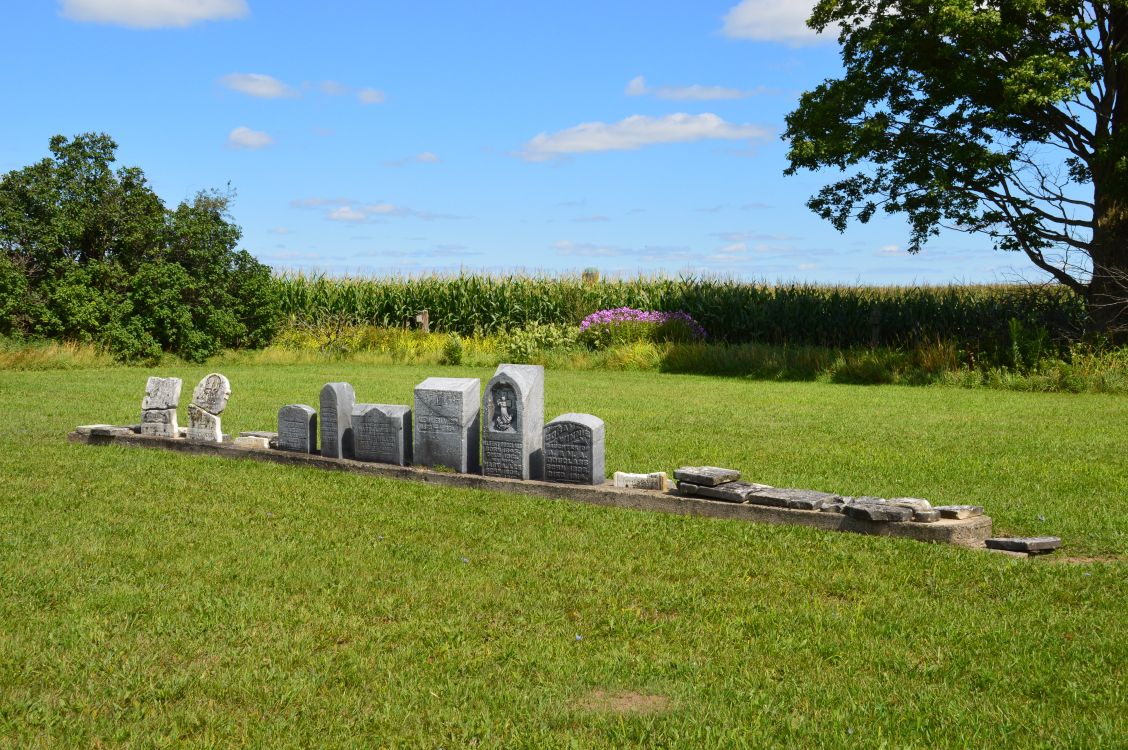
At the side of a gravel road northwest of Elmira, Ontario sits a row of weathered and broken gravestones. This cemetery has suffered not only from the ravishes of time and vandalism, but also from misguided attempts to repair the stones. While similar to many other small cemeteries in Southern Ontario, the African British Methodist Episcopal Cemetery is unique in that it is all that remains of the Queen's Bush Settlement, once the largest Black settlement in Canada West (Ontario), and the first to which fugitive slaves from the United States migrated in large numbers.

In the early 19th century the unsettled area between Guelph and Lake Huron was known as the "Queen's Bush." Starting about 1820, hundreds of free and formerly enslaved Blacks established farms near the Conestoga River in an area which eventually became the southwestern part of Peel Township in Wellington County.


John Little, who settled in the area in 1842, described his experience:
Then we marched right into the wilderness, where there were thousands of acres of woods which the chain had never run around since Adam. At night we made a fire, and cut down a tree, and put up slats like a wigwam. This was in February, when the snow was two feet deep.
Families who had recently fled slavery fared the worst for they had no resources to purchase even the simplest tools, and hunger was their constant companion. Black settlers often had to borrow farms implements, or work for more affluent white settlers to the south.

Thomas Smallwood, a Black abolitionist who visited in 1843, wrote:

They had to go fifteen miles out into the settlements, and there work for the farmers, a fortnight, to get provision sufficient to enable them to work one week in clearing their own land. And, while I was there, they were making their three meals a day on potatoes and salt.
Even clothing was in short supply. Reverend Melville Denslow of the Wesleyan Methodist Church, wrote:
There is a great destitution of clothing among these new settlers. Some of the children are naked — others with a shirt or pair of pantaloons, may be frequently seen. Bedding is very scarce, but the free use of wood serves in a measure as a substitute.

Despite these hardships a vibrant settlement developed with four churches and two schools. The children were taught by American abolitionist missionaries, who were also involved in the solicitation and distribution of clothing to new arrivals. 

The "Colored" Church: Source: Wellington County Museum and Archives

The Queen's Bush Settlement only lasted a few years. Because Peel Township was not surveyed until 1843, the land was not available for purchase. Black settlers squatted as did many white families. In 1848 the settlers were given the opportunity to purchase their land, however, most lacked the resources to do so. As a result, many abandoned their farms. A few families, however, were able to stay.

Rev. Samuel Brown
1795-1881

One of several denominations active in the Queen’s Bush was the African Methodist Episcopal Church (AME), first organized in Philadelphia in 1816. In 1844 Reverend Samuel H. Brown of the African Methodist Episcopal Church (AME) was assigned to the Queen's Bush, and settled on Lot 16, Concession 4 in Peel Township. The AME was first organized in Philadelphia in 1816. In 1856 the Canadian congregations amicably split from the AME and became the British Methodist Episcopal Church (BME).

Born in Maryland about 1795, Reverend Brown was an inspiring preacher and a leader in the AME and later the BME. A church was erected on his farm and a cemetery was established in the churchyard. In 1862, his church boasted 165 members and 65 children in Sunday School. Reverend Brown formally transferred the land to BME Church in 1877. Services at the BME church continued until about 1918. The last burial occurred in 1924, and the church building was removed in 1934.
 

Priscilla Brown
1786-1853
Reverend Brown died in 1881. His gravestone is in three pieces, however, at some point a misguided attempt was made to repair the stone by bolting the three pieces to steel bars. Also in several pieces is the gravestone of his first wife, Priscilla, who died in 1853 at the age of 67, and his second wife, Ellen, who died in 1887 at the age of 74.

It is unfortunate that so many of the stones at the African British Methodist Episcopal Cemetery have been badly damaged. A 1979 transcription records at least two gravestones for former slaves: Jacob Steward and Vincent Douglass.

While only a fragment of Vincent Douglass's gravestone remains, that of his youngest son Albert is intact. Vincent Douglass was born into slavery in Virginia about 1798 but had been able to purchase his own freedom. In 1839, Vincent offered Joseph Mead of London County, Virginia, $2000 for Vincent's wife Martha, also known as Patty or Patsy, and her six children, five of whom had been fathered by Vincent. When Mead refused, Martha and the children were "carried off" by Vincent. Despite a $700 reward, they escaped to Canada and settled in the Queen's Bush in what is now Wellesley Township.

Vincent and Martha's youngest child, Albert, was born in Wellesley in 1845 but after the death of his father in 1877 relocated to Lot 14 Concession 2 in Peel Township. Albert and his wife Mary Ann Lee had at least 12 children, one of whom, Oscar Raymond Douglas served with the 5th Canadian Railway Troops in France during World War One. Martha Douglass survived her husband by 20 years and may have been over 100 when she died in 1897.

Mary Ann Steward
1816-1886

Jacob Steward was likely born into slavery in Maryland. In 1847 he married Mary Ann Knox, a Quaker who had been born in Philadelphia. Mary Ann may have been the sister of Thomas Elwood Knox, a free black from Pennsylvania whose account of coming to Canada in 1844 was included in Benjamin Drew's 1856 A North-Side View of Slavery: The Refugee, or the Narratives of Fugitive Slaves in Canada.

Jacob's Steward's broken gravestone is now almost unreadable, while that of his wife is marred by two rusty steel bars bolted to the front. Census data suggests that Jacob and Mary Ann were at least twenty years younger than their death registrations and gravestones indicate.

The gravestones of two children of William Lawson (1843-1899) are also intact. William was the son of Dangerfield Lawson (1806-1861) a fugitive slave who was born in Virginia. According to family tradition, Dangerfield absconded with one of his owner's horses and wagon. Dangerfield was overtaken by his owner, but when the owner tried to flog him, he was overpowered by Dangerfield and strangled to death with his own whip.

By 1848, the Queen's Bush Settlement was home to perhaps as many as 1500 free blacks and fugitive slaves. Four years later, however, this number had dropped dramatically. The 1852 Census records 192 black residents in Peel Township and 45 in neighbouring Wellesley Township.

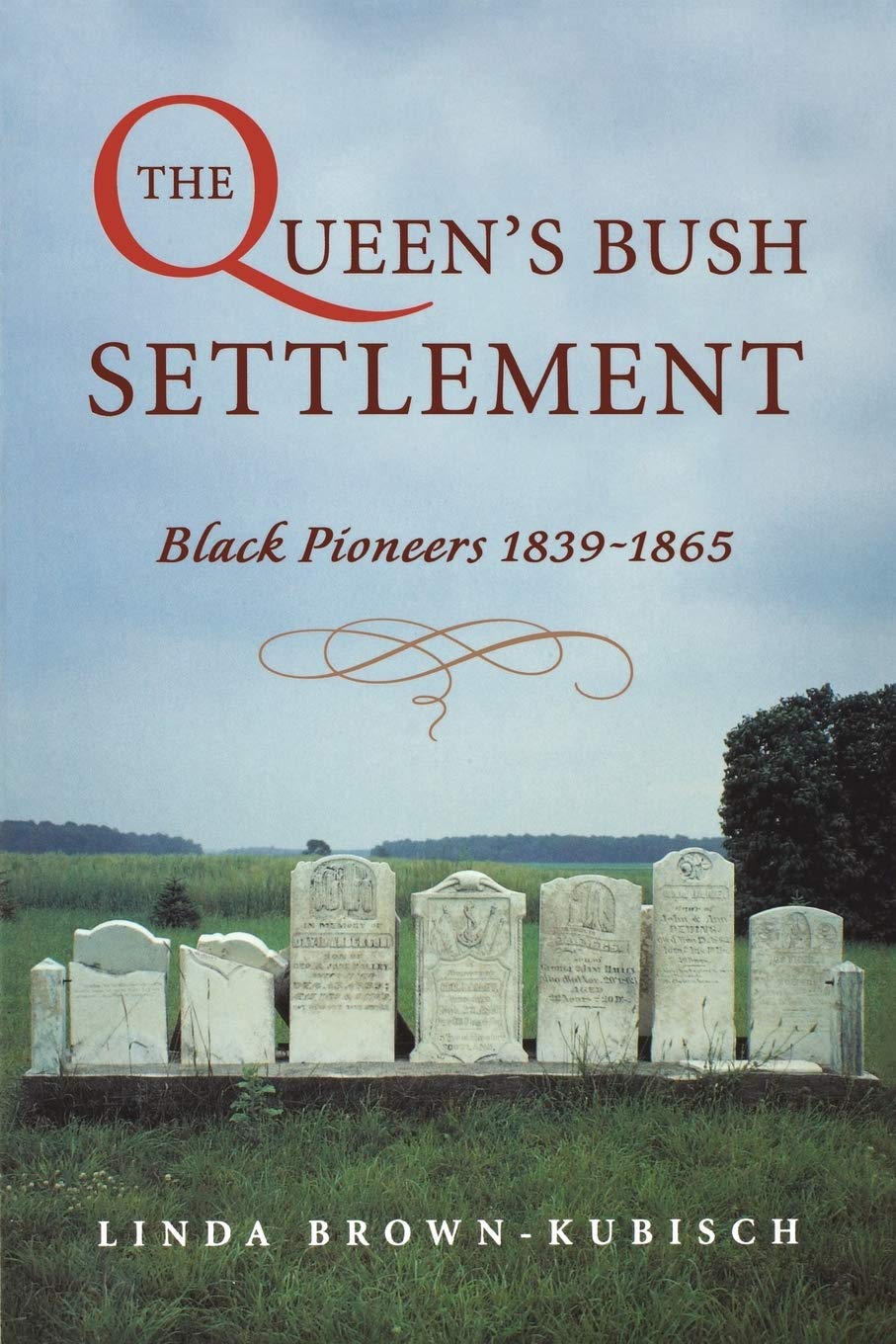
Despite it's importance to African Canadian history, the story of the Queen's Bush Settlement was largely unknown until the 2004 publication of Linda Brown-Kubisch's book on the subject. But while the cover of her book shows a pioneer cemetery, it is not the African British Methodist Episcopal Cemetery, but the nearby Olivet Cemetery, established in the late 1850s by English and Scottish immigrants.

Sources:

British and Foreign Anti-Slavery Society. Proceedings of the General Anti-Slavery Convention. London: John Snow, 1843.

Brown-Kubisch, Linda. "The Black Experience in the Queen's Bush Settlement". Ontario History. Ontario Historical Society. Vol 78 (1996) pp. 103–108.

Brown-Kubisch, Linda. 2004. The Queen's Bush Settlement: Black Pioneers 1839-1865. Natural Heritage Books, Toronto.

Drew, Benjamin. A North-Side View of Slavery: The Refugee, or the Narratives of Fugitive Slaves in Canada. Boston: J.P. Jewett and Company, 1856. https://archive.org/details/northsideviewofs00drew/

"The Queen's Bush Settlement, 1820-1867." https://web.archive.org/web/20161020162043/http://www.heritagetrust.on.ca/CMSImages/3a/3a92b73d-a359-42e9-ba17-360d676d1eb1.pdf

Mountjoy, Max, ed. 1999. Portraits of Peel: Attiwandaronk to Mapleton. Peel History Committee.

Tuesday, June 23, 2015

Greenlaw Cemetery, Caledon

Greenlaw Cemetery, Caledon, Peel, Ontario
Greenlaw Cemetery (sometimes referred to as Baker's Cemetery) is one of numerous small cemeteries in the historic township of Caledon northwest of Toronto. It is the only remnant of the hamlet of Greenlaw, better known as The Grange.

When Caledon was surveyed and opened for settlement shortly after the War of 1812, most of the early settlement was along the Credit River. At nearby Belfountain, settlement began 1825 when a sawmill was built. Greenlaw, located at the intersection of Mississauga Road and The Grange Sideroad, developed during the 1850s, but went into decline during the 1920s.

The cemetery marks the location of a Congregational Church (The Congregational Church merged with the Methodists and Presbyterians in 1925 to form the United Church of Canada). In 1852, Michael Baker deeded 3/8 of an acre for a church, cemetery and parsonage, but it is unclear what denomination initially used the church. In 1865 the church and cemetery were sold to the Congregationalists. The church closed around 1900, however, burials continued until 1941. In addition to the church, Greenlaw was also the location of a post office, blacksmith, and Temperance Hall.


Greenlaw Cemetery in 2011
When local historian William Perkins Bull visited the cemetery in the 1930s, he described it as being, "another neglected and overgrown cemetery with long grass, logs scattered here and there, and an abandoned church." He described the church as being "roughcast" and "built on a stone foundation." About 1940 the church was demolished and some years later the gravestones were gathered together into a cairn. The gravestones, unfortunately, were placed far too close together, making reading the inscriptions difficult. Transcriptions were prepared in 1974 and again in 1984. In 2014, the Town of Caledon rebuilt the cairn, making it much easier to read and photograph the gravestones.

Michael Baker 1795-1873
The earliest gravestone is that of Michael Baker who died in 1873. Michael was born in Williamsburgh Township, on the north shore of the St. Lawrence River, in 1795. His father, Conrad Baker was an United Empire Loyalist who had served in the King's Royal Regiment of New York during the American Revolution. During the War of 1812, Michael served in the 1st Regiment Dundas Militia. In 1818, the same year he married Caterina Frank, Michael petitioned the government of Upper Canada for land as the son of a United Empire Loyalist. He was granted 200 acres in Caledon and was one of the earliest settlers.

The most recent gravestone records the deaths of Sarah E. Tomlinson and her husband Henry Scott in 1939 and 1941 respectively.