Thursday, August 1, 2013

Cornelius Lambert (1758-1818)

Before
I recently had the opportunity to revisit Homer Cemetery near St Catharines, Ontario. I photographed this cemetery for CanadaGenWeb's Cemetery Project last summer, and wrote about its neglected state on this blog.

Not much has changed. The grass is mowed but continues to encroach on the many gravestones that lie flat on the ground. The trunks of two fallen trees continues to obscure several gravestones at the rear of the cemetery.

I spent a few minutes carefully clearing the grass and soil from a gravestone that I had neglected to clean last summer. Here is the result:

After
Little is known about Elizabeth (1767-1845), and not much more is known about her husband Cornelius Lambert (1758-1818). Cornelius was born in New Jersey and was a Loyalist during the American Revolution. He served with Butler's Rangers for six years during the Revolution, was promoted to Corporal, and was discharged in 1784. As a Loyalist he was granted Lots 144, 145 and 146 in Niagara Township. By 1787 he was married and had two children. In 1796 he petitioned the crown for additional land, stating that he had five sons, and consequently received 250 acres in Beverley Township. Elizabeth was likely the daughter of another Loyalist refugee family.

After the War of 1812, Cornelius made a claim for losses that occurred during the fighting. In the summer of 1813, Native allies of the British had taken two "fat hogs" and one "young ox" as well as a saddle, two bridles, and a pair of boots. In November of 1813, American troops took from Cornelius a horse and steer, as well as a quantity of oats, wheat, and hay. In his claim, Cornelius also noted that the traitor Joseph Willcocks had seized 17 1/2 pounds of beef. 

In his will, Cornelius split the Niagara property amongst his five sons. Cornelius is also frequently mentioned in the journals of Francis Goring, and his son Robert Lambert (1795-1873) married Francis's daughter Lucretia Caroline Goring (1799-1872).

Saturday, June 29, 2013

A Burford Tragedy

Seven children of Daniel and Julia Ann Utter
Losing a child to illness was a common occurrence in nineteenth century Ontario. Losing seven in 16 days, however, was a tragedy beyond imagination. I discovered this tragedy while photographing gravestones in Northfield Cemetery for CanadaGenWeb's Cemetery Project.

Daniel Utter was a blacksmith who lived in Burford Township southwest of Brantford, Ontario. Daniel was born in 1832 in Trafalgar Township, Halton County, the son of Daniel Utter and Elizabeth Kinder. Daniel and his brother David (1818-1903) moved west to Burford in the early 1850s. In 1855, Daniel married Julia Ann Hainer (1838-1899), daughter of John Hainer (1795-1860) and Nancy Bowman (1808-1892).

Large families were common in nineteenth century Ontario, and Daniel and Julia Ann followed this trend. Their first child, John, was born in 1859. By the time of the 1871 the family had grown to six children with the addition of Anna (1862), Melissa (1864), Mary (1866), Charles (1869) and Rosy Bell (1871). William (1873) and Nancy followed (1875). But in 1877 tragedy struck. One of the children, most likely 11-year-old Mary, contracted diphtheria just before Christmas.

Diphtheria is a high contagious and potentially fatal respiratory infection. Although it has been largely eradicated through routine immunization, it is still endemic in some parts of the world. Until the introduction of a vaccine in the 1920s, diphtheria was a common cause of child mortality in Canada and the United States.

Mary died first on December 24th. Melissa died on Christmas Day, followed by Annie, Charles and Nancy two days later. William died on the January 7th and Rose Bell succumbed the following day. The only child to survive was 18-year-old John, most likely because he working away from home at the time.

All seven children were buried in Northfield Cemetery in Burford Township. Daniel and Julia Ann eventually had three more children: Nancy (1880-1948), William (1882- ?) and Elroy (1886- ?). Daniel and Julia Ann remained in Burford Township for the rest of their lives and were buried with their children: Julia Ann in 1899 and Daniel in 1920. Their son John was buried at Northfield in 1928
.

Sunday, June 2, 2013

Mount Pleasant Cemetery

Gravestones at Mount Pleasant Cemetery,
Nichol, Wellington, Ontario

Mount Pleasant is a small rural non-denominational cemetery located in what was once Nichol Township north of Guelph, Ontario. The hundred or so gravestones form a large horseshoe around a open grassed area. Gravestones on the east and north sides of the cemetery are in good condition and record deaths as early as 1861 and as late as 2012.

Abraham J. Flewwelling
(1789-1849)
The same is not true for gravestones on the west side of the cemetery, especially in the southwest corner. Whether because of vandalism or age, many of these stones are broken or toppled, and no attempt has been made to repair them. When I photographed the cemetery for the Canada Genweb Cemetery Project, I discovered a large number of headstones, footstones and pieces of headstones stacked against trees, other gravestones, and the corner post of the cemetery. Despite this I managed to locate and photograph all but one of the gravestones transcribed by the Ontario Genealogical Society in 1988.
  
The cemetery was originally part of the property of Abraham Jewel Flewwelling. Flewwelling was the first settler in the area, having arrived in Nichol Township in 1827 with his wife, Martha Livermore, and seven children. Flewwelling was born in New Brunswick in 1789, the son of an United Empire Loyalist of Welsh descent. Six additional children were born after the family came to Upper Canada (Ontario). Flewwelling died in 1849. His burial place is marked by a simple rectangular marble gravestone.
  
Jane Gaball (1843-1873)
The earliest gravestone in this cemetery is that of Henry Metcalf, who died in 1844 at the age of 46 years, having emigrated to Upper Canada in 1833. Henry was born in Yorkshire, England, and had lived near Buffalo, New York for three years prior to coming to Nichol Township.

Many of the older gravestones bear motifs and epitaphs. The gravestone of Jane Watt (1843-1873), wife of John Gaball, displays a clenched hand with one finger pointing upwards, indicating the pathway to heaven. Jane was born in Scotland, and died three days after giving birth to her fourth child. Her epitaph reads:

In death's cold arms lies sleeping here
A tender parent, a companion dear:
In love she lived, in peace she died,
Her life was asked, but was denied.

Tuesday, May 21, 2013

Moffat United Cemetery

Moffat United Cemetery, Nassagaweya, Halton, Ontario
Moffat United Cemetery is a small graveyard located in Nassagaweya Township southeast of Guelph, Ontario.  The 59 stones record deaths as early as 1855 and as late as 1990. The cemetery was originally the graveyard for the Bethany Methodist Episcopal Church (later Moffat United), however, the church was converted into a private home many years ago.

George Allison (1809-1885)
Unlike many of the cemeteries that I have photographed for the Canada GenWeb Cemetery Project, Moffat is very well kept. No pruning of bushes, no cutting back of encroaching grass, and no cleaning was needed in order to photograph all the stones. While some of the stones are in several pieces, they were at one point been restored, most often through the use of metal frames. Inscriptions for the most part are still quite readable, and only two stones have disappeared since the 1976 Ontario Genealogical Society transcription.

The most common surname is the graveyard is Allison. George Allison (1809-1885) emigrated from Yorkshire and settled in Nassagawaya in 1831, on land he purchased from the Canada Company. In 1877 his son Jacob sold part of his property to the Methodist Episcopal Church, and a red-brick building was erected soon after. The graveyard, however, had existed for a number of years prior to this sale.

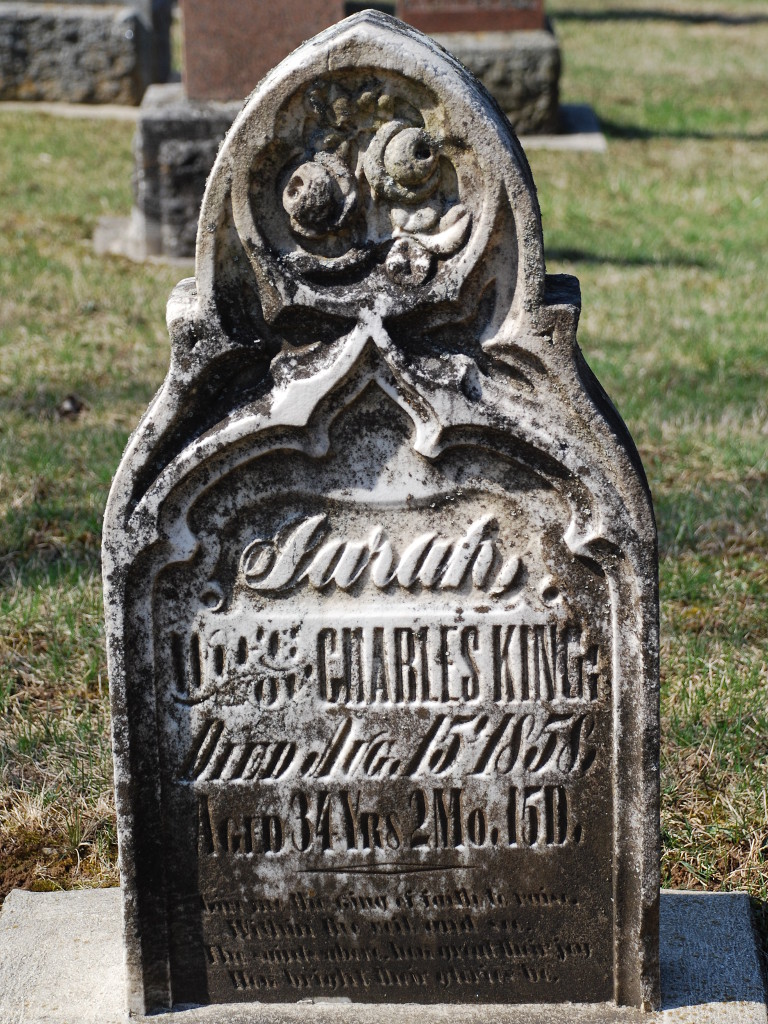
Sarah King (1824-1858)
The most visually interesting gravestone in the graveyard is that of Sarah, the wife of Charles King, who died in 1858 at the age of 34. Unfortunately, nothing is known about Sarah, since Charles King was no longer living in the area at the time of the 1861 Census.

Nassagaweya Township was created in 1819, and is one of four historical townships in Halton County. The land for the township was purchased from the Mississauga First Nation, and its name is based on the Mississauga word meaning "river with two outlets."

Sunday, April 14, 2013

A Peasant Girl Pick-Pocket

Ilfracombe, Devon in the 1890s
My great-great-grandmother Margaret Mock was born in Braunton, Devon in 1851. Margaret was the youngest of ten children born to James Mock (1804-1882)  and Catherine Thomas (1808- ?). It is not certain when Margaret's mother died. What is known is that by 1861, James was a widower living in Ilfracombe, Devon with his daughter Mary Ann, his son George (1849-1922), my great-great-grandmother Margaret, and Mary Ann's twin daughters, Caroline (1854-1908) and Selina (1854-1922).

Margaret eventually married a mariner, Joseph Snow Pittaway (1852-1927), and moved to Watchet, Somerset. Her story is not that unusual. What is somewhat unusual is the story of two of Margaret's sisters: Mary Ann and Elizabeth.

Mary Ann was born in Braunton in 1833. When she was twenty and unmarried, she became pregnant, and twin girls were born in January of 1854. Again, not all that unusual. However, starting in 1865, Mary Ann went on to have seven more illegitimate children.

In the 1871 Census, Mary Ann's occupation is listed as laundress, however, one cannot escape the conclusion that Mary Ann had become a prostitute. Ilfracombe was an important Bristol Channel port so demand for such services would have been significant. Poverty was certainly a factor as Mary Ann's father is listed as either a Greenwich pensioner or a labourer in census data.

Mary Ann and her children did eventually gain some respectability. When Mary Ann died in 1908, a death notice appeared in the North Devon Journal. Her son John Henry Mock (1866-1938) apprenticed as a plumber and according to his obituary in the North Devon Journal was "a familiar figure in Ilfracombe" and "well-known, especially among the older inhabitants of the town."

Mary Ann's sister Elizabeth Mock was born in Braunton in 1839 and was living there with her parents in 1851. In November 1856, however, Elizabeth was charged with picking pockets at the Barnstaple Market.

The North Devon Journal's account of Elizabeth's appearance before the Barnstaple Magistrates is quite lengthy. Elizabeth had been sent by her parents to Barnstaple to pawn some of her mother's dresses, as a consequence of "wages having not been paid for the last three weeks." Having received a half crown from the pawnbroker, Elizabeth then went to the market, picked the pocket of one woman, but was caught when she tried to pick the pocket of another.

The article describes in detail the fourteen stolen items recovered including a "pink lozenge" and "a piece of red sealing-wax. The stolen coin amount to 6¾ pence. Elizabeth herself is described as a "dextrous thief" and "a peasant girl pick-pocket." The author of the article adds, "From the dexterity show by the girl in the plundering art, it was conjectured that she much have been under instruction in that line at least." No evidence, however, was presented to support this opinion. Elizabeth was committed to trial, and at the next Quarter Sessions was sentenced to six weeks imprisonment.

Five years later Elizabeth was in trouble once again, this time for stealing a quantity of bacon. In October 1860, Elizabeth entered the Newport shop of George White and asked for a halfpenny worth of milk. While the shopkeeper's wife was occupied fetching the milk, Elizabeth concealed a 2¾ pound piece of bacon beneath her cape. The theft was discovered shortly after she left the shop, and the police arrested her a few hours later.

Elizabeth was "sentenced to imprisonment with hard labour for six calendar months," which she served in the Barnstaple Gaol.

After her release, Elizabeth joined her sister Mary Ann and her father in Ilfracombe.  Like her sister, Elizabeth may have turned to prostitution, as three illegitimate children were born to her over the next few years.

It should also be mentioned that Elizabeth's father James was himself known to the police. In 1849 he had been sentenced to one month imprisonment for larceny as a consequence for stealing "two ash boards."

Elizabeth died in Ilfracombe in 1887. She was 48.


Sources:

Exeter Flying Post, Thursday, 11 Jan 1849
North Devon Journal, Thursday, 29 Nov 1855
Western Times, Saturday, 19 Jan 1856
North Devon Journal, Thursday, 25 Oct 1860
North Devon Journal, Thursday, 10 Jan 1861

Thursday, March 28, 2013

Twice Emigrated: Henry Smith (1834-1903)

Elizabeth Tucker Budd (1836-1927) and her children. This
photograph likely dates from early in 1878.
In the nineteenth century, most emigrants to Canada would leave England never to return. My great-great-grandfather, however, left, returned, and then left again.

Henry Smith was born in the Dolton, a parish once described to me as being in "deepest, darkest Devon." An exaggeration perhaps, except the B3217 (the main road through the parish) is frequently a single paved lane with tall hedgerows on either side. Henry, the son of Thomas Smith (1807-1841) and Mary Field Bulleid (1809-1894) was baptised at St Edmund's in Dolton on 18 Feb 1835, having been born the previous December. According to a letter written many years ago by my great-grandmother, Thomas "was a cooper by trade, rather too fond of a good time for his own good." Shortly after Henry's seventh birthday, Thomas died, leaving Mary to raise Henry and his one year old brother alone.

Mary remarried in 1847. William Halls (1813-1893) was a building contractor and the cousin of Henry's father. The story goes that after her husband's death, Mary took in boarders including William. When William expressed romantic interest, Mary was shocked and insisted he move out and court her properly.

William Halls's five brothers had emigrated to Canada West (Ontario) in the 1840s and had settled in Westminster Township south of London. In 1851, one of the brothers, James (1830-1901), purchased and later cleared 100 acres of land in Usborne Township, southeast of Exeter. He was later joined by two of his brothers and a nephew.

Sometime in the late 1850s, James Halls was also joined by his step-nephew, Henry. Henry had learned masonry and plasterwork from his step-father, however, opportunities for employment were apparently much better in Canada. Henry worked for his step-uncle for several years and then returned to Dolton.

Back in Dolton, Henry married Elizabeth Tucker Budd, the daughter of a yeoman farmer who had fallen on difficult times. Four children were born in England: Polly, Edith, Kate and Fanny. At some point Henry became a Bible Christian. Although he married Elizabeth at the parish church, his daughters Edith and Kate were baptised at home by Bible Christian ministers, and he is listed as Bible Christian in both the 1861 and 1881 Canadian Censuses.

On 24 April 1873, Henry, Elizabeth and their four children boarded the North American, sailing from Liverpool to Quebec City. From Quebec City they would have taken a train to London, Ontario where they lived for a year and a half. Henry then moved his family to Usborne Township, joining his step-uncles in the small community of Elimville.

Henry and Elizabeth eventually had nine children that survived to adulthood. All but one were girls.

In 1888, Henry Smith left Elimville for Brandon, Manitoba, taking with him Elizabeth, Edith and his five youngest. Polly, Fanny and Kate stayed behind in Ontario. Henry worked in Brandon for a number of years, and Edith was married there in 1892. By this time Henry had likely developed silicosis although at the time it was called "plasterer's asthma."

In 1894, Henry homesteaded a quarter (160 acres) west of Hamiota, Manitoba. Nearby were his daughter Edith and her husband William Wesley Lewis. Henry received his patent in 1898 and he lived on the quarter until his death in 1903. His widow and son continued farming until 1905 but then moved to Hamiota. A number of descendants still live in the Hamiota district but others are scattered throughout Canada.

Friday, March 15, 2013

A Granddaughter's Letter

Letter from Maria Lovenia Jarvis to Samuel Peters,
Oct 2, 1802. John Macintosh Duff Collection,
University of Guelph, XR1 MS A210031


Maria Lovenia Jarvis (1788-1829) was only three years old when she accompanied her parents and siblings to Upper Canada (Ontario). Maria, the oldest daughter of William Jarvis (1756-1817) and Hannah Peters (1762-1845), was born in London, England on 31 Dec 1788. In 1791, Mary's father, a Loyalist living in London, had been appointed Provincial Secretary of Upper Canada, a post he held until his death.

For the first few years Maria and her family lived at Newark (Niagara-on-the-Lake), but in 1798 they moved across Lake Ontario to York (Toronto).

In 1802, Maria wrote the following letter to her grandfather, Reverend Samuel Peters (1735-1826). Samuel Peters has been born in Hebron, Connecticut, but at the start of the Revolutionary War had left for England. He was living in London at the time of this letter.

The letter forms part of the John Macintosh Duff Collection at the University of Guelph. A significant part of the collection consists of letters written to Reverend Peters by his daughter Hannah and his son-in-law William Jarvis. One of the recurring themes of the letters is the entreaties for Reverend Peters to visit his daughter's family. This is reflected in this letter from his granddaughter.

From Maria Lovenia Jarvis
York 2nd October 1802

Honoured Grand Papa
    It is a long time since I have seen you. I have no remembrance of you but your name which is so often repeated that it would be rather hard if I forgot. Our expectations of seeing you in Upper Canada has been long and as yet in vain but hope that we shall be gratified when Mr. Mosely returns. The tall pines which surround us I believe have wafted away all my ideas for fun—not think of any thing to amuse you with. The Castles in this place are so numerous were I to undertake a description it would swell my letter to a greater size than would be pleasing to you. The one I have seen appears to me that the owner had some thoughts of looking over the trees at the time of building and after all forgot the trees grew as high on the hill as in the valley Castle Frank—the rest being inhabited by bears and wolves. I have not ventured as yet to take a view of then as yet. We have a tolerable house unfinished but can I hope make you very comfortable if you will come. I am almost as tall as Mama and I have learnt to nurse. It would give me much satisfaction to have it in my power to practice in some degree with my Grand Papa with or without sickness. My sister and self have been hard at work to send you a patchwork counterpane the which we request your acceptance. Mama sends you a lap, tippet, socks and gloves and believes you will wear them for her sake and is sure you will find comfort in them on your passage out to Canada and also a Bottle of Bear's Grease. I shall be very much obliged to you for some useful and entertaining books. It is very difficult to procure any here and those very indifferent print. Mama finds it so painful to write or read that she cannot write you at this time. Without a glass she cannot read at all and very little with.
    I am honoured Grand Papa your most dutiful Grand Daughter.
    MLJ
Castle Frank may refer to the now buried Castle Frank Brook or to the rustic lodge built in 1796 by John Graves Simcoe, the first Lieutenant Governor of Upper Canada. The word "castle" was used ironically by the early inhabitants of York. Maria's sister, Augusta Honoria Jarvis (1790-1848) was eleven when this letter was written.

Maria married George Hamilton (1788-1838) at York in 1812. After the War of 1812, George purchased land in Barton Township at the head of Lake Ontario. He developed a town site which grew to become the City of Hamilton. Maria's grandfather finally visited in 1818, and baptised his grandaughter, Maria Lavinia Hamilton.


Maria Lavinia Jarvis died in 1829, leaving behind her husband and eight children.