Saturday, October 3, 2020

Rebel and Ranger: James Secord (1732-1784)

East Branch of Susquehanna River near Wyalusing in
Pennsylvania. James Secord settled on the
Susquehanna a few years before the Revolutionary War.

The story of Laura Secord (née Ingersol) has been told, embellished, dismissed, corrected, and retold numerous times. Less well known is the story of some other members of the Secord family, including Laura's father-in-law, James Secord.

James (Jacques) Secord was born on 24 Apr 1732 in New Rochelle, Westchester, New York, the son of Daniel Secord (1698-1766) and Catharine Mabee (1703-1761). He was baptized at the Église Françoise at New Rochelle on 28 May 1732. James married Madelaine Badeau, likely the daughter of Jean Badeau and Madelaine Parcot, about 1754. Their first child, Solomon, was born on 9 Mar 1755. Stephen (Etienne) was born two years later followed by David in 1759, Madelaine in 1764, Esther in 1766, Mary in 1770, and James in 1773.

Some family historians have also included a child named John, born in 1762, however, this is not supported by primary sources. While the New Rochelle baptisms of Solomon, Steven, David and Madelaine are found in the register of the Église Françoise À La Nouvelle York, there is no baptism record for John. He does not appear on the pay rolls of Butler's Rangers or the Indian Department, nor is he listed in the 1783 Niagara Return.

James and Madelaine may have lived in New Rochelle for a time after their marriage but tax records show that by 1762 they were leasing a farm in the Southern Precinct of Dutchess County (now Putnam County).

The Philipse Patent was granted to Adolphus
Philipse in 1697 and was held by three of his
descendants in the 1760s.

On 20 Jun 1766, however, a warrant for issued for the arrest of James. In the fall of 1765, James, a tenant farmer in the Philipse Patent, had been recruited by William Prendergast (1727-1811) to participate in an armed rebellion against their absentee landlords.

At issue were the excessive rents, the threat of evictions, and debt imprisonment. Prendergast and his followers refused to pay their rents. Tenants who had been evicted were restored to their farms, and anyone who had been imprisioned for rent debt was broken out of jail.

On 1 May 1766, hundreds of Prendergast's followers marched on New York City. Prendergast halted his "army" at the Harlem River and sent a delegation to meet with Governor Sir Henry Moore. Moore listened to their grievances and assured them that he would not interfere in their dispute. Prendergast's army returned to Dutchess Country and disbanded, however, the landowners soon pressured the Governor into sending British grenadiers from the 28th Regiment of Foot to restore order. Several skirmishes followed in which several soldiers and rebels were killed. Prendergast evaded capture when his supporters made a stand at the Oblong Friends Meeting House, however, he later surrendered and was taken to New York City.

Oblong Friends Meeting House
At his trial in early August, Predergast was found guilty of high treason and was sentenced to be executed: “The prisoner shall be led back to the place whence he came, and from thence shall be drawn on a hurdle to the place for execution, and then shall be hanged by the neck, and then shall be cut down alive, and his entrails and privy members shall be cut from his body, and shall be burned in his sight, and his head shall be cut off, and his body shall be divided in four parts, and shall be disposed of at the King’s pleasure.”

Fortunately, Predergast's wife, Mehetibal, was able to obtain a stay of execution from Governor Moore, and several months later a royal pardon from King George III.

It is not known if James Secord was ever arrested or imprisoned. Instead, he may have fled Dutchess County for Cortlandt Manor in Westchester.

Most researchers list Somers, Westchester as the birth place for James and Madelaine's three youngest children. Although the Town of Somers was not established until 1808, the area was part of the 86,000 acre patent granted to Stephanus van Cortlandt in 1697.

In 1773, James and his brother Peter appear on a tax assessment list for Walpack, Sussex, New Jersey. Walpack lies on the Delaware River, which forms the boundary between Pennsylvania and New Jersey.   Within a year, however, James and Peter had likely moved west to the Susquehanna River, in an area that was claimed by both Connecticut and Pennsylvania.

In his war losses claim, Solomon Secord wrote:

That your Memorialist’s Father at the beginning of the late unhappy disturbances in America was settled on Susquhannah River in Northumberland County in the Province of Pennsa where he was in possession of a good Farm with Buildings thereon erected, Live Stock, Household Furniture, Farming utensils &c the whole valued at £227 New York Currency.
Solomon testified that his late father had settled about three years before the war, and had cleared between 20 and 30 acres. Losses included a house and barn, two head of cattle and five horses.

James is thought to have settled near Mehoopany, several kilometres upriver from Tunkhannock where his brother John had settled. Also in the area were his brother Peter and his sister Mary, wife of Joshua Beebe (my ggggg-grandparents).

In October 1775 the 24th Regiment, Connecticut Militia was established, and James was appointed captain of the Ninth Company. The following June he was replaced because he was "suspected and accused of Tory proclivities."

Because James "would not side with the rebels," he left his farm on the Susquehanna for Fort Niagara in the spring of 1777.  With him were his sons Solomon, Steven, and David. Madelaine and the younger children remained behind. James and his sons were part of a group that became rangers in the Indian Department under Deputy Superintendent John Butler. This group included Peter Secord and his son Silas, John Secord and his son John, Joshua Beebe and his son Adin, Jacob Bowman and his son Adam, and Abraham Wartman and his son Adam.

On 31 Mar 1777, John Butler wrote to Sir Guy Carleton, Governor of the Province of Quebec:
A number of people daily coming in from the Mohawk River and many of the first inhabitants who will be greatly distressed unless some way relieved. I therefore make bold to ask your permission and authority to form these, with numbers more I can draw from that country into a Ranger's Battalion, which I think I can complete in three months, having received letters from seventy of the inhabitants of the Susquehanna by one Depue, expressing a desire of entering into His Majesty's service as Rangers. I have, by consent of Captain Lernoult, wrote them to come on and do expect them here in the space of twenty days; their use as scouts with Indians to an army would be presumptuous in me to point out.
John Butler noted the arrival of a number of Susquehanna loyalists in a letter to Carleton on 8 Apr 1777:

Since my letter to Your Excellency of the 31st ulto, several people have arrived from the Susquehanna, who inform me of more being on their way and more to follow them in a few days.
In a letter from Butler to Carleton dated 16 Jun 1777, James is shown as being paid 8 shillings per diem while his sons and the others received 4 shillings. In his response Carleton wrote:
I cannot, however, but observe that the pay of the men of the company of Rangers is very high and I wish you had given me your reason for proposing it at that high rate; but I take it for granted that it is only to continue at that rate during the expedition.
The expedition that Carleton refers to was the St. Leger Expedition, part of the 1777 Saratoga Campaign. Butler brought his rangers to Oswego to rendevous with Brigadier General Barry St. Leger. St. Leger's expedition left Oswego on July 26 and travelled overland to Fort Stanwix which was besieged beginning on 2 Aug 1777. On August 6, James and the other rangers were part of the ambush of American reinforcements known as the Battle of Oriskany. Ernest Cruickshank is his history of Butler's Rangers states that 18-year-old David was wounded during this battle.

St. Leger lifted the Seige of Fort Stanwix on August 22 after receiving misleading intelligence that an American relief column commanded was approaching.  A few days later St. Leger gave leave to the Susquehanna rangers "to go home for their families and to bring off some cattle." Several secondary sources record that James was placed in charge.

In early January, however, many of the Susquehanna rangers were captured by a patriot force commanded by Nathan Dennison. 18 were sent to prison in Connecticut. Among their numbers were Philip Buck, Jacob Bowman, and his son Adam Bowman.  James and eleven others were released for lack of evidence.

Butler reported on their capture in a letter to Captain Francis Le Maistre, Adjutant General dated 28 Jan 1778.
By accounts from the Susquehanna River, I am well informed of the rebels having taken prisoners thirty of the Rangers who went from Oneida Lake by leave of Colonel St Leger. They were to have returned to this place with as many beef cattle as they could drive off. The rebels, as is supposed, got notice of their design and with a party of 200 men surprised and took them with three Indians.
In September 1777, Butler had finally received permission to form a Loyalist regiment. Solomon, Steven, and David enrolled in Butler's Rangers, however, James remained an employee of the Indian Department. In his Upper Canada Land Petition dated 12 Jan 1796, James's youngest son wrote: "That your Petitioner’s Father brought in to this province about forty men who all joined Col Butler's late Corps of Rangers and for which he was promised a Company in said Corps but afterwards withheld from him." Pay records show that James held the rank of Lieutenant in the Indian Department and served until at least April 1779.

In their 1795 Upper Canada Land Petition, David and James Secord wrote that their father:
... brought to this Post [Fort Niagara] forty six Loyal subjects all which Joined his Majestys Standard and in the year following he also brought to this Post his family consisting of a wife seven children three of which Joined Coll Butlers Rangrs and served during the war—your Petitioners father likewise served as a Lieut in the Six Nation Indian Department and having received five Hundred Acres and hopes your Excellency will assign your Petitioners such further quantity of Land as they may be entitled to."

Given his status as a Lieutenant in the Indian Department, James likely spoke several indigenous languages including Mohawk and Seneca, and may have also been fluent in French. At various times he would have served as a liasion with the Haudenosaunee, as a recruiter for the Rangers, or as a scout.

Butler's Rangers Belt Plate,
Niagara-on-the-Lake Museum

While it is not known if James was present at the Battle of Wyoming in July 1778, his three sons saw action. In the early years of the American Revolution, the Wyoming Valley was a hotbed of Patriot support and a leading producer of grain. Butler decided to attack the valley with a joint force of Rangers and Seneca.

Butler's combined force descended the Susquehanna in canoes, and arrived at the head of the Wyoming Valley on July 1. After capturing Fort Wintermoot and Fort Jenkins, Butler ambushed a force of about 300 Patriot militia who had left the security of Forty Fort in the belief that Butler was withdrawing. The inexperienced militia panicked and ran, and were slaughtered by the Seneca.

In his report to Fort Niagara's commanding officer, Lt. Col. Mason Boulton, Butler wrote:

When they were within 200 yards of us they began firing. We still continued upon the ground without returning their fire till they had fired three volleys. By this time they had advanced within 100 yards of us, and being quite near enough, Saingerachta ordered his Indians, who were upon the right, to begin the attack upon our part, which was immediately well seconded by the Rangers on the left. Our fire was so close and well directed that the affair was soon over, not lasting above half an hour from the time they gave us the first fire till their flight. In the action were taken 227 scalps and only five prisoners. The Indians were so exasperated with their loss last year near Fort Stanwix that it was with the greatest difficulty I could save the lives of these few.
Later in the report Butler added:
But what gives me the greatest satisfaction is that I can, with great truth, assure you that in the destruction of this settlement not a single person has been hurt of the inhabitants but such as were in arms. To those, indeed, the Indians gave no quarter.

A lurid and misleading account of the "Wyoming Massacre" was published in the Connecticut Courant on July 28, 1778, and was widely reprinted in other American newspapers. The account claimed that some prisoners were thrown onto a fire and held down with pitchforks, that women and children were burned alive within their homes, and that several instances of fratricide and familicide occured. Other accounts erroneously claimed that the Mohawk war leader Thayendanegea (Joseph Brant) led the indigenous warriors, and that a Seneca woman known as Queen Esther executed at least fourteen captive American soldiers at Bloody Rock.

Ensign Downey's Escape, Battle of Wyoming by Don Troiani

Perhaps the most reliable account of the Battle of Wyoming appears in the journal of Richard Cartwright (1759-1815). Cartwright was a civilian who served as Butler's secretary from 1778 to May 1780. He later married Madelaine Secord, daughter of James and Madeline.

    ... on the 1st of July [they] entered the settlement, the party consisting in the whole of 464 Indians and 110 Rangers. That day and the next, two small forts, in which were a number of women and children and a few men, surrendered on condition of having their lives spared and being allowed to retire into the country.
         The Indians at first, seeing the inhabitants shut up in forts, and in some measure secured from their fury, thought of nothing but of scattering through the settlement to vent it upon the cattle and buildings, and at the same time to collect as much plunder as they could. Major Butler, however, by his earnest entreaty, prevailed upon them to keep in a body till he tried what effect a flag of truce would have, and finding it attended with such unexpected success in the two first instances, they were desirous of getting possession of all the rest of the forts by the same method, and a flag was accordingly sent to the principal fort on the 3rd, but was insulted, and soon after the greatest part of that garrison, and some small ones below it, in all about 450 men, commanded by a Colonel Butler, came out to attack them, on which a very warm engagement ensued, and lasted for about fifteen minutes, when the rebels retreated with precipitation, and were hotly pursued by the Indians, who took 226 scalps and three prisoners, and several were besides drowned in attempting to pass the river.
    Major Butler's loss was only seven wounded, two of whom died of their wounds. This victory made them entire masters of all the settlement, as it occasioned such a panic that all the forts were either abandoned or surrendered, on the same conditions as the first, before the 7th Instant. Most of the houses were burnt except such as belonged to people under the name of Loyalists; a very large number of cattle were driven off; and effects to a great amount were brought away in plunder by the Indians.
    All this was said to be done without any acts of cruelty being committed by the savages; for the deliberate murder of prisoners after they are brought into their camp is not, it seems, reckoned among acts of cruelty by these barbarous wretches.

The Wyoming expedition also provided the opportunity for Loyalist families still living on the Susquehanna to be safely escorted to Fort Niagara. In his journal, Richard McGinnis wrote of encountering families "on their way to Niagara" at Tioga. In her war losses claim Mary Beebe (nee Secord), wife of Joshua Beebe and sister of James Secord, stated that "corn, turnups [sic], potatoes and wheat” were left in the field, suggesting a late spring departure. Mary and Joshua's youngest child was born at Tioga in late July.

Madelaine Secord, however, was no longer on the Susquehanna. In the early spring of 1778, Madelaine, Elizabeth Bowman, and Anna Buck had brought their families to Canojahorie, Elizabeth's former home in the Mohawk Valley area.  A few months later they were escorted to Fort Niagara, arriving in early November.

Unlike many families who were sent to refugee camps in lower Quebec, Madelaine and her children remained at Niagara for the remainder of the war. In October 1778, James's brothers, John and Peter, were discharged from Butler's Rangers on 7 Oct 1778 due to their age. James, however, remained with the Indian Department.

George Romney, Thayendanegea,
National Galley of Canada, 1776

While there is no evidence that James was present at the Cherry Valley Massacre, as experienced rangers, Solomon, Stephen, and David would have certainly have been. In November 1778, Captain Walter Butler, son of John Butler, led a combined force of Seneca, Rangers and regulars from the 8th Regiment of Foot against the Mohawk Valley settlement of Cherry Valley. With Bulter was Thayendanegea and a score of Mohawk warriors. While the Rangers and regulars attacked the fort, the Seneca attacked homes in the village where American officers were billeted.

Unlike the "Wyoming Massacre," where only militiamen had been killed, 30 non-combatants, mostly women and children, were slaughtered by the Seneca, despite the efforts of Thayendanegea to curtail the violence. 15 soldiers of the 7th Massachusetts Regiment were also killed including their commanding officer.

Arriving soon after the massacre, one witness wrote:

I was never before a spectator of such a scene of distress and horror. The first object that presented was a woman lying with her four children, two on each side of her, all scalped; the next was the wife of the Reverend Mister Dunlop, likewise scalped, stripped quite naked, and much of her flesh devoured by the Indian dogs. But it would be tedious to mention all the shocking spectacles that were to be seen.
An additional 70 non-combatants were taken prisoner, however, Thayendanegea secured the release of many of them a few days later. About 30 women and children remained captives of the Seneca along with four officers and 12 enlisted men from the 7th Massachusetts. Lt. Col. William Stacey, second-in command of the 7th Massachusetts was turned over to the British and remained a prisoner-of-war until 1782.

John Butler (1728-1796). Copied from
the original by Henry Oakley.
Niagara on the Lake Museum, 1834

In February 1779, John Butler reported that, "Mr. Secord is sent to Chemung for the purpose of keeping a constant watch upon the rebels towards Wyoming, from since I daily expect intellingence as parties have been out that way for some time." Chemung was a Lenape village on the Chemung River several kilometres upriver from Tioga Point where the Chemung merged with the Susquehanna. James was still at Chemung in April but does not appear to have been in the area when the Sullivan Expedition burned the village in early August. It is not known whether James was present at the Battle of Newtown on August 29, 1779. Captain Walter Butler's company, however, was at Newtown which suggests that Solomon, Stephen and David once again saw action.

James retired from the Indian Department sometime after April 1779. In the summer of 1780, James, his brothers Peter and John, and his nephew John were part of the first group to start farming on the west side of the Niagara River. James and Peter began clearing land along Four Mile Creek several kilometres inland from Lake Ontario, while John and his son John settled closer to the mouth of the Niagara River.

By August 1782, James had cleared 20 acres and had 11 sheep, three horses, three cows, and three hogs. A year later an additional 20 acres had been cleared.

Recognizing the need for a sawmill and gristmill, James and Peter requested government assistance to transport millstones and iron works from lower Quebec. Governor Haldimand, however, insisted that the mills, like the farms on the west side on the Niagara, would belong to the Crown. Haldimand, however, was willing to pay for construction and materials. In his letter to John Butler dated 9 Jul 1782, Adjutant General Robert Matthews wrote:
With respect to the mills proposed to be built by the Secords, His Excellency will not permit any thing of the kind as private property. It must be undertaken entirely upon the same footing as the farms. Some estimate of the expense must be sent down by the most intelligent of these men. The General will provide and send up the materials; they will be paid for building the mills and allowed a reasonable profit for working them. The sooner Secord is sent down the better and he should be furnished with remarks in writing respecting the situation of the intended mills, the materials wanted, what parts of them can be procured above, &c.
After many delays the mills began operating in the fall of 1783. The grist mill escaped destruction during the War of 1812, and was in operation until 1910. About 1990 the building was converted into a residence and received heritage designation in 2004.

Secord grist mill c. 1920
Solomon, Steven, and David Secord remained with Butler's Rangers until the end of the war. Steven was promoted to Sergeant and appears in Capt. Lewis Geneway's company on a return dated 30 Nov 1783. David appears with his father on the list of farmers "settled at this Post" dated 1 Dec 1783. Solomon after many delays was commissioned a 2nd Lieutenant before the regiment was disbanded in June 1784.

According to the claim for losses submitted by Solomon Secord, James died in summer of 1784. Madelaine appears as "Widow Secord" on the 20 Jul 1784 Niagara Return. Some family historians record her death as having occured on 21 Sep 1796, however, evidence for this is lacking.

James never met his famous daughter-in-law but his story, while not heroic, illustrates the hardships suffered by those who supported the Crown during the American Revolution.

Sources:

Connecticut Courant and the Weekly Intelligencer, 28 Jul 1778, p. 3.

Crowder, Norman. Early Ontario Settlers: A Source Book. Baltimore: Genealogical Publishing, 1993.

Francavilla, Lisa A., "The Wyoming Valley Battle and 'Massacre': Images of a Constructed American History" (2002). Dissertations, Theses, and Masters Projects. Paper 1539626377. https://dx.doi.org/doi:10.21220/s2-00ct-xe13

Harvey, Oscar Jewell. A History of Wilkes-Barré, Luzerne County, Pennsylvania: From Its First Beginnings to the Present Time, Including Chapters of Newly-discovered Early Wyoming Valley History, Together with Many Biographical Sketches and Much Genealogical Material. Wilkes-Barre: Raeder Press, 1909

Jones, J. Kelsey. Loyalist Plantations on the Susquehanna. Self-published, 2009. https://docplayer.net/100900251-Loyalist-plantations-on-the-susquehanna-j-kelsey-jones-updated-2009.html

Library and Archives Canada. Land Petitions of Upper Canada, 1763-1865

Library and Archives Canada. Haldimand Papers (MG21, Add. MSS 21765, Volumes B105, B166, B167, B168)

Miner, Charles. History of Wyoming: In a Series of Letters, From Charles Miner, to His Son William Penn Miner. Philadelphia: J. Crissy, 1845.

Moulton, R. Kirk. "Early Sicard-Secor Famiies of New York: Origins of United Empire Loyalist William Secord." New York Genealogical Bulletin, Vol. 150, No. 4 (October 2019) p. 302-316.

Nester, William R. The Frontier War of American Independence. Mechanicsburg, Pennsylvania: Stackpole Books, 2004.

Reilly, Bob. "The Heroine of Quaker Hill," The Pawling Record, 13 Jul 2018. https://www.pawlingrecord.org/single-post/2018/07/13/The-Heroine-of-Quaker-Hill

Smy, William. An Annotated Nominal Roll of Butler's Rangers 1777-1784. Welland, Ontario: Friends of the Loyalist Collection at Brock University, 2004.

Smy, William A., editor. The Butler Papers: Documents and Papers Relating to Colonel John Butler and His Corps of Rangers. Brock University Library Archives & Special Collections, 1994. https://dr.library.brocku.ca/handle/10464/9242

Stone, William L. The Poetry And History of Wyoming: Containing Campbell's Gertrude, And the History of Wyoming, From Its Discovery to the Beginning of the Present Century. Fourth edition, Wilkes-Barre, Pa.: C. E. Butler, 1869.

The National Archives of the UK. American Loyalist Claims, 1776–1835 (AO 12–13).

Watt, Gavin. Fire & Desolation: The Revolutionary War's 1778 Campaign as Waged from Quebec and Niagara Against the American Frontier. Toronto: Dundurn, 2017.

Watt, Gavin K. and James F. Morrison. The British Campaign of 1777, Volume One, The St. Leger Expedition: The Forces of the Crown and Congress. Second edition, Milton, Ontario: Global Heritage Press, 2010.

Wittmeyer, Alfred Victor and Edward F. De Lancey. Registers of the Births, Marriages, And Deaths, of the "Église Françoise À La Nouvelle York,": From 1688 to 1804. New York: Huguenot Society of America, 1885.

Saturday, August 29, 2020

And Only One Pair of Shoes (Part 2)

Detail from the 1791 Adlum and Wallis Map of Pennsylvannia.
Source: Norman B. Leventhal Map Center Collection, Boston Public Library


When primary sources such as the Upper Canada Land Petitions or the Haldimand papers are used to verify the information contained in Elizabeth Spohn's letter, it becomes possible to more accurately recreate the harrowing story of Jacob and Elizabeth Bowman during the Revolutionary War.

In the spring of 1777, Jacob Bowman and his 18-year-old son Adam left their farm on the Susquehanna River near Tunkhannock, Pennsylvania and travelled to Fort Niagara to become rangers in the Indian Department under John Butler. In August 1777, Jacob and Adam saw action at the Siege of Fort Stanwix and the Battle of Oriskany. After the British abandoned the siege, Jacob and Adam were given leave to return to the Susquehanna for the winter. In early January 1778 they were captured and with 16 others sent to Connecticut as prisoners of war. Later that year Jacob and Adam were exchanged and sent to New York. In the spring of 1780, they received permission to leave New York and travel overland to Fort Niagara. Adam was severely wounded when they were once again taken prisoner near Wysox on the Susquehanna. Adam was exchanged in the summer of 1782 and returned to Fort Niagara. Jacob was not released until the spring of 1783, after spending nearly three years in captivity.

Portrait of a Soldier in Butler's Rangers by Garth
Dittrick. Peter Bowman enlisted in Butler's Ranger's
Rangers after his family reached Fort Niagara.
Source: Wikimedia Commons

Meanwhile, Elizabeth Bowman and her eight children abandoned their home on the Susquehanna in the spring of 1778. They headed first to Canajoharie in the Mohawk Valley region where Jacob and Elizabeth had lived previously. In the fall of 1778, they were escorted to Fort Niagara, where their son Peter enlisted in Butler's Rangers. Elizabeth and her other children were sent to the refugee camp at Machiche on the St. Lawrence River near Trois-Rivières.

In 1780, her eleven-year-old son Abraham joined the Kings Royal Regiment of New York as a drummer. Elizabeth remained at Machiche until the spring of 1781 but was afterwards billeted at various sites outside Montreal until the summer of 1773. By the fall of 1783, Elizabeth and Jacob had reunited and returned to Niagara. When Butler's Rangers was disbanded in June 1784, Jacob and Elizabeth settled on the west side of the Niagara River near the Whirlpool Rapids.

The captivity of Jacob Bowman and his son Adam is well-documented in primary sources. Jacob's Upper Canada Land petition, dated 3 Jul 1795, describes his ordeal in detail:

That in the year 1777 your Petitioner Joined the Corps of Rangers commanded by Lieut. Colonel John Butler—and went on actual Service on the Expedition for the Reduction of Fort Stanwix—on the failure of which Expedition your Petitioner being on his return as far as the Oneyera Lake obtained leave to go into the Country and bring thence his family to Niagara in the prosecution of which attempt your Petitioner was taken prisoner and sent to Hartford Gaol—and afterwards, by exchange got into New York—from thence your petitioner made an attempt to force his way into Niagara in order to Join his Regiment, but in the progress of it was again taken prisoner on the Susquehanna River, and having made resistance sorely wounded. Your Petitioner being thus again captured was sent to the provost and loaded with Irons—thence sent to the Rebel Headquarters for sometime and afterwards moved from Gaol to Gaol to the Kats Kiln—and after remaining some time imprisoned there your Petitioner, along with a number of other Loyalists chained together by couples, was sent to Lancaster where he remained Eighteen months in imprisonment twenty weeks of which time he lay in Chains—from there your Petitioner was removed to Philadelphia Gaol where having remained Eighteen months he was exchanged and sent into New York—whence he was sent to Quebec and from thence Joined again the Corps of Rangers—having been Seven years Separated from his family by reason of his Loyalty & Sufferings—That your Petitioner has in this Province a wife & nine Children—That your Petitioner has only as yet drawn four Hundred acres of land for himself & family. Where your Petitioner prays that your Excellency would gake into Consideration your Petitioners various Sufferings, exclusive of the forfeiture of all his real & personal property in the States to a very considerable amount, and for which your petitioner never claimed or received any Compensation, and grant to your Petitioner such additional allowance of Land as in Your Excellencys Widsom may seem meet—and your Petitioner as in duty bound will ever pray.
Adam's petition states, "That your Petitioner was a Soldier in Col. Butlers Rangers during the American War; that he was repeatedly taken prisoner by The Rebels & wounded. A certificate from John Butler, dated 7 Aug 1788, goes into more detail:
I do hereby Certify that the bearer Adam Bowman joined the late Corps of Rangers under my Command in the year 1777 and served in the Expedition Against Fort Stanwix commanded by Brigadier General St. Leger, that after the retreat from Fort Stanwix he obtained the General’s leave with some others to go to Susquehanna in order to fetch their families into Niagara, as they had been drove by the enemy from their habitations, where he was taken & put into prison & after some time was put into Irons & removed to Hartford in Connecticut, where he remained until the latter end of the year 1778, when he was exchanged & sent to New York where he remained until the year 1780 & then got leave to join the Corps of Rangers in attempting of which he had the misfortune to be taken again at the Susquehanna after receiving three bad wounds, he was then conveyed to different parts of the Colonies until 1782 when he was exchanged by the way of Canada & joined his Corps & served until the General reduction took place in 1784. But one of the wounds he received when last taken prisoner on the Susquehanna River being badly attended while a prisoner, has never been made a care of & still remains open, he not being able to employ a Surgeon, begs the benefit of one of his Majesty’s Hospitals where he may have such attendance as may restore him to health—to which I beg leave to recommend him as a man deserving notice.

The Haldimand Papers contain several references to Jacob and Adam. They first appear on A List of Persons Employed in the Indian Department dated Niagara, 15 Jun 1777. That fall, John Butler was granted permission to raise a "corps of rangers." Jacob, Adam, and many of the others who had returned to the Susquehanna after the Siege of Fort Stanwix were "transferred" from the Indian Department to Butler's Rangers. Jacob and Adam are shown on the paylist of Walter Butler's Company from 24 Dec 1777 to 24 Oct 1778 even though they were prisoners of war during this time.

Jacob and Adam appear on A List of Prisoners in the Hands of Congress belonging to Corps of Rangers, Royalists & their Families with the notation "Taken on the Susquehanna Jany 1778." In a letter dated 24 Dec 1780 to Governor Haldimand's secretary Robert Mathews, Walter Butler, a company commander in Butler's Rangers, lists Jacob Bowman and Adam Bowman as having been taken prisoner on 3 Jan 1778.

The circumstances behind Jacob and Adam's arrest along with others are described in the records of the Connecticut Assembly in a memorial dated 26 Jan 1778:

The memorial of Nathan Denison, of Westmoreland, in the county of Westmoreland, humbly sheweth—That he being colonel of the 24th regiment of militia belonging to this State; and on the 20th day of December last, being informed that a band of tories were forming on the westward of said town of Westmoreland, in order to stir up the Indians of Tioga to join said tories, and kill and destroy the inhabitants of this State; upon which information your memorialist ordered part of his regiment to be immediately equipt, and march to suppress the conspirators...
Denison reported to the Assembly that his officers and men, "marched about 80 miles up the river and took sundry tories, and happily contented the Tioga Indians, and entirely disbanded the conspirators." At the next session of the Connecticut Assembly it was resolved:
...that Richmond Berry, Philip Buck, Thomas Silk, Edward Hicks, Edward Hicks, Jr., John Young, Jacob Bowman, Adam Bowman, Jr., Jacob Bruner, John Henry Short, Henry Hover, Nicholas Phelps, Nicholas Phelps, Jr., John Phelps, Jacob Anguish, George Kentner, and Frederick Frank, who were taken in arms against the United States by the militia of Westmoreland, and sent to the deputy commissary general of prisoners of this State, are ordered to be received and treated as prisoners of war, provided that nothing in the aforesaid order shall  be construed to excuse said prisoners from any treasonable offense against the laws of other States.

The capture of "sundry tories" was also noted in an anonymous letter from Quebec dated 25 Aug 1778 that was published in The Remembrancer:

About his time the inhabitants having discovered that many of these villainous Tories, who has stirred up the Indians, and been with in fighting against use, were within the settlements, 27 of them were, in January last, taken up and secured. Of these 18 were sent to Connecticut, the rest, after being detained some time, and examined, were for want of sufficient evidence set at liberty; they immediately joined the enemy, and became active is raising in the Indians a spirit of hostility against use. This disposition soon after began to appear, in the behavior of the Tories and Indians, which gave the people apprehensions of danger, and occasioned some preparations for defense.

In a letter dated 28 Jan 1778, John Butler reported from Fort Niagara:

By accounts from the Susquehanna River, I am well informed of the rebels having taken prisoners thirty of the Rangers who went from Oneida Lake by leave of Colonel St Leger. They were to have returned to this place with as many beef cattle as they could drive off. The rebels, as is supposed, got notice of their design and with a party of 200 men surprised and took them with three Indians.
In her letter to Egerton Ryerson, Elizabeth Spohn wrote about the night Jacob and Adam were taken:
He [Jacob Bowman] was surprised at night, while his wife was sick, by a party of rebels, and with his eldest son, a lad of sixteen years of age, was taken prisoner; his house pillaged of every article except the bed on which his sick wife lay, and that they stripped of all but one blanket. Half an hour after my grandfather was marched off, his youngest child was born. This was in November. There my grandmother was, with an infant babe and six children, at the commencement of winter, without any provisions, and only one blanket in the house. Their cattle and grain were all taken away.
Spohn's letter would suggest that Jacob and Adam were captured in November 1775, however, the preponderance of evidence shows that they were taken in early January 1778. According to the information on his gravestone, Adam was born on 25 Apr 1758, so he would have been 19 at the time of his arrest. Elizabeth named her youngest child Eve. Eve, aged 5, is listed with her parents in the Return of Loyalists at Niagara dated 30 Nov 1783.

Spohn describes what happened to Elizabeth and her children after Jacob's arrest:
My father, Peter Bowman, the eldest son at home, was only eleven years old. As the pillage was at night, he had neither coat nor shoes; he had to cut and draw his firewood half a mile on a hand-sleigh to keep his sick mother from freezing; this he did barefooted. The whole family would have perished had it not been for some friendly Indians that brought them provisions. One gave my father a blanket, coat and a pair of mocassins. A kind squaw doctored my grandmother, but she suffered so much through want and anxiety that it was not until spring that she was able to do anything. She then took her children and went to the Mohawk river, where they planted corn and potatoes; and in the fall the commander of the British forces at Niagara, hearing of their destitute situation, sent a party with some Indians to bring them in. They brought in five families: the Nellises, Secords, Youngs, Bucks, and our own family (Bowman), five women and thirty-one children, and only one pair of shoes among them all. They arrived at Fort George on the 3rd of November, 1776; from there they were sent first to Montreal, and then to Quebec, where the Government took care of them—that is, gave them something to eat and barracks to sleep in. My grandmother was exposed to cold and damp so much that she took the rheumatism, and never recovered.

According to the information on his gravestone, Peter Bowman was born about 1761, so he would have been about sixteen when his father and brother were captured. It is also unlikely that he would have had to walk "half a mile" to cut firewood since most of the Bowman farm was still heavily forested.

HMS Ontario off Fort Niagara by Peter Rindlisbacher.
Warships such as the HMS Ontario were used on Lake
Ontario to ferry troops, supplies, prisoners, and refugees
between Carleton Island, Oswego, and Fort Niagara.
Source: Marine Museum of the Great Lakes at Kingston

The main difficulty with Spohn's account is the date she provides. Elizabeth Bowman and the others could not have arrived at Fort George on 3 Nov 1776. Not only were Jacob and Adam not arrested until January 1778, but Fort George, on the west side of the Niagara River, was not built until 1796. Had the letter said "arrived at Fort Niagara on the 3rd of November, 1778" there would be a lot less confusion.

Of the five families named in the letter, only three were families of Susquehanna Loyalists. Madelaine Secord was the wife of James Secord, a senior ranger with the Indian Department. James is thought to have been taken prisoner at about the time of Jacob and Adam's arrest, but was released. Anna Margarethe Buck was the wife of Philip Buck, who was imprisoned with Jacob and Adam at Hartford and later exchanged to New York. He was with Jacob and Adam when they were "taken again at the Susquehanna" but Philip evaded capture and returned to Fort Niagara by September 1780.

The Young and Nelles families were from the Mohawk Valley region of New York. Priscilla Nelles was the wife of Hendrick William Nelles, a Captain in the Indian Department from Stone Arabia in the Mohawk Valley. Catharine Young was the wife of John Young, a Lieutenant in the Indian Department. John, a suspect in the burning of a grist mill, had fled to Fort Niagara from his home in Canojaharie in March 1777. That summer, Catharine was ordered apprehended by the Committee of Safety for Tyron County. She later appears with her four children and mother-in-law on the List of Prisoners in the Hands of Congress.

The Spohn letter is silent as to why Elizabeth decided to take her children to the Mohawk River rather than Fort Niagara. Before settling on the Susquehanna River opposite Tunkhannock, Jacob and Elizabeth had lived on Bowman's Creek near Canojaharie in the Mohawk Valley region of New York. Madelaine Secord and Anna Buck, however, had no connections to the Mohawk Valley, so it is a mystery why they went with Elizabeth.

Elizabeth Spohn claims that her father, Peter Bowman, and her uncle, Abraham Bowman, both joined Butler's Rangers:

... my father joined Butler's Rangers, and was with Colonel Butler in all his campaigns. His brother, only nine years old, went as a fifer.
Peter joined Butler's Rangers soon after arriving at Fort Niagara, and may have seen action at the Battle of Newtown in August 1779. Elizabeth's uncle Abraham, however, is included on the returns of loyalist refugees with his mother and sisters at Machiche during the summer and fall of 1779. Abraham enlisted at eleven years of age in the King's Royal Regiment of New York as a drummer on 1 Feb 1780, but there is no evidence that he ever served with Butler's Rangers.

Elizabeth and her children were likely "sent down to Montreal" soon after their arrival at Fort Niagara. In a letter dated 11 Nov 1778, the commanding officer at Niagara, Lieutenant-Colonel Mason Bolton, wrote to General Frederick Haldimand:

I have sent down to Montreal a considerable number of families who have suffered a great deal of distress on account of their attachment to Government. Many of them have not only been driven from their lands, but plundered of everything they had in the world and came in here in a ragged, starving condition. I have ordered some blankets, &c, to be bought for sufficient to serve them to Canada and thought it best to remove them from this post where provisions are of so much consequence.
Return of Loyalist Refugees at Machiche,
24 Oct 1779. Source: Haldimand Papers,
Library and Archives Canada

The returns of loyalist refugees in the Haldimand Papers show Elizabeth with six children at Point Clare west of Montreal in the early summer of 1779. In the late summer and fall of 1779 she is at the  Machiche refugee camp. In the spring of 1781 she is still at Machiche but with five children, having "lost" Abraham to the King's Royal Regiment of New York. That summer Elizabeth is at Lachine, west of Montreal. Her daughters Margaret and Elizabeth were "struck off the provision list" in August 1781 since they were old enough to obtain employment. In the early spring of 1783, Elizabeth was billeted with her three youngest children at Saint Vincent-de-Paul on Île Jésus to the north of Montreal, and at Saint-Martin on Île Jésus in the summer of 1783.

The Spohn letter and the returns of loyalist refugees suggest that Jacob and Elizabeth only had eight children: three boys and five girls. Jacob, however, states in his Upper Canada Land Petition that he has nine children. In his will he names six girls: Hannah, Margaret, Elizabeth, Sarah, Christina, and Eve.

Later in her letter, Elizabeth Spohn describes how her grandfather and uncle's were imprisoned, released, recaptured, and imprisoned again:
But to return to my grandfather, Jacob Bowman: his captors took him and his son to Philadelphia, where he was confined in jail eighteen months. An exchange of prisoners then took place, and they were sent to New York; from there he, with his son and Philip Buck, started for their homes, not knowing that these homes they never would see again, and that their families were far away in the wilds of Canada. The third evening after they started for their homes, they came to a pond, and shot some ducks for their supper. The report of their guns was heard by some American scouts, who concealed themselves until our poor fellows were asleep, when they came stealthily up and fired. Six shots took effect on my uncle, as he lay with his hat over his ear. Five balls went through it, andone through his thigh. My grandfather and Buck lay on the opposite side of the fire. They sprang into the bushes, but when they heard the groans of my uncle, grandfather returned and gave himself up. Buck made his escape. They then marched off carrying the wounded boy with them.They were taken to the nearest American station, where grandfather was allowed the privilege of taking care of his wounded son. As he began to recover, grandfather was again ordered to abjure the British Government, which he steadfastly refused to do. He was then taken to Lancaster jail, with Mr. Hoover. They were there fastened together by a band of iron around their arms, and a chain with three links around their ankles, the weight of which was ninety-six pounds; and then fastened by a ring and staple to the door. In that condition they remained either three years and a half or four years and a half, until the flesh was worn away and the bones laid bare four inches.
In 1778, Jacob and Adam were imprisoned at Hartford, Connecticut. Later that year they were sent to British controlled New York. According to Butler's certificate, they were not given permission to leave New York for Fort Niagara until 1780. The Spohn letter records that they were recaptured three days after leaving New York, however, both Jacob's petition and Butler's certificate state they were retaken on the Susquehanna, almost 200 kilometres away. Jacob further states that he was kept in chains for twenty weeks while imprisoned for eighteen months at Lancaster, Pennsylvania then later held at Philadelphia for eighteen months.

Oscar Jewell Harvey, author of The History of Wilkes-Barre, provides an American perspective about the 1780 capture of Jacob and Adam. In The Harvey Book, Harvey writes about how his great-great-grandfather Elisha Harvey was with a scouting party that captured "three Tories" near Wysox on the Susquehanna on 9 Jun 1780. Jacob Bowman, Adam Bowman, and Henry Hoover were brought first to Wilkes-Barre and then to Continental Army headquarters at Morristown, New Jersey. Harvey records that they were returned to Wilkes-Barre as prisoners of war, however, the Spohn letter and Jacob's petition indicate that Adam and Jacob were separated. While Adam was held at Wilkes-Barre, Jacob and Henry Hoover were sent to Lancaster.

Accounts of the capture also appear in Charles Miner's History of Wyoming and William Stone's Poetry and History of Wyoming. Miner makes the interesting claim that Jacob, Adam and Henry Hoover were taken with "a fine lot of plunder, valued at £46 18s. 11d.," while Stone, quoting the diary of Lieutenant John Jenkins, notes that Philip Buck escaped capture.

In December 1780, Elisha Harvey and his father Benjamin were taken near Wilkes-Barre by a party of Butler's Rangers and Haudenosaunee and brought to Fort Niagara. Benjamin was paroled in May 1781, but Elisha remained a prisoner. In the spring of 1782 Benjamin learned that Elisha was at Montreal. Benjamin made arrangements to escort Adam Bowman to Montreal and exchange him for Elisha. At Saratoga, a cautious American commander decided that Benjamin did not have the proper authorization to proceed to Montreal, and had Adam taken downriver to West Point. Benjamin returned to Wilkes-Barre where he obtained the following certificate:
These certify the ADAM BOWMAN now a prisoner of War to the United States of America was taken by the inhabitants of Westmoreland and brought to the garrison sometime in 1780 when I commanded this post and upon application made to me by Mr. Benjamin Harvey for the prisoner to send him to Montreal and exchange for his son then and yet in captivity—which request I granted and Mr. Harvey at his own expense did take the prisoner from this place to Saratoga from the above purpose and I have been informed that he has for some reason been sent from there down to West Point or its vicinity—and should yet request that Mr. Harvey may be indulged with the prisoner for the purpose of redeeming his son.
 
     Zebn. Butler. Col.
     4th Connect. Regt.
     Wyoming, July 29th, 1782

According to Harvey, Benjamin met with George Washington at Newburg before proceeding to West Point. Adam was once again placed into Benjamin's custody and they resumed their journey to Montreal where Adam was successfully exchanged for Elisha Harvey.

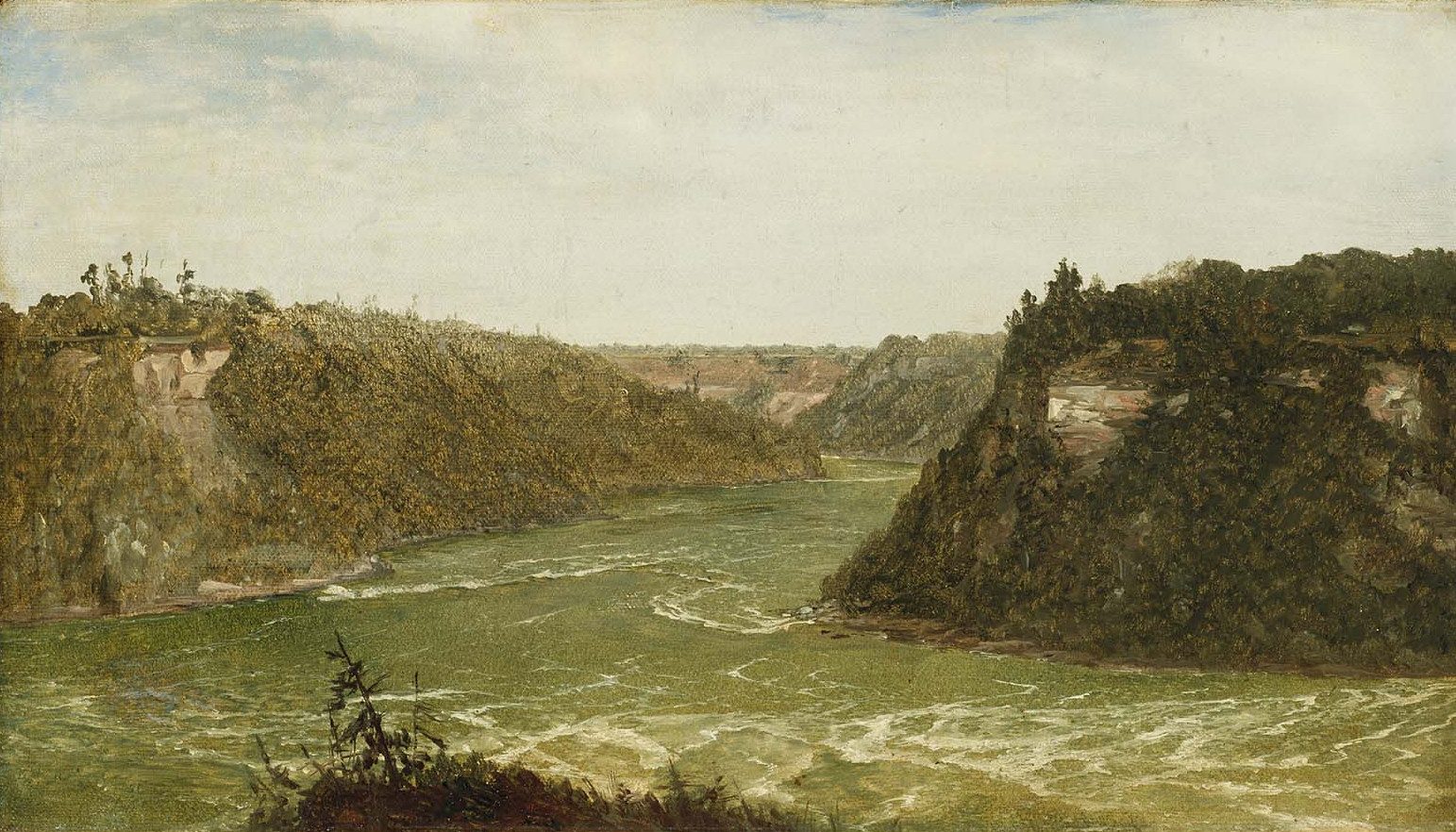
Whirlpool, Niagara by American landscape painter John Frederick
Kensett depicts the Niagara River near Jacob Bowman's farm.
Source: Museum of Fine Arts, Boston.

Jacob Bowman was likely freed in the spring of 1783 after spending nearly three years in captivity. After the formal cessation of hostilities on 1 Apr 1783, George Washington ordered that prisoners of war be "conducted from their places of detention." Jacob's petition indicates that he was "conducted" to New York, where he appears on a "list of destitute persons" dated 26 May 1783. Jacob was later "sent to Quebec" where he would have reunited with Elizabeth before heading to Fort Niagara.

Jacob and Elizabeth appear on the Return of Loyalists at Niagara dated 30 Nov 1783 with five of their six daughters. Adam and Peter Bowman are listed elsewhere. At this time Abraham was still with the Kings Royal Regiment of New York, however, he rejoined his family at Niagara after the regiment was disbanded on 23 Dec 1783.

Missing from the return is Jacob and Elizabeth's daughter Margaret (1764-1841). Margaret at some point married Lieutenant Solomon Secord (1755-1799), son of James Secord and Madelaine Badeau, however, neither the 1783 Return of Loyalists at Niagara or the 1784 List of Persons or the 1786 provisioning list show that Solomon was married. In his Upper Canada Land Petition dated 15 Dec 1796, Solomon states that his daughters Clementine and Nancy were born before 1789. Clementine's gravestone at Homer Cemetery indicates that she born about 1784. The 1787 Census compiled by Robert Hamilton shows Solomon married and with one child.

After Butler's Rangers were disbanded in June 1784, Jacob was allocated 200 acres (Lots 57 and 59) in Township 2 (later Stamford Township) on the west side of the Niagara River adjacent to the Whirlpool Rapids. He was granted patent to both lots on 31 Dec 1798. In November 1802, Jacob sold both lots to his son Abraham Bowman for £500.

Group of Bowman Gravestones at Stamford Presbyterian Cemetery

Elizabeth Bowman died at Stamford on 28 Jan 1800 at the age of 61, and is buried in the Stamford Presbyterian Cemetery.

Jacob's second wife, Ann, is not named in Jacob's will, so that marriage may have occurred after 1806. Ann died in 1820 and was buried beside Jacob and Elizabeth in the Stamford Presbyterian Cemetery.

Jacob's will was dated 20 Jun 1806. In it he gave £20 to each of his daughters (except Margaret who only got £12), and either a cow or a sheep (except Hannah who got one of each). The remainder of his estate was equally divided between Adam and Peter. Adam was named as executor. Strangly, Abraham was not named in his father's will.

Jacob Bowman died at Stamford on 15 Oct 1815 at the age of 77 and is buried between his two wives in the Stamford Presbyterian Cemetery.

Sources:

Almon, John (ed.). The Remembrancer, or Impartial Repository of Public Events, Vol 7. London, 1779

Canniff, William. History of the Settlement of Upper Canada. Toronto: Dudley & Burns, 1869.

Crowder, Norman. Early Ontario Settlers: A Source Book. Baltimore: Genealogical Publishing, 1993.

Cruikshank, Ernest A., and Gavin K. Watt. The History and Master Roll of the King's Royal Regiment of New York. Revised ed., Carleton Place, Ontario: Global Heritage Press, 2006.

Harvey, Oscar Jewell. A History of Wilkes-Barré, Luzerne County, Pennsylvania : from its first beginnings to the present time, including chapters of newly-discovered early Wyoming Valley history, together with many biographical sketches and much genealogical material. Wilkes-Barre: The Raeder Press 1909.

Harvey, Oscar Jewell. The Harvey Book: giving the genealogies of certain branches of the American families of Harvey, Nesbitt, Dixon and Jameson, and notes on many other families, together with numerous biographical sketches. Wilkes-Barre: E.B. Yordy & Co., 1899.

Jones, J. Kelsey. Loyalist Plantations on the Susquehanna. Self-published, 2009. https://docplayer.net/100900251-Loyalist-plantations-on-the-susquehanna-j-kelsey-jones-updated-2009.html

Library and Archives Canada. Land Petitions of Upper Canada, 1763-1865

Library and Archives Canada. Haldimand Papers (MG21, Add. MSS 21765, Volumes B105, B166, B167, B168)

Matthews, Hazel. The Mark of Honour. Toronto: University of Toronto Press, 1965

Miner, Charles. History of Wyoming: In a Series of Letters, From Charles Miner, to His Son William Penn Miner. Philadelphia: J. Crissy, 1845.

Ousterhout, Anne M. “Frontier Vengeance: Connecticut Yankees vs. Pennamites in the Wyoming Valley.” Pennsylvania History: A Journal of Mid-Atlantic Studies, vol. 62, no. 3, 1995, pp. 330–363. JSTOR, www.jstor.org/stable/27773826.

Penrose, Maryly. Baumann/Bowman Family of the Mohawk, Susquehanna, and Niagara Rivers. Franklin Park, New Jersey: Liberty Bell Associates, 1977.

Ryerson, Egerton. The Loyalists of America and Their Times. Toronto: William Briggs, 1880.

Smy, William. An Annotated Nominal Roll of Butler's Rangers 1777-1784. Welland, Ontario: Friends of the Loyalist Collection at Brock University, 2004.

Smy, William A., editor. The Butler Papers: Documents and Papers Relating to Colonel John Butler and His Corps of Rangers. Brock University Library Archives & Special Collections, 1994. https://dr.library.brocku.ca/handle/10464/9242

Stone, William L. The Poetry and History of Wyoming: Containing Campbell's Gertrude and the History of Wyoming from its Discovery to the Beginning of the Present Century. New York: Mark H. Newman, 1844.

Watts, Gavin. Loyalist Refugees: Non-Military Refugees in Quebec 1776-1784, Global Heritage Press, 2014.

Sunday, August 23, 2020

And Only One Pair of Shoes (Part 1)

In her 1861 letter to Rev. Egerton Ryerson, Elizabeth Spohn describes the arrival
of "five women, thirty-one children, and only one pair of shoes" at Fort Niagara
during the Revolutionary War.
James hesitated a moment. "I was three years old at the beginning of the war, when my mother escaped with us to Niagara. There were five women with thirty-one children. I was the youngest. We made it to a shelter at Fort Niagara in November of '76. A terrible winter. It was a nightmare. We nearly froze to death and arrived half-starved. Mother says we almost died—the lot of us."

Connie Brummel Crook, Acts of Courage

Elizabeth Bowman stirred her large, cast-iron stew pot, looked into the fire, and sighed. It hardly seemed possible. The war was over. Her family had lost everything and for what? She remembered vividly the autumn night when rebels had sacked her home on the Susquehanna River and carried off her husband and oldest boy. So great had been her terror that her youngest had been born prematurely within the half hour. She and her seven remaining children had been left with literally nothing; it it had not been for friendly Indians, they would have starved that winter. In the spring, she had led her brood to the Mohawk River where they had attempted, with several other husband-less Loyalist families, to grow corn and potatoes. The British commandant of Fort Niagara had had them brought off in the fall, five women and thirty-one children with only one pair of shoes among them.

Bruce Wilson, As She Began

Quite a few authors1 have used the story of five women, thirty-one children and only one pair of shoes to illustrate the hardships faced by Loyalist women during the American Revolution. The story has its origins in a letter written in 1861 by Elizabeth Spohn to the Reverend Egerton Ryerson. The letter, which was later included in Ryerson's The Loyalists of America and their Times, is an account of the struggles of Elizabeth's Loyalist grandparents, Jacob and Elizabeth Bowman. Elizabeth describes how her grandfather and uncle were captured, imprisoned, released, and captured again; and how her grandmother and her seven other children eventually arrived at Fort Niagara.

Elizabeth Spohn's letter first appeared in print in 1875 when Ryerson, a Methodist minister, politician, and public education advocate, asked the Christian Guardian to publish the letter along with her obituary. Ryerson also appears to have shared the letter with Dr. William Canniff who included snippets of it in his 1869 History of the Settlement of Upper Canada:

The Rebels, on one occasion, entered a house and stripped it of everything, even the bed on which lay a woman on the point of confinement. But a single sheet was left to cover the woman upon a winter’s night, who, before morning became a mother. In 1776, there arrived at Fort George, in a starving state, Mrs. Nellis, Mrs. Secord, Mrs. Young, Mrs. Buck and Mrs. Bonnar [sic], with thirty-one children, whom the circumstances of the rebellion had driven away.

In the process of researching the experiences of the Secord and Beebe families during the Revolutionary War, I have often encountered references to this letter. It would appear that a plethora of genealogists and family historians have treated the Spohn letter as a definitive source of information about the Bowman family. In doing so they have ignored available primary sources and the historical context. They have forced the facts to fit the narrative, rather than adapt the narrative to reflect the facts.

It should be obvious that a letter written eighty years after the events it describes would have errors. Even Elizabeth Spohn recognized this:

I have no memorandum to refer to. I have just related the tale I have often heard my parents tell, without any exaggeration, but with many omissions.
Part 2 of "And Only One Pair of Shoes" will take a critical look at Elizabeth Spohn's account, and will place her narrative in the context of several primary and secondary sources. But first, the letter as it appeared in Ryerson's The Loyalists of America and their Times, published in 1880:
Ancaster, July 23rd, 1861

Rev. and Dear Sir,—

    I have long wished some person would give the world a true history of that much-traduced and suffering people, the U.E. Loyalists; and I assure you that when your circular came I was greatly rejoiced to learn that they would at least get justice from such an able source as yourself; and if the plain narrative of the sufferings of my forefathers will assist you in the least in your arduous and praiseworthy undertaking, I will be exceedingly gratified.

    My great-grandfather emigrated from Germany in the reign of Queen Anne. He settled near the Mohawk river, at a creek that still bears his name (Bowman's Creek). My grandfather, Jacob Bowman, joined the British army in the French war; at the conclusion of peace he was awarded 1,500 acres of land on the Susquehanna river, where he made improvements until the revolutionary war broke out. The delicate state of my grandmother obliged him to remain at home, while nearly all that remained firm to their allegiance left for the British army.

He was surprised at night, while his wife was sick, by a party of rebels, and with his eldest son, a lad of sixteen years of age, was taken prisoner; his house pillaged of every article except the bed on which his sick wife lay, and that they stripped of all but one blanket. Half an hour after my grandfather was marched off, his youngest child was born. This was in November. There my grandmother was, with an infant babe and six children, at the commencement of winter, without any provisions, and only one blanket in the house. Their cattle and grain were all taken away.

My father, Peter Bowman, the eldest son at home, was only eleven years old. As the pillage was at night, he had neither coat nor shoes; he had to cut and draw his firewood half a mile on a hand-sleigh to keep his sick mother from freezing; this he did barefooted. The whole family would have perished had it not been for some friendly Indians that brought them provisions. One gave my father a blanket, coat and a pair of mocassins. A kind squaw doctored my grandmother, but she suffered so much through want and anxiety that it was not until spring that she was able to do anything. She then took her children and went to the Mohawk river, where they planted corn and potatoes; and in the fall the commander of the British forces at Niagara, hearing of their destitute situation, sent a party with some Indians to bring them in. They brought in five families: the Nellises, Secords, Youngs, Bucks, and our own family (Bowman), five women and thirty-one children, and only one pair of shoes among them all. They arrived at Fort George on the 3rd of November, 1776; from there they were sent first to Montreal, and then to Quebec, where the Government took care of them—that is, gave them something to eat and barracks to sleep in. My grandmother was exposed to cold and damp so much that she took the rheumatism, and never recovered.

In the spring of 1777 my father joined Butler's Rangers, and was with Colonel Butler in all his campaigns. His brother, only nine years old, went as a fifer.

But to return to my grandfather, Jacob Bowman: his captors took him and his son to Philadelphia, where he was confined in jail eighteen months. An exchange of prisoners then took place, and they were sent to New York; from there he, with his son and Philip Buck, started for their homes, not knowing that these homes they never would see again, and that their families were far away in the wilds of Canada. The third evening after they started for their homes, they came to a pond, and shot some ducks for their supper. The report of their guns was heard by some American scouts, who concealed themselves until our poor fellows were asleep, when they came stealthily up and fired. Six shots took effect on my uncle, as he lay with his hat over his ear. Five balls went through it, and one through his thigh. My grandfather and Buck lay on the opposite side of the fire. They sprang into the bushes, but when they heard the groans of my uncle, grandfather returned and gave himself up. Buck made his escape. They then marched off, carrying the wounded boy with them.

They were taken to the nearest American station, where grandfather was allowed the privilege of taking care of his wounded son. As he began to recover, grandfather was again ordered to abjure the British Government, which he steadfastly refused to do. He was then taken to Lancaster jail, with Mr. Hoover. They were there fastened together by a band of iron around their arms, and a chain with three links around their ankles, the weight of which was ninety-six pounds; and then fastened by a ring and staple to the floor. In that condition they remained either three years and a half or four years and a half, until the flesh was worn away and the bones laid bare four inches.

Men, women, and children all went to work, clearing land. There were none to make improvements in Canada then but the U.E. Loyalists, and they, with their hoes, planted the germ of its future greatness. About this time, my father with his brother returned from the army; they helped their father two years, and then took up land for themselves near Fort Erie.

My father married the daughter of a Loyalist from Hudson, North River (Mr. Frederick Lampman); he was too old to serve in the war, but his four sons and two sons in-law did. They were greatly harassed, but they hid in the cellars and bushes for three months, the rebels hunting them night and day. At length an opportunity offered, and they made their escape to Long Island, where they joined the British army. One of his sons, Wilhelmus Lampman, returning home to see his family, was caught by the rebels within a short distance of his father's house, and hanged, because, as they said, he was a Tory.

At the restoration of peace, the whole family came to Canada. They brought their horses and cattle with them, which helped to supply the new country. They settled in the township of Stamford, where their descendants are yet.

My father settled on his land near the fort; he drew an axe and a hoe from Government. He bought a yoke of yearling steers; this was the amount of his farming utensils. Mother had a cow, bed, six plates, three knives, and a few other articles. It was the scarce year, on account of the rush of Loyalists from the States, who had heard that Canada was a good country, where they could live under their own loved institutions, and enjoy the protection of England.

The amount of grain that the U.E. Loyalists had raised was hardly sufficient for themselves; still they divided with the new comers, as all were alike destitute. After planting corn and potatoes, they had nothing left. My father cleared two acres, on which he planted corn, potatoes, oats, and flax; his calves were not able to work, and he had to carry all the rails on his shoulders until the skin was worn off them both. This was the way he made his first fence. In the beginning of May [1789], their provisions failed; none to be had: Government promised assistance, still none came. All eyes turned toward their harvest, which was more than three months away; their only resource was the leaves of trees. Some hunted ground nuts; many lived on herbs; those that were near the river, on fish. My father used to work until near sun-down, then walk three miles to the river, get light wood, fish all night, in the morning divide the fish, carry his share home on his back, which they ate without bread or salt. This he did twice a week, until the middle of June, when the moss became so thick in the river that they could not see a fish; still they worked on, and hoped on every day. My father chopped the logs and they had milk for their breakfast, then went to work until noon; took their dinner on milk; to work again till night, and supped on milk. I have frequently heard my mother say she never was discouraged or discontented; thankful they were that they could eat their morsel in peace.

Their only crime was loyalty to the Government which they had sworn fealty to. The God of Heaven saw all this, and the sword of vengeance is now, in 1861, drawn over the American people (now they know how to appreciate loyalty), and will perhaps never be sheathed again until they make some restitution for the unheard-of cruelties they inflicted upon those most brave and loyal people.

At the close of the war they were liberated. Grandfather was sent to the hospital for nearly a year, but his leg never got entirely well. As soon as he was able to walk, he sent for his family (it had been eight years since he saw them): they had suffered everything but death. Coming in the boats from Quebec, they got out of provisions and were near starving. He never had his family all together again. He drew land near the Falls of Niagara, where he went to work in the woods, broken down with suffering, worn out with age; his property destroyed, his land confiscated, and his family scattered; without money or means, and worse than all, without provisions. Still, to work they went with willing hands and cheerful hearts, and often did he say he never felt inclined to murmur. He had done his duty to God and his country; his own and his family's sufferings he could not help. Theirs was not a solitary case; all the Loyalists suffered. The Government found seed to plant and sow the first year; they gave them axes and hoes, and promised them provisions. How far that promise was fulfilled, you well know; they got very little; they soon found that they had to provide for themselves.

As soon as the wheat was large enough to rub out, they boiled it, which to them was a great treat. Providence favoured them with an early harvest; their sufferings were over, and not one had starved to death. They now had enough, and they were thankful. Heaven smiled, and in a few years they had an abundance for themselves and others.

I have no memorandum to refer to. I have just related the tale I have often heard my parents tell, without any exaggeration, but with many omissions. I have not told you about my father's sufferings in the army, when, upon an expedition near Little Miamac, he and some others were left to carry the wounded. They got out of provisions: went three days without anything to eat, except one pigeon between nine. I will give you his own words. He says: "The first day we came to where an Indian's old pack-horse had mired in the mud; it had lain there ten days in the heat of summer; the smell was dreadful; still some of our men cut out slices, roasted and ate it; I was not hungry enough. The next day I shot a pigeon, which made a dinner for nine; after that we found the skin of a deer, from the knee to the hoof. This we divided and ate. I would willingly, had I possessed it, have given my hat full of gold for a piece of bread as large as my hand. Often did I think of the milk and swill I had seen left in my father's hog-trough, and thought if I only had that I would be satisfied."

Such were some of the sufferings of my forefathers for supremacy. They have gone to their reward. Peace to their ashes!

Elizabeth Bowman Spohn

P.S.—One thing more I must add: My father always said there never was any cruelty inflicted upon either man, woman or child by Butler's Rangers, that he ever heard of, during the war. They did everything in their power to get the Indians to bring their prisoners in for redemption, and urged them to treat them kindly; the officers always telling them that it was more brave to take a prisoner than to kill him, and that none but a coward would kill a prisoner; that brave soldiers were always kind to women and children. He said it was false that they gave a bounty for scalps. True, the Indians did commit cruelties, but they were not countenanced in the least by the whites.

E.S.

1 See also Peter Newman, Hostage of Fortune: The United Empire Loyalists and the Making of Canada; Helen Matthews, Mark of Honour; Merril D. Smith, Women's Roles in Eighteenth-Century American; Alexander Cain, I See Nothing But the Horrors of a Civil War; Walter S. Herrington, Heroines of Canadian History; Janice Potter-MacKinnon, While the Women Only Wept: Loyalist Refugee Women; Don Gillmor and Pierre Turgeon, Canada: A People's History;  Janet Carnochan, History of Niagara; and Gavin Watts, Fire and Desolation: The Revolutionary War’s 1778 Campaign as Waged from Quebec and Niagara Against the American Frontiers.