Thursday, March 6, 2014

A Respectable Woman

Gravestone of Michael Snell (1788-1810)
at St Giles in the Wood
Mary Ann Isaac was born in Yarnscombe, Devon in 1788, the youngest of three children of Hugh Isaac and Ann Cheek. Little is known about her childhood, although it was somewhat usual to grow up in a family with so few children.

In September of 1808, Mary married Michael Snell, youngest son of William Snell and Rebecca Cooke of Dodscott in the neighbouring parish of St Giles in the Wood. Mary Ann was pregnant at the time of her marriage, as her son William was born early the following year.

Then tragedy struck. Michael died in November of 1810 at the age of 32. At the time Mary Ann was pregnant with her second child, Michael, who was born in early 1811.

Michael Snell's will was proven at Barnstaple a month after his death. The will is somewhat unusual in that it provides both for his son William and for his unborn child.

After her husband's death, Mary Ann likely lived with her parents. Her mother died in the summer of 1811. Seven years later, she married Thomas Joce of Yarnscombe.

Ann and Thomas had two children:  James William who was born in 1821, and Mary Jane was born in 1829. In 1841, Thomas was a farmer living at Slees, Yarnscombe with Mary Ann and his two children.

Mary Ann should have lived an ordinary life as the wife of respectable farmer, except for two incidents. In January 1846, Mary Ann was accused by Mrs. Cory of the Fortescue Arms Inn in Barnstaple of having stolen a sable muff. The case generated considerable interest, and was the subject of two lengthy articles in the North Devon Journal, likely because Mary Ann was "a respectable woman." Mary Ann was a regular vendor at the Barnstaple Market, selling poultry and vegetables. On January 30, 1846, Mrs. Cory purchased a turkey from Mary Ann, but accidentally left her sable muff behind. When Mrs. Cory later returned to the market, Mary Ann at first denied having seen the muff, although other nearby vendors were certain that they had seen it with her. Mary Ann then stated that another woman had claimed the muff shortly afterwards. The magistrates concluded that there was enough evidence to send Mary Ann to trial. At her trial in April she was found guilty and sentenced to three months imprisonment.

Three years later, Mary Ann was in trouble with the law again, although this time it was her husband and son who were charged. When a sheep went missing from the flock of Samuel Davis, suspicion fell upon the family of Thomas Joce. Although Mary Ann and her husband willingly allowed their house to be searched, they refused to account for the 50 pounds of mutton that was being pickled in salt and obvious signs that a sheep had recently been butchered. The evidence was sufficient for the magistrates to commit Thomas and his son James to trial. At their trial, however, the Court ruled that there was no case whatsoever against James, and that there was insufficient evidence to show that Thomas had stolen the sheep, despite "strong circumstantial evidence" and the suspicious behaviour of his wife. The North Devon Journal noted that Thomas "
is very respectfully connected, and has always been considered an honourable man and a man of some substance."

Thomas died in October of the following year. Mary Ann followed him to the grave four months later.
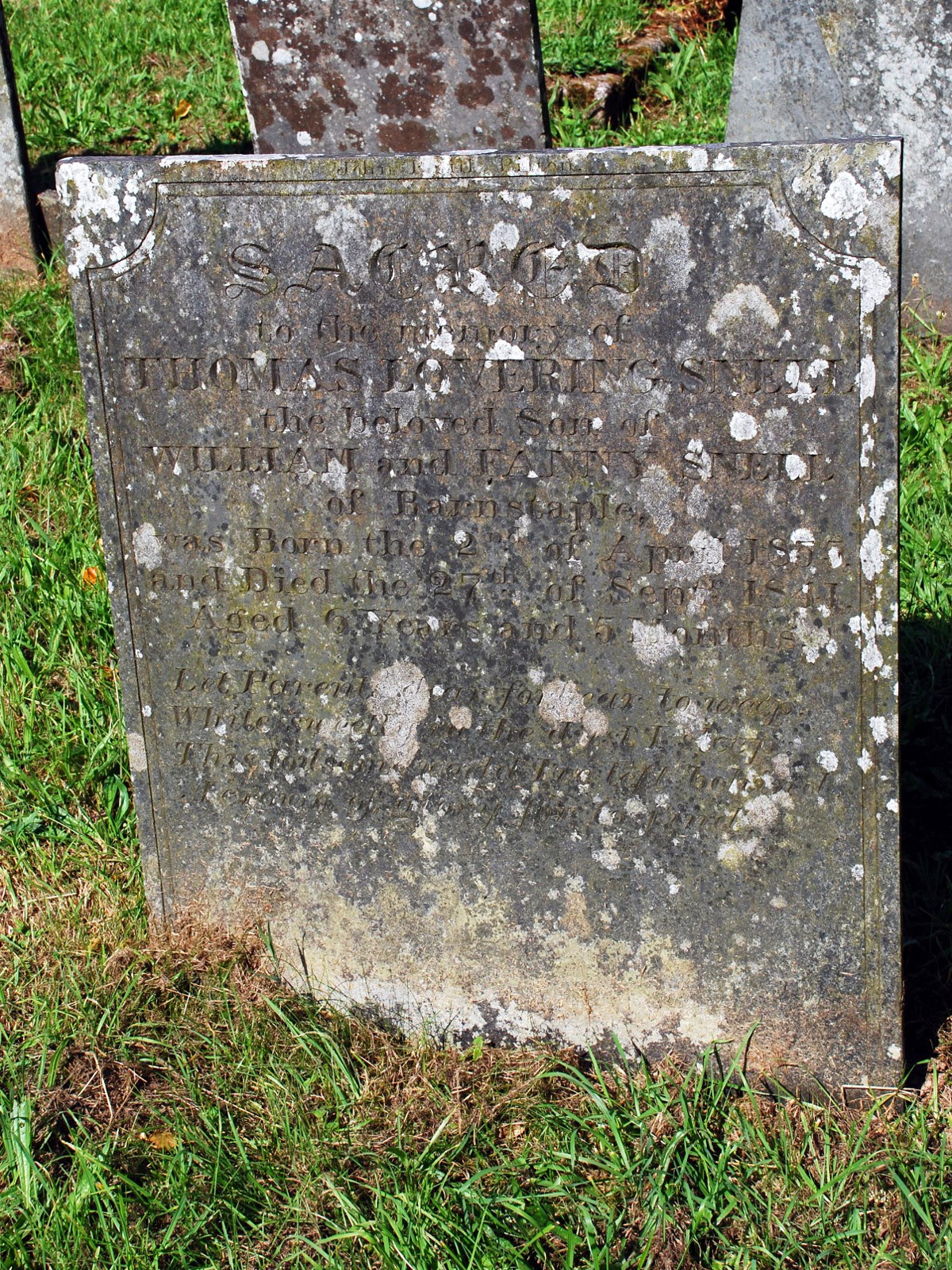

Gravestone of Thomas Lovering
Snell (1835-1841) at Tawstock
Mary Ann's oldest child, William Snell, is something of a mystery. According to the terms of his father's will, he would have received half of his father's estate as well as his father's watch when he turned 21 in 1830. A year later he married Fanny Lovering of Tawstock. Four children followed: William, Michael, Thomas Lovering, and Elizabeth.

Here begins the mystery. William Snell does not appear in the 1841 Census. His wife Fanny is a servant at the Vicarage in Bishops Tawton, Devon. Two children live with another family in Bishop's Tawton, while the youngest, Elizabeth, is living with her aunts in Tawstock. Their other child, Michael, is living with his grandmother, Mary Ann Joce. Thomas died later that year and is buried at Tawstock.

In 1851, Fanny is still a servant at the Vicarage, the children are still living with relatives or elsewhere, and William Snell is a lodger in Finsbury, Middlesex. 1851 also saw the death of William and Fanny's son Michael.

In 1861, William is back in Barnstaple, while Fanny is now living with her brother-in-law in Landkey, Devon. In 1864, William death at Landkey was announced in the North Devon Journal. Fanny died at Barnstaple nine years later.

Advertisement in Trewman's Exeter Flying Post

His brother Michael Snell seems to have been far more successful. Michael established himself as a Wine and Spirit Merchant in Barnstaple, Devon. Several flagons bearing his name survive, and advertisements appeared frequently in the North Devon Journal and Trewman's Exeter Flying Post.

Michael married Eliza Sharland Taylor, eldest daughter of Isaac Taylor and Ann Sharland, at Tiverton, Devon in May 1837. Their daughter Ellen Taylor SNELL was born the following February. Nine months later Eliza died, leaving Michael a widower with a infant child. Ellen was sent to live with her maternal grandparents but eventually returned to Barnstaple to live with her father.

In 1843, Michael married Elizabeth Bowden, third daughter of John Bowden and Mary Keen of Berrynarbor, Devon. Michael and Elizabeth had eight children, six girls and two boys, five who survived to adulthood.

Sometime after 1871, Michael retired to Lee Cottage in Berrynarbor. Elizabeth died in 1888. Michael died in 1895 at the age of 84. Their son Michael, a stockbroker, landowner and justice of the peace, continued to live in the area until his death in 1932. Inside Berrynarbor church is a commemorative plaque describing him as a "generous benefactor of this Church and Parish."


Sources:

North Devon Journal, Thursday, February 12, 1846
North Devon Journal, Thursday, April 16, 1846
North Devon Journal, Thursday, July 5, 1849
Trewman's Exeter Flying Post, Thursday, July 5, 1849
Western Times, Saturday, July 7, 1849

Sunday, January 19, 2014

The Descendants of John Lewis (1817-1897)

Advertisement in the North Devon Journal
During the mid-19th century there was a wave of emigration from Devon to Canada. Part of this exodus was my ggg-grandfather, John Lewis. My ggg-grandfather was born in Filleigh, Devon in 1817. His father, John Lewis (1782-1871), an agricultural labourer, had married Hannah Parker at Filleigh in 1815. My ggg-grandfather was their second child.

In 1839, my ggg-grandfather, then an agricultural labourer living in Charles, Devon, married Elizabeth Stevens, daughter of William Stevens and Elizabeth Huxtable of East Buckland. Elizabeth was a year older than John. Their first child, Eliza, was born the same year. William, my great-grandfather, was born two years later, and was followed by Hannah in 1843, John in 1848, and Elizabeth in 1850.

Sometime after Hannah's birth, John moved his family to North Molton, Devon. At the time of the 1851 census, he was a farmer of 56 acres living at Higher Leigh, North Molton. Like most of North Molton, Higher Leigh was owned by George Bampfylde, 1st Baron Poltimore. The following year, John and his family emigrated to Canada.

As some point prior to emigrating, my ggg-grandfather became a member of the Bible Christian church, a Methodist denomination founded by William O'Bryan in 1815. Many of the emigrants from North Devon were Bible Christian and helped spread the denomination into Canada. John was an active member of the Church and a lay preacher.


John and his family likely sailed from Bideford to Quebec City. There are two candidates for the ship they sailed on. One possibility is the barque Secret, which sailed on April 3rd and arrived at Quebec City on May 5th. An account of the departure of the Secret appeared in the North Devon Journal of April 8, 1852:
DEPARTURE OF THE 'SECRET.'—At five o'clock on Saturday morning, amidst the firing of cannon, and cheering of those on board the emigrant ship, the 'Secret,' was towed as far as the pool by the 'Princess Royal,' and in the afternoon of the same day the voyagers to Yankeeland has the honour of being joined by a little stranger who had just come into the world to make the voyage of life by commencing it on the seas, to be rocked and cradled by its waves, whilst the wild winds sing its lullaby. We refer to the fact of a Mrs. Wilton giving birth to a fine son, who, in honor of the event, was named John Secret Wilton. On Monday, she crossed the bar and crowded all sail for her destination. The afternoon being beautifully fine, several of our townsmen accompanied her to a distance of four of five miles. At last the time came for parting; and, after a few interchanges of cheering sentiments, and the sincerest expressions of goodwill, they parted company, those on board the 'Secret' firing a salute as a last farewell. We also say 'farewell;' and, whilst they think of their friends at home and anticipate the land of their hopes, we will sing—

God speed ye, brethren, o'er the main;
We never more may meet again,
But, if kind prayers avail,
This morning orisons shall rise,
And piece the circumanbient skies,—
God send a prosperous gale!

We are happy to find that so many have already started under such auspicious circumstances, and that it is our province to say "Still there is room." The 'Worthy' has a few berths to spare. A word to the wise in enough; and, therefore, to those intending to emigrate this season we have no need to say—Take time by the forelock!
The Secret made a second voyage to Quebec that year, departing Bideford on July 11th.

Another other possibility is the Worthy of Devon which departed Bideford on April 17th and arrived at Quebec in early June. On its second voyage of the year the Worthy arrived at Quebec City on July 22nd after a passage of 26 days. Both vessels were owned by Richard Heard of Bideford who also transported emigrants to Prince Edward Island. Advertisements frequently appeared in the North Devon Journal promising:
...excellence of the accommodations, the approved sailing qualities of their vessels, the ability and civility of their commanders, and the exceedingly low rate of passage required, are advantages which persons about to cross the Atlantic from these parts will be likely to appreciate.
On the return voyage the ships carried pine, oak and birch logs that Heard would then sell in his Bideford timber yard.

In October 1852, John purchased 200 acres of land (Lot 16 Concession 11) in Stephen Township, part of the Huron Tract, from the Canada Company. The Canada Company was a large British land development company that assisted emigrants by providing inexpensive transportation, implements and tools, and cheap land. Two of Elizabeth's brothers later emigrated to Stephen Township as well: John Stevens and Michael Stevens. There is evidence that John's younger brother George also emigrated with his family to Canada and settled in the Huron Tract a few years later.

Whether John occupied his property in the fall of 1852 is unclear. A number of emigrants to Canada West appeared to have found lodging and work for the winter in Toronto or Hamilton for the winter, and then headed for the Huron Tract in the spring.

Getting to the Huron Tract from Quebec in the early 1850s was a significant undertaking as the railroads were not opened until later that decade. John and his family likely travelled by a succession of steamers, the first from Quebec to Montreal, a second up the Ottawa River and through the Rideau Canal to Kingston, and a third along the north shore of Lake Ontario to Toronto or Hamilton. From there it was likely northwest to Guelph and then west along the Huron Road to Stephen Township.
 

Fryfogel Tavern on the Huron Road
The Canada Company arranged to have a number of inns built along the Huron Road to accommodate emigrants. John and his family may have spent a night at the Fryfogel Tavern located east of the Village of Shakespeare. Built in the Neoclassic style in 1845, this two story brick and fieldstone building is now a registered historic site.   

Another possibility, however, is that John and his family continued aboard steamers through the Welland Canal, along the north shore of Lake Erie to Port Stanley, and then overland, first to London, and then north along the London Road to Stephen Township.

Upon arrival the process of clearing the land and building a log cabin would begin. Animals would be brought in: a yoke of oxen, a cow, pigs, sheep and fowl. A garden would be dug and planted. Once clear of trees, the land would be first ploughed and then harrowed, and a crop sewn.

By 1861, John and Elizabeth had had at least two more children: Mary Jane, born in 1857 and Michael, born in 1859. There is a seven year gap between Mary Jane and her older sister Elizabeth, so it is possible that there were one or two other children who died very young.

Eliza is a mystery. She was living with her family in 1841 and 1851 and so presumably emigrated with them to Canada, but she does not appear with them in the 1861 Census.

The first of the children to marry was my gg-grandfather, William Stevens Lewis, who married Lydia Mary Madge in 1863. Lydia, the daughter of Walter Madge and Mary Webber, was born in Meeth, Devon in 1843 and had come to Canada in 1849. William and Lydia had three children: Mary Elizabeth, William Wesley, and Lydia Mary. Lydia died shortly after the birth of her second daughter, leaving William a widower with three small children. Less that a year afterwards he married Charlotte Jory, a young widow with two daughters. William and Charlotte went on to have five more children.


At some point William started practicing as a veterinary surgeon, and and from 1880 to 1917 he was Division Court Clerk. Like his father he was a lay preacher, and an active member of the Bible Christian Church. In 1884 the Bible Christian Church merged with the Methodist Episcopal Church and the Primative Methodist Church to become the Methodist Church of Canada. William died in 1921 at the home of his daughter Effie, the wife of Francis Clark.
 
Home of Samuel and Hannah Langford
Next to marry was John and Elizabeth's daughter Hannah. In 1865, Hannah married Samuel Langford, a widower from Cornwall, England with two children. They lived in Lambton County for over ten years then crossed the St. Clair River into Michigan where they live for a few years in St. Clair County. Six children were born in Canada and two in the United States. The youngest, unfortunately, died in 1877.

In the spring of 1881, Samuel travelled west with his eldest son to North Dakoka to begin homesteading in Griggs County. A history of Griggs Country describes Hannah's journey to join her husband later that year.
Late in August, delicate in frame, gentle by nature, but with indomitable spirit, Hannah Langford began the long journey with their eight children. She brught with them the household goods, twenty chickens, and a pure bread cow.... She came by boat to Duluth and train to Sanborn, North Dakota, where Mr. Langford met them with two wagons pulled by oxen.
Samuel Langford was also a veterinary surgeon. Samuel and Hannah had one more child, Minnie, who was born in 1885. Samuel died in 1913 and Hannah in 1923.

William and Hannah's brother John married Elizabeth Camm in 1868. Their first four children were born in Stephen Township. In 1878 he also crossed the St. Clair River into Michigan and lived in Sanilac County.

Last to marry was Elizabeth (1850-1916). In 1876 she married Roland Ferguson Johnstone (1849-1916) in Detroit, Michigan. They lived in Harbor Springs, Michigan and had no children.


According to his death certificate, Michael Lewis was murdered in 1874 at the age of 15. No newspaper account of his death survives, however, his gravestone in Exeter Cemetery bears this epitaph:

Beneath this stone our child doth lay
From us his life was taken away
In the field where he did stand
 

There should be a fourth line, however, at some point this line was physically removed from the stone.

Michael's sister, Mary Jane, committed suicide in 1878 at the age of 20.

Lewis Gravestones, Exeter Cemetery
Sometime before 1879, John moved to Lot 5 Concession 8 of Stephen Township. When Elizabeth died in 1885, she was buried beside her son and daughter in Exeter Cemetery. The three adjacent gravestones are surrounded by daylilies. John died in 1897 and was buried nearby. In his will he named his daughters Hannah and Elizabeth, and his sons William and John. 

William Wesley and Edith Lewis
After the death of his mother, my great-grandfather, William Wesley Lewis, spent considerable time at the farm of his maternal grandparents. In 1888 he travelled to Manitoba in order to homestead, journeying by train to Brandon and then walking with a team of oxen to the site of his future farm west of Hamiota. His first home was a sod shanty with a sod roof, and his first crop of potatoes was planted on the roof. In 1890, he married Edith Smith, daughter of Henry and Elizabeth Smith in Brandon. Edith had been born in Dolton, Devon. Wesley and Edith had two boys and four girls including my grandmother Hazel who was born in 1900.

In 1920 Wesley and Edith moved to Winnipeg where Wesley worked for the railroad. The Hamiota property was rented out until 1926 when Wesley asked his son Sidney to move back to the homestead.

Edith died in 1954 followed by Wesley in 1960 at the age of 93. Several of their descendants still live in the Hamiota area.

William Wesley Lewis with his daughters
Nora and Hazel

Thursday, January 2, 2014

A Child Arsonist at Dodscott

West Dodscott, St Giles in the Wood, Devon

Dodscott is a small hamlet in the parish of St Giles in the Wood, Devon, about one kilometre east of the village, and was listed in the Domesday Book of 1086. The hamlet historically consisted of  three farms with the unimaginative names of East Dodscott, West Dodscott and Great Dodscott. In the 16th century Great Dodscott had likely been the home of Thomas Chafe (1585-1648) whose effigy is found inside the church of St Giles in the Wood. Chafe was the brother-in-law of Tristram Risdon (1580-1640), author of Survey of the County of Devon.

During the 19th century all three farms (indeed most of St Giles in the Wood) were part of the Rolle Estates and were leased to tenants. The same family would often occupy the farm through several generations. East Dodscott, for example, had been occupied from before 1742 to 1786 by my ggggg-grandfather Michael Cooke (1707-1777), and then by my gggg-grandfather George Cooke (1742-1821).

In 1868 Dodscott suffered two incidents of arson. Arrests were quickly made in both cases. The alleged perpetrators? Two fourteen and one eleven year old girl.

William Squire had occupied Great Dodscott since the death of his father Robert Squire in 1858. Shortly after he returned home from Stevenstone on the morning of Wednesday, September 9, 1868, Squire discovered that a linhay (a shed with an open front) was on fire. A lack of water meant that the fire "spread with great fury" to the other outbuildings and to the farmhouse. Fortunately, Squire was able to save most of his household goods. Suspicion fell upon two fourteen year old girls with a donkey and cart who Squire had seen at the gate to his farm: Elizabeth Copp and Polly Diment.

Elizabeth, daughter of William Copp, was born in Black Torrington in 1854. Her father was a miller at Stonyford, a kilometre south of Dodscott. Mary, also known as Polly, was born in Great Torrington in 1854, the daughter of Elizabeth Diment. Both girls had been frequent visitors to South Dodscott.

Despite protesting their innocence, and despite "assisting in the removal of the household goods," Elizabeth and Polly were taken into custody on the Thursday. Their
"distressed" parents bailed them out on the Friday, and they appeared before the magistrates in Great Torrington the next day. The Bench adjourned the case for two weeks as the only evidence was that the two girls had been in the vicinity. Why the girls had been incarcerated given the slight evidence was also questioned.

Two weeks later the bench ruled that there was not enough evidence to commit the case to trail, and the charges were dismissed.

Following the fire, William Squire, his wife Fanny, and their four children moved in with William's aunt and uncle, William and Fanny Snell of West Dodscott. With them was their eleven-year-old servant, Selina Matthews.

Selina, the daughter of Thomas and Mary Mathews, was born in St Giles in the Wood in 1857. Her father was an agricultural labourer. Like many girls from poor families, Selina had entered domestic service at a very young age.

On November 4, 1868, at about four in the afternoon, a fire broke out in the loft above the stable at West Dodscott. Luckily, Snell was able to rescue the horses and prevent the fire from spreading. Suspicion, however, immediately fell upon Selina.

Selina had left the house for a few minutes before the fire, and on her return had been the one to alert Fanny Snell about smoke coming from the stable. The constabulary was summoned and when Selina was searched a box of matches was found.

Selina was taken into custody. The following day she made this statement to Eliza Babbage, the wife of Police Sergeant George Babbage:

I went out to give the pigs some corn. I was going into the stable, but was afraid the horses would kick me. I went into the shippen, took up a handful of straw, and there was a little hay in the rack. I set fire to it, and went in upstairs to make up the beds. I looked out of the window and saw smoke and fire—smoke first, and fire after. I shouldn't have done it if I hadn't been told by Polly Diment to burn Black Fan and old Will.
Black Fan and Old Will were taken to mean Fanny and William Squire, but Selina may possibly have meant Fanny and William Snell who were considerably older. Selina told Police Sergeant Babbage that she had set the fire because Polly Diment, a suspect in the South Dodscott's fire, had told her to do so. Polly strongly denied the accusation.

Selina appeared before the magistrates a few days later. The Bench committed her for trial at the Lent Assizes.

At her trial on March 11, 1869, Selina said she was sorry she did it, and began to cry. The judge in his charge to the jury said, "there could be no doubt that prisoner set fire to the stable, and it was for them to consider whether it was done with a felonious intent." The jury found the prisoner guilty with a recommendation to mercy. Selina was given a deferred sentence of two months hard labour.

Two years later Selina was a servant in the household of Thomas Shearm of Beaford.

In 1877, Selina gave birth to a son, Thomas James Matthews. The reputed father was James Hearn of Great Torrington who had promised to marry her, and had gone so far as to have banns published. James, however, had absconded, and Selina was forced to apply for a court order. The Bench made an order for two shillings a week.

In 1881, Selina was a servant in the household of Joseph Row of St Giles in the Wood. Thomas James was living with his grandfather Thomas Matthews. Thomas James also fell afoul of the law. In 1896 he was charged with "feloniously wounding Annie Hooper, with intent to murder her, and to do her grievous bodily harm." Thomas pleaded guilty and was sentenced to seven years. Annie had been Thomas's "sweetheart" but when she broke off the relationship he cut her throat with a razor.

In 1884, Selina, then an inmate of the Torrington Union Workhouse, gave evidence at an inquest into the accidental death of a infant.

Sometime before 1891, Selina "married" George Buse, a labourer who lived in Great Torrington. While no record of the marriage has been found, Selina and George had several children: John Henry in 1890, Norah Ellen in 1891, Alice Maud in 1893, Kate in 1894, Albert William in 1895 and Walter Cyril in 1897.

Selina died in Great Torrington in 1923 and was buried in Torrington Cemetery.

Sources:

North Devon Journal, Thursday, September 17, 1868
Western Times, Tuesday, September 22, 1868
North Devon Journal, Thursday, October 1, 1868
North Devon Journal, Thursday, November 12, 1868 

Exeter and Plymouth Gazette, March 12, 1869
North Devon Journal
, Thursday, January 10, 1878
North Devon Journal, Thursday, January 31, 1884
North Devon Journal, Thursday, June 25, 1896
North Devon Journal
, Thursday, May 31, 1923

Saturday, December 21, 2013

The Little Sufferer

RMS Bavarian
Old newspapers are an important resource for the family historian as they provide "colour" to what otherwise might be a dry recitation of names and dates. As the volunteer Online Parish Clerk (OPC) for the North Devon parishes of St Giles in the Wood, High Bickington, Atherington, Tawstock and Yarnscombe, I have a particular interest in the historical issues of The North Devon Journal available online through The British Newspaper Archive.

While browsing through articles that mention Yarnscombe, I came across this piece:

North Devon Journal, Thursday, October 4, 1860

CAUTION TO MOTHERS.—On Saturday last, a melancholy occurrence took place at Yarnscombe. The wife of a man named Thomas Moore, residing at Delly, in the above parish, placed her infant child, a girl aged 5 months, into the cradle, in the kitchen. Shortly afterwards the mother had occasion to leave the house for a short time, and, during her absence, a large pig found its way into the kitchen where the child was sleeping, seized the infant by the right hand and dragged it from the cradle, crushing and fracturing the bones of the hand and arm, with fearful lacerations, and was only rescued just in time by the horror-stricken mother from further injuries. Doctor Jones and his assistant (Mr. Barr) were immediately in attendance, when it was found necessary at once to amputate one finger. It is doubtful whether the little sufferer will survive the injuries it received from this brutal attack.
Curious as to whether "the little sufferer" had survived the "melancholy occurrence," I checked the 1861 Census. Rebecca Moore, daughter of Thomas Moore and Harriet Hellings, was eleven months old and living with her parents and four siblings at East Delly. Her father was an agricultural labourer who later became a road contractor. Further research showed that Rebecca's mother died in 1874, and that in 1879 her father married Mary Ann Mansfield, a woman only nine years older than Rebecca. By 1881, Thomas had moved his family to the neighbouring parish of Alverdiscott where he continued working as a road contractor. Thomas died in 1915.

In 1882, Rebecca married Frank Braunton, an agricultural labourer from Huntshaw, Devon. Her son Francis John was born in 1883, her daughter Alice Gertrude in 1886, and her daughter Annie in 1891. They lived in Alverdiscott until 1905 when they emigrated to Canada on board the RMS Bavarian and settled in North Dorchester, Middlesex. Ontario. Frank died in 1929. Rebecca died at the age of 76 in 1932. Both were buried at Dorchester Union Cemetery, however, no grave marker exists.

Friday, December 13, 2013

Neglect and Horrible Wickedness

The North Devon Journal
The Victorian appetite for gossip and scandal is clearly reflected in 19th century newspapers. A primary source were the inquests held whenever a suspicious death occurred. Journalists delighted in reporting all the lurid details, and were not above embellishing the story with rumour, innuendo and calumny.

The death of an illegitimate child in Victorian England often led to an inquest. This was a reflection of how births of out wedlock were viewed, and the belief that unwed mothers were not capable of properly caring for their children.


Once a death had been reported to the coroner, he would summon a jury, and investigate how the child died by interviewing the mother, the attending doctor, and any witnesses, as well as viewing the child's body. In rural areas these inquests were often held in public houses. Not surprisingly the jurors were often familiar with the situation of the child's mother.

Consider this article on the inquest that was held when three year old Eliza Pethebridge, the illegitimate daughter of Maria Pethebridge, died of the measles.

North Devon Journal, Thursday, November 28, 1878

DEATH OF AN ILLEGITIMATE CHILD.—NEGLECT OF THE MOTHER AND HORRIBLE WICKEDNESS.—An inquest was held at the Hunter's Inn, in this parish, on Wednesday (yesterday), before John Henry Toller, Esq., on of the coroners for the county, and a respectable jury, on view of the body of Eliza Pethebridge, aged three years and ten months, daughter of Maria Pethebridge, single woman, who lives in the house of her brother, Emanuel Pethebridge, labourer.—The first witness was Elizabeth Ballment, wife of the county policeman stationed in the village, who deposed that she knew the deceased very well, who was a healthy and well-nourished child, and did not appear to want for anything. On the evening of Friday last the child's mother came to her and told her the child was ill, and asked her to call and see her, which she did about five o'clock the same evening, and found the deceased in the arms of the mother's brother, Emanuel Pethebridge, who was nursing her by the fire. The child was dressed, but appeared very ill, and witness persuaded the mother to send for the doctor. She did not remember whether Emanuel Pethebridge made any reply, but the mother said she did not know how she would get the doctor, as she had no one to send for him. Witness saw that the child had the measles, and thought they were "going back." Had been in the habit of seeing the child daily, but not since she had had the measles, and had never heard that the mother ill-treated her in any way.—Dr. John Day Jones, physician and surgeon, of Torrington, who is the parish doctor of Yarnscombe, deposed that about half-past eight o'clock on the morning of last Saturday, the 23rd, Emanuel Pethebridge came to his house with an order from Mr. Thorne, the overseer, to give attendance to the children of Maria Pethebridge, sick with measles. He asked the man how long the children had been ill, and why he had not been sent for before; and he replied that they had been ill for a week, but the mother did not think it necessary to have the doctor. He went as soon as he could, and arrived at Yarnscombe between nine and ten o'clock. When he came to the house he found the child was dead. He saw on the body a few faint marks which resembled measles. Asked the mother why she had not sent for him earlier as he was the parish doctor, and she answered that "she knew nothing about the parish doctor," and that it was a long way to send. He told her is was a case of great neglect, and that he should not give a certificate to bury the corpse. Death had resulted from inflammation arising from partially suppressed measles. The child was well nourished, and appear to have been properly taken care of. Of course he could not say the child would have lived if he had been called in earlier, but she would have had a great chance of living.—The mother, Maria Pethebridge gave evidence that the deceased was her base child. She was taken ill on Saturday the 16th, but witness thought that she was sickening for the measles, and that a doctor was not necessary. Her neighbours told her that other children in the village had recovered from measles without the doctor, and they did not see why hers should not. The child went on from day to day, sometimes better and sometimes worse, until Friday evening, when she seemed to get worse, and witness went to the first witness (Mrs. Ballment) and asked her to come and see her, which she did. Mrs. Ballment said the child was very ill, when the witness rose up and said she would go for a doctor, but Mrs. Ballment said she would leave it until the morning. The child seemed afterwards to get a little better, but at about four o'clock next morning she became much worse, and at witness's request her brother, Emanuel Pethebridge, got up at five o'clock and went for the doctor, but at nine o'clock, before the doctor arrived, the child died.—Having heard the evidence, the jury returned a verdict that deceased had died from measles, and that the mother was neglectful in not having medical assistance earlier.—In announcing the verdict to her, the Coroner severely rebuked her for her neglect of her child; and said also that, although it was not within his province officially, he considered it a duty he owed to the public to censure her for living in the disreputable way she was known to be.—The only reply of the woman was that she did not care what people said of her.—The allusion made in the latter remark of the coroner was to the horrible fact that the woman and her brother are, and for many years have been, living together as man and wife, and that several children, some dead and some living, have been born of this incestuous intercourse!
Maria Pethebridge was baptised at Yarnscombe on 1 Oct 1837. She was the youngest daughter of Isaac Pethebridge (1782-1853) and Ann Pett (1792-1862). Maria's older brother, Emanuel, was baptised at Yarnscombe on 13 May 1827. Maria had been living with her brother in Yarnscombe since the death of their mother, and had borne at least three illegitimate children.

There appears to have been considerable friction between Maria and her neighbours. In 1868, William Cooke (no relation), had been charged with assaulting Emanuel Pethebridge. Emanuel had intervened when Maria was being "served rather roughly" by Cooke and members of his family. Ten years later another neighbour, Betsy Waldron, had been charged with assaulting Maria. The incident began with an exchange of "rough and abusive language" initiated by Waldron, and ended with Maria receiving a black eye.


It is interesting to note that incest was not a criminal offence England until 1908.
 

Emanuel died in 1880. Maria was still living in Yarnscombe with her eleven-year-old daughter Elizabeth in 1881. In 1884 Maria married Robert Slooman, a widower from the neighbouring parish of Atherington, and perhaps at last found a measure of respectability. She died in 1925.

Saturday, October 26, 2013

The Roof Bosses of South Tawton


One of the more remarkable architectural features of many churches in Devon are the roof bosses. Carved of oak in the 14th and 15th centuries, they survived not only the widespread destruction of images during the English Reformation of the 16th century, but also the "restoration" of many churches by the Victorians in the 19th.

Two of the five North Devon churches which I have "adopted" as part of the Devon OPC project have good collections of roof bosses: St Peter's, Tawstock and St Mary's, Atherington. One of the more interesting collections, however, is found further south at St Andrews, South Tawton, on the northern edge of Dartmoor. During my recent trip to England I made a point to visit South Tawton.

The paired male and female heads at the top of the page represent idle talk or gossip. "Sinful speech" was a serious concern of the late medieval church , and complaints about gossip were a recurring feature of Middle English literature.


The foliate head or "green man" is found in many Devon churches. The carvings tend to be both beautiful and sinister. South Tawton has several including the one above. The symbolism of the foliate head is a topic of some debate. The green man is commonly thought to be a pagan symbol of fertility. Another interpretation, more in line with Christian teaching, is that the green man is a symbol of rebirth or resurrection.


The meaning of the three hares is uncertain. A modern myth is that the three hares are "Tinner's Rabbits" and represent an association with Dartmoor's medieval tinners. The South Tawton church guide states that the three hares represents the Trinity, although this is unlikely to be a medieval interpretation. Another theory associates the three hares with the Virgin Mary as hares were thought capable of virgin birth.

The hares may have have a negative connotation. The Middle English poem The Names of the Hare lists many disparaging names: the lurker in ditches, the filthy beast, the coward, the traitor, the friendless one, the one who makes you shudder, the covenant-breaker, the animal that all men scorn, the animal that no one dares name. It is also possible that the three hares represent the three  temptations of the flesh, the world, and the devil.


The horned headdress depicted in this roof boss was frequently condemned in religious tracts of the late medieval period because of its associations with the devil and with the sin of pride. A confessor's manual from the 15th century instructs the confessor to ask woman if they "go about wearing horns and looking outlandish, which is a category of pride."


This owl wearing a horned headdress is quite unique. In the late medieval period, screech owls in particular were used to represent sinners. The Alberdeen Bestiary, a early 13th century illuminated manuscript, describes the owl as:
...a filthy bird, because it fouls its nest with its droppings, as the sinner dishonours those with whom he lives, by the example of his evil ways.
The roof boss therefore likely represents the connection between sinners and one those are guilty of pride when they wear "extravagant, vainglorious, outlandish and inordinate apparel" on their heads.


Finally, we have this "charming" example of the late medieval woodcutter's craft. The figure appears to be a winged female demon displaying its genitalia, and most certainly represents the sin of lust. The figure is also similar in appearance to stone carvings known as sheela na gigs which typically depict a naked female pulling apart her vulva. Not surprisingly, postcards of this particular roof boss are not for sale inside the church.

Wednesday, September 4, 2013

Churchcrawling and Cheese

A selection of English cheeses

It sometimes seems that I spent my entire summer vacation visiting cemeteries and photographing gravestones. Of course this summer, quite a few of the gravestones were in England.

England was a somewhat unusual experience for me this time around. As usual, I was met by my brother who has lived in England for the past forty years. This time, however, I flew into Gatwick (south of London) instead of Exeter (southwest England). Instead of two weeks in Devon, we spent one week in North Devon and one week in the Cotswolds. And instead of the usual cool temperatures and frequent showers, it was clear skies and warm temperatures. Ironically, I had packed an umbrella but had forgotten to pack a hat.


North Devon

My focus in North Devon was once again on the five parishes for which I am the volunteer Online Parish Clerk. I finally was able to view the interiors of St Mary's, Atherington and St Mary's High Bickington. Both churches were closed for roof repairs the last time I was in England.
 

Rood screen and loft
at Atherington, Devon
Of the two churches, Atherington is the most interesting. While High Bickington has carved bench ends, Atherington has roof bosses, a rood screen and loft, effigies, brasses, mural monuments, ledger stones, old stained glass, as well as unusual crocketed bench-ends. Needless to say we spent a lot of time at Atherington, and not as much time at High Bickington. Tawstock, Yarnscombe, and St Giles in the Wood were also visited, as were a number of parishes further south. And of course there were also several trips to Barnstaple to visit the North Devon Record Office.

Devon cream tea
No trip to Devon is complete without a Devon cream tea, but this time around I made my own. I also sampled and purchased a variety of local cheeses available at the West Country Cheese Company in Barnstaple, as well as a variety of Sheppy's ciders. July is also the perfect time to feast on English strawberries and raspberries.


The Cotswolds

  On the drive from North Devon to the Cotswolds we stopped in Bath, and also spent a hour or so in the "quaint" Cotswold village of Lower Slaughter. Incidentally, "Slaughter" has nothing to do with killing. It's derived from the Old English word slothre meaning "muddy place."

Gravestone at Duns Tew
Finally we headed to Lyneham, Oxford our base for the second week.

The focus now was tourism rather than family history. Still, we spent one day church crawling around Banbury trying to locate gravestones for some of our Lymath ancestors. We did find quite a few, but unfortunately are still no closer to solving the mystery of my great-great-grandfather George Lymath. I also learned that Cotswold stone makes for picturesque cottages but hard to read gravestones.

Tourist destinations included Blenheim Palace, Gloucester Cathedral, Christ Church Cathedral in Oxford, the Rollright Stones, Sudeley Castle, White Horse Hill and Chastleton House.

Then it was back to Gatwick for the return flight to Canada.